
Victory Friday | Issue 134
Orthopedic Insights: Retiree Rejuvenation • Hamstring(-Hip) Speed Drills • Another Aorta Achievement!

“To resist the frigidity of old age, one must combine the body, the mind and the heart. And to keep these in parallel vigor one must exercise, study and love.” ~ Charles Victor de Bonstettenrace
Victory Friday is a weekly digest of reflections, insights, and tools from the world of functional manual and performance medicine. It is a free weekly publication. To support Victory Friday with a paid subscription, click below:
While most physical therapists fantasize about training the next generation of elite athletes, I somehow became the patron saint of the 70-and-up crowd.
And, I don’t mind it: they’re a lot of fun!
My clients don’t just want to “get by”; they want to keep hiking, running, and embarrassing their grandchildren on the pickleball court. In this issue we turn creaky joints and stubborn aortas into a surprisingly effective fountain of youth!
What I’m Into: Retiree Rejuvenation. Many people are surprised to find out that most of my clients are not young athletes. Rather, my caseload is filled with my favorite people, who are:
• 40+ years old
• moderate-to-high-complexity: including significant trauma history (both acute/major events like falls, auto accidents, concussions; and micro-repetitive traumas experienced in contact sports)
• highly-active: they walk, hike and even run a lot; they often lift weights, have a yoga practice, and are otherwise active around the house, with extended (younger) family, and in the community.
• highly motivated: they are intent (if not hell-bent) to maintain their high level of function, investing time, energy and financial resources to stay healthy and fit.
As such, even my older clients — 70+ and 80+ year olds — come to me in good overall physical condition: if not excellent for their age cohort.
But recently, outside the office observing more of the general population, I began to think:
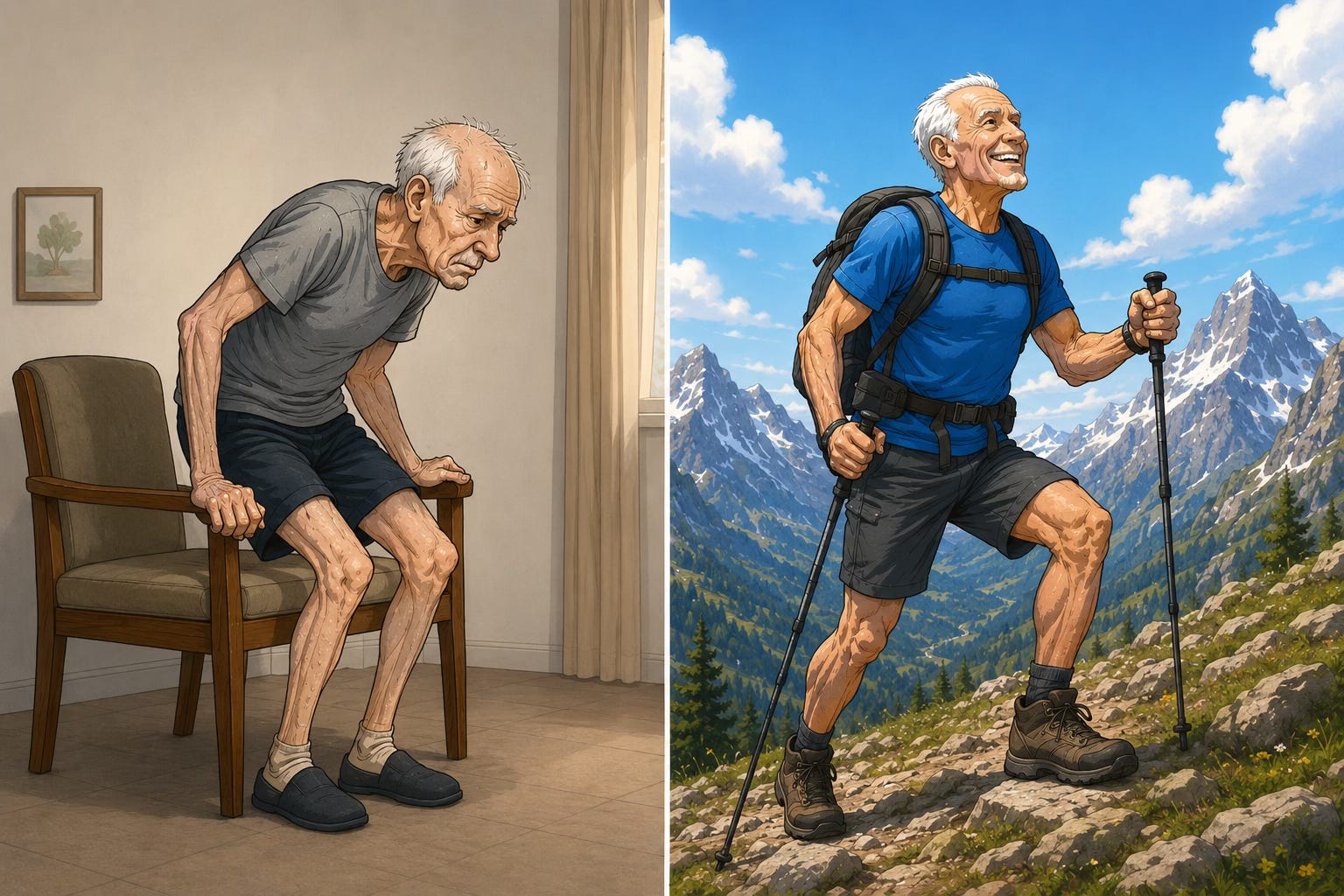
How I would rehabilitate a severely-deconditioned geriatric client?
One who has lost significant (if not profound) mobility, strength and stamina, yet they are still highly motivated.
The person I imagine:
• has stooped (forward-flexed) posture
• has significant functional mobility & balance loss: hip extension, ankle dorsiflexion, spinal movement (in all planes), having difficulty with transitions (sit-stand) and impaired balance
• has significant strength loss, including muscle atrophy
What would I do to safely and effectively get them stronger, more mobile and more active?
And how would I safely and sustainably do so, minimizing risk of injury or other harm?
Here’s what I’d do:
1. Safe Mobility & Core Stability: Aquatic Therapy. Water exercise is a crucial tool in dealing with a sensitive client. What it offers:
• safety: It allows for aggressive mobility with hardly any (impact) fall risk.
mobility: water does two things. First it unweights the body, creating a traction effect in key weight bearing joints (legs and spine). Second, water reduces tone. Both combine to powerfully improve mobility: possibly faster than any other technique.
stability: water provides dynamic resistance and perturbation stimulus. The faster you move in water, the more resistance, challenging both mover and stabilizer muscles. Moving (wavey, turbulent) water creates irregular, unpredictable perturbation, challenging the neuromuscular system to stabilize.
For low-functioning clients nothing is better than water to get them to quickly level up.
What to do in the water? There are many things you can do, ranging from deep water (non-weight bearing) running1 to various “aerobic” (arm and leg mobility and strength) movements.
But the best may simply be, fast-walking. Getting into waist- to belly-deep water and:
• walking with long strides
• “paddling the arms” — reaching forward with one hand, while “paddling” (pushing back) the opposite
This creates a ripple effect2. It:
• facilitates good shoulder motion
• maximizes hip extension (and ankle dorsiflexion) motion
• facilitates spinal rotation
2. Max Muscle Blast, Minimal Strain: Resistance Machines. After the pool, the biggest bang-for-buck is resistance training. But weightlifting is risky for an aging population: fall risk can be very high, and strain (and even fracture) potential is significant.
However, the potential gains from strength training are huge in two areas:
• neuromuscular. The stimulus of weights is a massive wake-up to a sleeping nervous system. There is nothing better (and relatively safer) to stimulate the brain and neuromuscular system than strength training.
• hormonal. Strength training is a major squeeze of the endocrine system to secrete anabolic hormones — at any age.
But if you’re nervous to put your grandpa (or aging parent) under a back squat bar3, how do you get the gains of near-maximal neuromuscular effort with minimal risk of fall or injury?
Machines.
Isolated “circuit machines” are an ideal way to load the muscles in a safe, supported manner. With next-to-no fall risk and minimal strain potential (outside the area of focus), machines allow a person to heavily load a muscle group and simply push hard — with no balance challenge and minimal coordination, required.
Just sit, select and blast away.
Most gyms recognize this and have created a “circuit area” — a group of machines targeting different muscles throughout the body: a sort of multi-vitamin for strength training!
While this may be limited in functional development — it’s not going to overtly improve grandma’s single leg balance — it delivers all the neuromuscular and hormonal gains in the biggest — and safest — dose.
3. Mindful Movement: Yoga & Tai Chi. After significant repetitions in the pool, restoring mobility, stability and balance; then adding gym machines, awakening the nervous system and rebuilding real muscle mass, it’s finally time to take it, weight bearing.
Mindful movement practices such as yoga and tai chi bring it all together: stability, strength, mobility, balance and coordination — but done mindfully and (as needed) slowly and patiently.
I love yoga for runners4. But I love it for everyone: the thoughtful movements, checking in with each side of the body and slow, controlled movement and stability — all paired with deep breathing.
This is a perfect coalescing activity, bringing together the overt gains of mobility, stability and stamina from pool activity, the strength gains from the gym and combining to create smooth — if not elegant — functional movement.
That’s my fountain of youth, and I’m sticking to it.
And if you have a loved one who lost the pep in their step, consider this trio of strategies to get them moving and feeling great again.
Cool Exercises I Like. Hamstring(-Hip) Speed Drills. My colleagues at Capacity Performance Therapy (@capacity.pt) posted this great trio of run-specific drills emphasizing the hamstring in fast running.
But they benefit much more than the hamstring:
The trio of exercises:
• Wall Run Snap
• Hamstring Box Switches
• Hamstring Fast Leg Raises
work on the coordination of hip strength — both strong mobility and stance stability — in conjunction with a strong, active hamstring.
This hamstring-hip relationship is crucial for your fastest and best running. Give ‘em a try!
Victory Friday. Another Aorta Achievement! A few months back I shared some curious and powerful orthopedic wins after mobilizing a restricted abdominal aorta5:
The cases:
• A 50+ year-old woman with chronic right hip and pelvic pain. In addition to stiffness and pain in the right hip and posterior pelvis, she presents with a stubborn right torsion/rotation of her pelvis.
• A 50+ year-old woman with chronic, stubborn neurogenic anterior left pelvic, hip, thigh and knee pain. She is nearly two years post-hip replacement, but complains of pain, tension, and neuralgia over her left thigh and knee, limiting activity.
• A 40+ year-old man with chronic back and hip pain, with a painful, stubborn lateral (trunk and pelvis) shift.
Each experienced sustained improvement in pain, mobility and alignment after improving the side-to-side mobility (“play”) of the body’s biggest artery.
This week I had a similar case: this time involving a long-time client, in his late 60s, with a stubborn and dynamic lateral shift: his pelvis shifting left (and trunk counter-shifting right) on right stance phase of both walking and running gait.
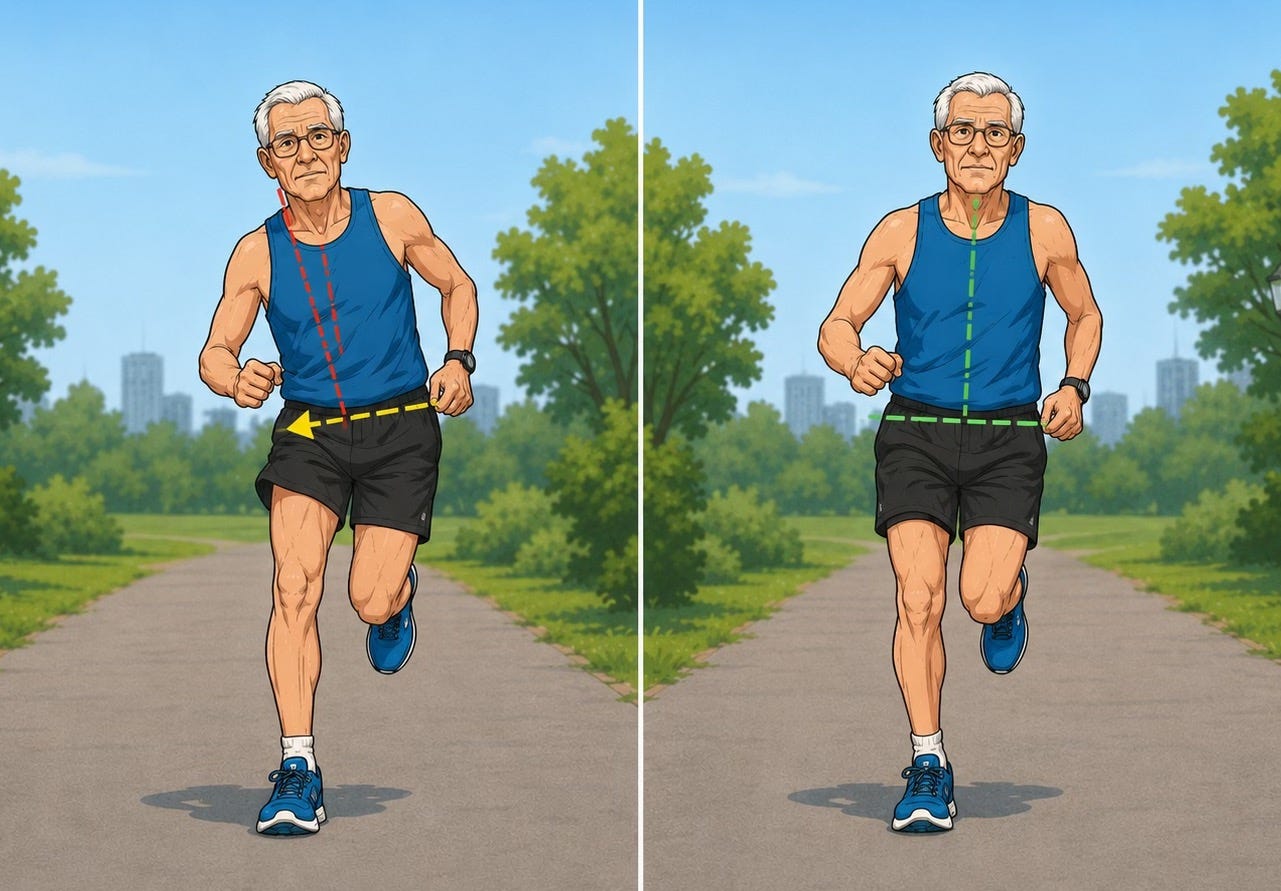
We have previously employed many strategies to correct this shift in the realms orthopedic (hip, pelvis, lumbar, thoracic, ribcage) and visceral (intestinal, diaphragm). Uncertain what he needed to correct this “pull” of his pelvis from center to right, I performed Barral Institute General Listening Technique.
The technique emphasizes both a location and a character: where you feel an “energy”, and what it feels like.
Often, the “feel” is simply a “presence” — a tone or density, often indicating an orthopedic or visceral structure.
This time, I felt something different:
• in the left-central abdomen
• and a rapid “UP-DOWN” shooting energy, of about six inches length, from lower to upper abdomen, then instantly back6.
I wasn’t sure what to make of that, until I did a closer Listening, then motion test.
“The aorta!”
His abdominal aorta was restricted: tight and restricted on his left side. This seemed to be the force that was pulling his pelvis left.
But I felt something else, too:
his right iliac artery was very restricted!
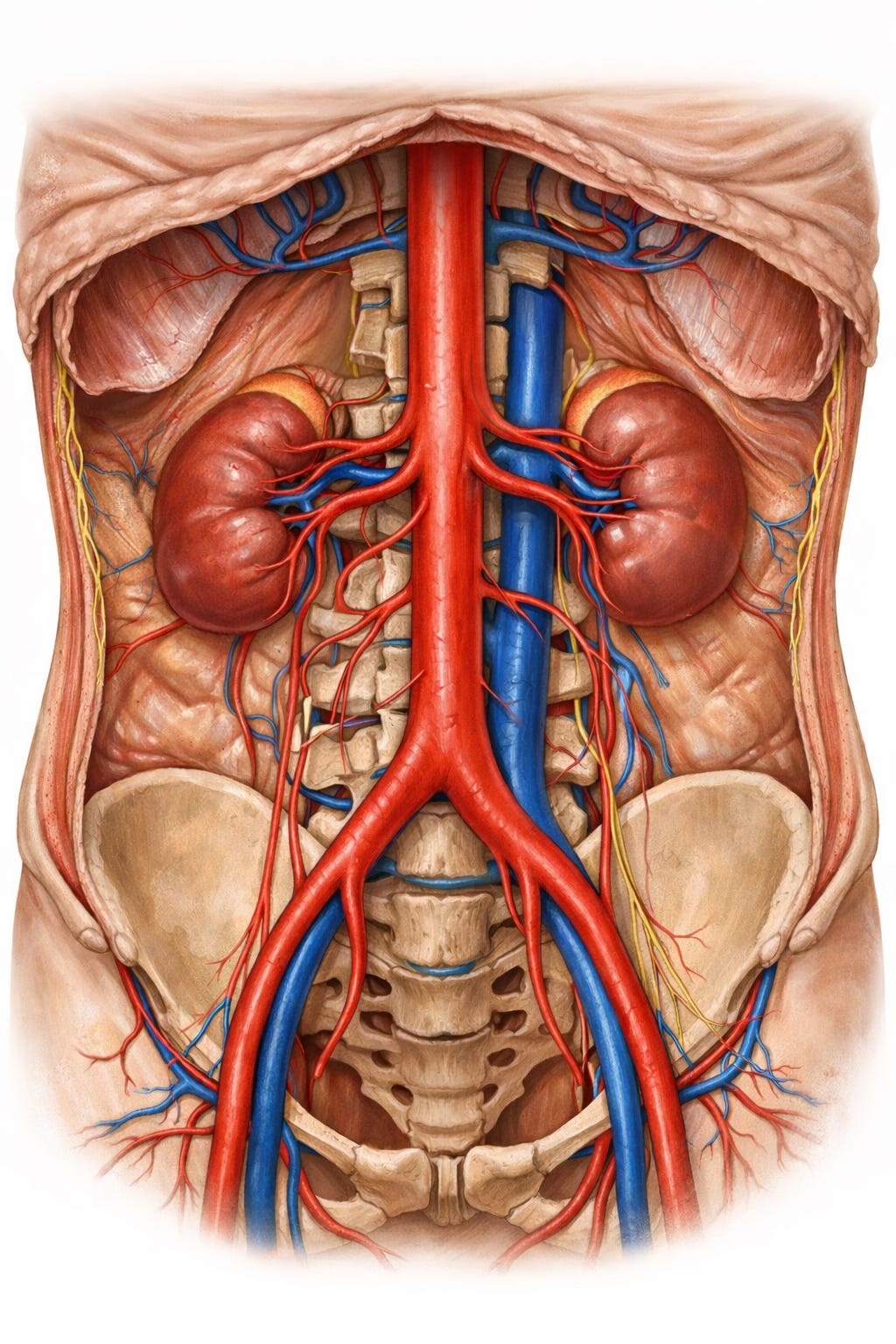
It felt glued down to the tissues around his right hip and pelvis, including his viscera (large and small intestine) and psoas muscle.
Mobilizing both arteries — the aorta to improve right medial play; the right iliac artery to free it from the hip and improve superior-inferior (“elongation”) mobility — resulting in a substantial improvement in alignment and gait.
Wild stuff, but plausible:
• he’s a life-long runner who has both used (pumped) and impacted those vessels with tens of thousands of fast miles
• a tight aorta will pull the pelvis left; a tight right iliac will “shorten the hip”, causing a trunk and pelvic sidebend right!
Take-Aways. As I said before:
Blood Vessels Need to Move! (Especially the Big Ones). This is yet another reminder:
….tension around both nerves and vasculature can cause not only pain but sustained — and profoundly stubborn — orthopedic mobility and alignment deficits.
I like to say, “The Brain only cares about itself and its nerves.” But what’s most important for the brain and nerves? It’s blood supply.
Keep checking in on those big, impactful blood vessels!
Issue 134 is complete!
Help people move, function and feel better: please share this publication!
Thanks for reading, and have a great weekend,

Issue 132. Pool Running (Isn’t Just) for (Broken) Runners. Weekly pool running offers low- or no-impact cross-training that reduces stress on the body, enhances mobility and posture through water’s unique properties, and builds strength, power, and turnover via resistance. Deep-water variations (e.g., high-knee “Stairmaster,” longer-stride “Elliptical,” or forward propulsion) and shallow-water intervals allow targeted work on hip drive, core stability, and intensity without pounding. Short sessions mixing swimming, deep/shallow running, and fun drills can keep runners feeling strong and fresh on land. (iRunFar.com, Performance Flexibility: Pool Running)
Get it? 🌊
And you should be, if they’re deconditioned!
Issue 72. Yoga for Runners. Yoga offers runners targeted performance flexibility benefits through spinal mobility (alternating flexion/extension, side-bending, and rotation), nervous-system mobility (via arm/leg motions in functional, spine-neutral positions), and improved breath efficiency/control with disciplined nasal breathing. It also replicates efficient running patterns by emphasizing spinal neutral, hip mobility, and pelvic stability, while vinyasa flows enable side-to-side comparison to address imbalances. An oldie but valuable addition to any runner’s routine. (iRunFar.com, Performance Flexibility: Yoga)
Issue 123. Sneaky Sticky Aortas (in Hip & Back Pain)! Restricted (“sticky”) abdominal aortas can contribute to stubborn hip, pelvic, back, and neurogenic pain by limiting mobility and alignment despite comprehensive treatment. In three patients with trauma histories, gentle aorta mobilization (induction, medial glide, and movement-coupled techniques) quickly improved lower-quarter mobility and alignment, often reproducing familiar symptoms during treatment. Blood vessels, especially the major ones, need to move freely—restrictions here may drive compensatory orthopedic and neural tension to protect blood supply.
I surmise this was the energetic feel of the blood pulsing through the aorta.