
Victory Friday | Issue 135
Orthopedic Insights: (More) Shoulder & Lumbar Landscapes • Justin’s Best Groin Stretch • Respect the 72! Post-Exertion Vulnerability • 3D Pelvis & Footstrike: Pelvic Mobility Crushes Leg & Foot Pain

“A person’s success in life can usually be measured by the number of uncomfortable conversations he or she is willing to have.” ~ Tim Ferriss
Victory Friday is a weekly digest of reflections, insights, and tools from the world of functional manual and performance medicine. It is a free weekly publication. To support Victory Friday with a paid subscription, click below:
It’s a spring Friday: are you getting out and enjoying yourself? Now’s a good time to open up (abduct) those hips — if you want to get rid of that foot, ankle and leg pain —check your (and your clients’) running strides, move more, and move better…but don’t forget to rest (at least 72 hours!) after those big efforts!
What I’m Into: Manual Microbursts: (More) Shoulder & Lumbar Landscapes.
Shoulder Pain is Always a Landscape Problem. I seldom see immediate post-op clients any more (acute post-operative care is the purview of insurance-based medical care, as it should be).
But I occasionally see post-operative shoulders, in protective sling-braces, and each time, without fail, I can clearly observe:
• a rounded, restricted upper thoracic spine
• a stiff, compressed cervical spine
and a five-second hands-on test would reveal:
• a scapula that is locked-down (stuck forward and/or in elevation)
All shoulder pain treatment must include — and should begin with — comprehensive “landscape treatment”.1
Only then can the direct shoulder ball-and-socket strain be relieved and prevented, and efficient, pain-free motion restored and maintained.
All Low Back Pain Benefits from Decompression. Lumbar pain is complex because of all the factors — and all the body systems — that can sensitize it.
Most low back pain is caused — or made worse by — two factors:
Excessive motion:
• hip mobility loss transfers excessive motion into the pelvis and sacrum, causing excess motion at the low lumbar segments
• thoracic spine and ribcage mobility loss causes excessive motion (all motions, but especially rotation) in the upper to mid-lumbar segments
Compression
• hip mobility loss drives the pelvis and sacrum up into the lumbar
• thoracic spine and ribcage stiffness results in excessive kyphosis (flexion), which is often counterbalanced by excessive lumbar lordosis: compressive extension strain.
Sustained low back pain relief must involve both Systems2 treatment as well as a decompressive strategy: releasing stiff, restrictive tissue (Dimensional3) elements above, below, in back and in front4 of the low back!
Cool Exercises I Like. Justin’s Best Groin Stretch. Hip (and pelvic!) opening is a crucial — and often overlooked — element in a lot of pain: and not just hip and thigh pain, but knee, lower leg, foot and ankle (see this week’s Victory, below)!
If the hip and pelvis are stuck in a “closed” (adducted) position, this can make the groin muscles tight and angry, but also cause all sorts of other problems downstream.
To sustainably re-open the hip, try this elevated hip abduction opener, courtesy of Justin Lin, PT at Rehab & Revive:
This is one of the key reinforcing exercises I prescribe my clients with sneaky hip and pelvic mobility loss.
Check out this week’s Victory, below, to find out why this is so important!
Joe’s Articles. Respect the 72! The Post-Exertion Vulnerability Window. During an injury repair process, the body initially breaks down tissue further, in order to rebuild even stronger:
Imagine a house that largely survives a tornado, with only a few damaged siding panels. To restore full structural integrity, a team of carpenters arrives and systematically inspects every wall. For approximately three days, they remove nails and screws, check each board, replace where necessary, and reinforce with additional fasteners.
During this repair period, the house is far more vulnerable. Should another storm strike while the carpenters are still working, the structure is much more likely to sustain additional — and potentially greater — damage.
The same principle applies to our connective tissue in the days following an ultra[marathon].
What most of us don’t realize, and what new real-world research is demonstrating: this process — tear-down - inspect - rebuild — occurs after every high-intensity, athletic activity. Regardless of pain or frank tissue damage.
Most of this process peaks at 72 hours post-activity. That means, on average, our tissue is at its weakest and is most vulnerable, three days after the event. Often after a lot of the soreness and fatigue has faded.
Thus the key to a high-integrity recovery and maximal injury prevention: limiting tissue load for at least three days.
From iRunFar.com:
Rest for 72 Hours: The Science Behind Post-Ultra Tissue Recovery
Victory Friday. Frontal Plane Pelvis & Footstrike: Pelvic Mobility Crushes Lower Leg & Foot Pain. Many issues ago I shared a fun and impactful Victory: an oft-injured high school runner whose chronic lower leg pain was resolved with pelvic alignment and mobility work5.
That was a potent lesson learned, which sensitized me to look at pelvis alignment and motion with any runner with repetitive foot, ankle, and lower leg pain — as well as lateral knee and hip pain.
This week I had multiple clients with stubborn, lingering pain that was resolved by examining and correcting pelvic alignment and mobility deficits: in the frontal and transverse plane.
For both runner clients, they initially presented with:
• chronic knee and ankle/foot pain
• significant pelvic torsions with ribcage mobility loss and asymmetry
Our initial treatments were focused on:
• restoring full and symmetrical thoracic spine & rib mobility: often with simple foam roll mobilization to the ribcage and diaphragm.
• hip and pelvic mobilization: to de-rotate the pelvis and improve flexion and extension mobility.
After doing so, pain rapidly improves:
• efficient hip and pelvic alignment and motion improve gait landing and push-off efficiency, greatly reducing strain to the legs.
• knee torsion dramatically improves (especially when paired with ankle dorsiflexion mobilization.)
But in both these folks, they were 80% better — back to running, cycling, hiking, weight training — yet still had some lingering pain:
• a stubborn fraction of their knee pain and sensitivity, and/or:
• stiffness and soreness in the lower leg, foot and/or ankle
Look Again & Look Closer. For each, to get rid of this remaining pain it took a closer look at two subtle-but-powerful factors:
Running stride width
Frontal & transverse plane pelvic mobility
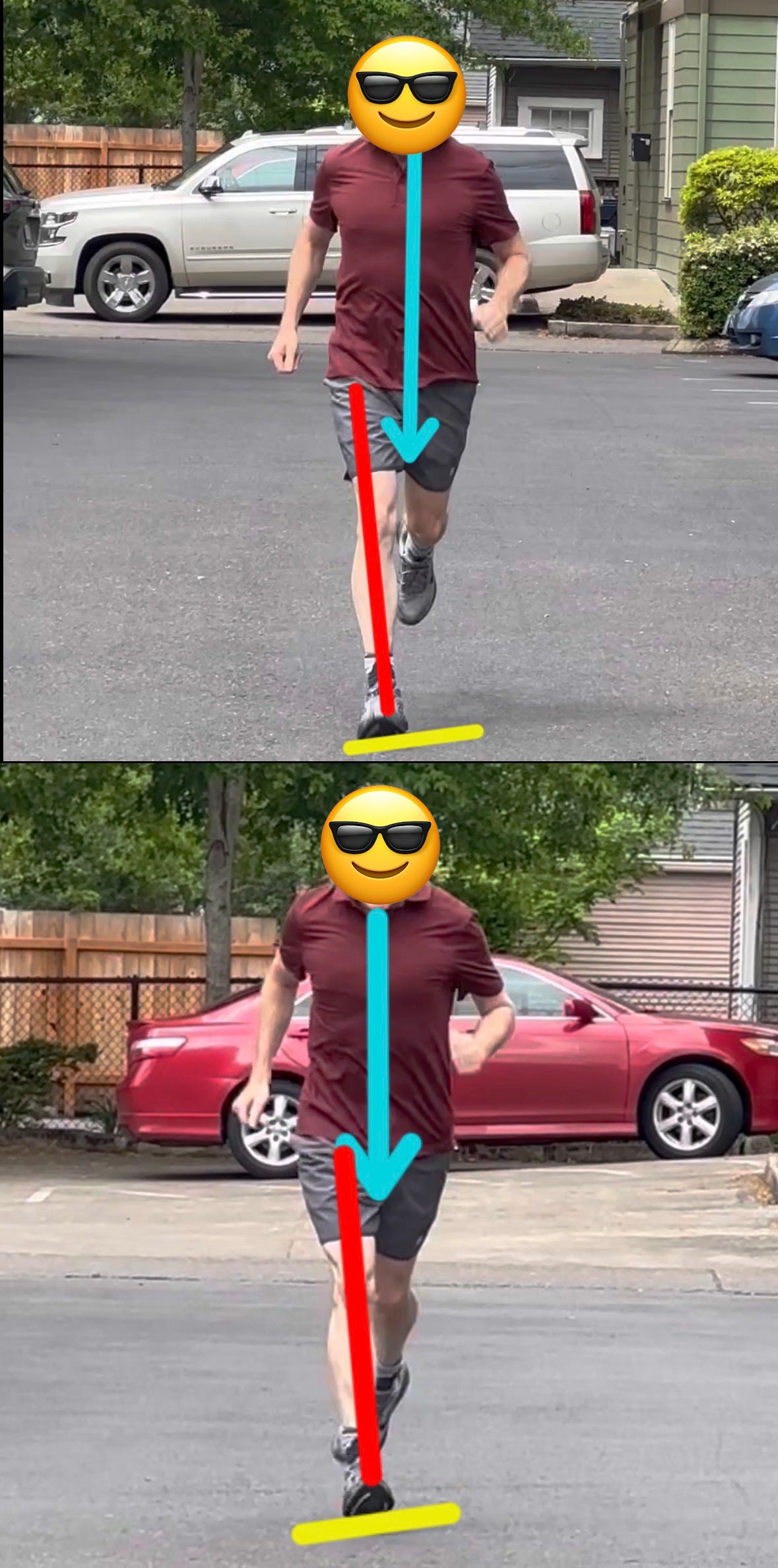
For my high school runner, the side view — the “aesthetic view” — of his running stride looked amazing! Tall, hip hinged, with excellent vertical hip strategy and foot-under-body landing.
But with closer examination:
• the frontal plane showed a narrow, crossover landing pattern
and on the treatment table:
• his pelvis was stuck in adduction and external rotation
Recalling that lesson, I re-examined the running strides of both clients this week. Unsurprisingly:
• each demonstrated a unilateral crossover landing pattern: the painful foot and ankle — for each, the right leg — was landing too narrowly, across midline.
• each had a paired pelvic dysfunction: the right pelvis was stuck in adduction (lacking abduction) with a paired (equal-opposite) issue on the left: stuck in abduction (lacking full adduction).
The solution wasn’t:
• foot and ankle work, or
• telling them to “run wider!”
The solution to footstrike efficiency was the restoration of
full and symmetrical pelvic mobility: abduction (on the right), adduction (on the left).
(And while external and internal rotation deficits weren’t huge issues with either, I did find minor deficits that I treated: if only to help facilitate full freedom of frontal plane opening/closing)
Immediately post-treatment, both demonstrated efficient, symmetrical — and effortless — improvement in stride width, with concurrent improvement in foot strike comfort.
Takeaways. A couple keys:
Examine Stride Width! Inefficiency — namely asymmetry — of frontal plane stride width is the biggest tell of a relevant pelvic alignment dysfunction. A pelvis stuck in adduction will drive that leg and foot to land excessively medially, “crossing-over” midline. And the converse is often true: the opposite pelvis is often stuck in abduction, and will result in a landing that may be too wide (even if slight).
Assess & Optimize (Frontal and Transverse Plane) Pelvic Mobility! Test for end-range motion of the hip and pelvis, particularly:
• pelvic abduction and adduction
• pelvic external and internal rotation
Pelvic alignment and mobility matters! And everything from moderate (but especially severe and/or repetitive) falls on the hip and butt, to subtle-but-prolonged fascial tensions in the belly and spine can mis-align and restrict motion of this leg-foundation bony system!
Clinicians should test it, and individuals should be educated on how to self-assess and restore symmetrical and full motion!
A little awareness and effort can go a long way to snuff out even the most stubborn leg aches and pains!
Issue 135 is a wrap!
Help people move, function and feel better: please share this publication!
Thanks for reading, and have a great weekend,

Issue 23: The Shoulder Landscape. The “Shoulder Landscape” analogy advocates treating persistent shoulder pain from the core outward: first restore smooth mobility and positioning in the thoracic spine and ribcage (“the foundation”), then improve shoulder blade stability (“the crane base”), cervical integrity (“power supply”), and finally work directly on the shoulder joint itself (“the crane arm”). Sustained pain relief and optimized efficiency of the shoulder requires this systems-based approach.
Issue 41: Systems & Dimensions. Full and sustained pain relief and recovery of function often requires a comprehensive treatment approach of multiple Systems (body areas: spine, pelvis, abdomen, pelvis, hip, knee, etc) and Dimensions (types of tissue: muscle, tendon, bone/joint, fascia, nerves, blood vessels, etc).
See #2.
Issue 104: Manual Microburts. Regarding the lumbar spine and visceral organs:
The back has a front. What happens on the front side of the lumbar, sacrum and pelvis bones is just as impactful as how they move in the back. Visceral fascial structure can play a huge role in lumbopelvic (dys)function.
Issue 4: Three Seasons, Three Stress Fractures. A 17-year-old cross-country runner with three prior season-ending foot and lower leg stress fractures presented with a hyper-narrow, crossover landing with foot external rotation caused by pelvic abduction and internal rotation deficits. Restoring pelvic mobility immediately corrected his mechanics for smoother running, enabling a strong, mostly pain-free season.