
Victory Friday | Issue 136
Orthopedic Insights: Robust Resisted Rotational Gym Warm-Up! • Five Couch-to-Adventure Run Workouts • Fascial Front & (Low) Back Freedom.

“Our bodies are apt to be our autobiographies.” ~ Frank Gelett Burgess
Victory Friday is a weekly digest of reflections, insights, and tools from the world of functional manual and performance medicine. It is a free weekly publication. To support Victory Friday with a paid subscription, click below:
Happy Friday everyone, it’s time to spring into action! But if you haven’t moved much lately, don’t fret: we have some excellent rotational warm-ups, a five-step couch-to-adventure plan, and a brand-new strategy to kick that stubborn (fascially-driven) low back pain. Check it out!
Cool Exercises I Like. Robust Resisted Rotational Gym Warm-Up! Avid readers of Victory Friday know I’m a big fan of:
• functional, athletic movement, emphasizing whole-body and spinal elongation and rotation1, and:
• combined mobility and strength: moving through full range with resistance2.
Tayla Cannon (@taylacannonphysio) shares this excellent multi-body warm-up sequence that emphasizes both full segmental range of motion and neuromuscular activation and control.
Her five pre-workout exercises:
Hip CAR (controlled articular rotations). This works three-dimensional hip and pelvic mobility (on a stable spine).
Sidelying thoracic rotation press. This weighted rotation is pretty brilliant: pushing a dumbbell against gravity to work on active rotation; while the same dumbbell eccentrically stretches into increased counter-rotation… but all executed in non-weightbearing.
Jefferson curl. I’m a big fan of these (highlighted here before3): again, using weight for a controlled stretch into spinal and posterior fascial flexion, then actively extending out of it.
Banded kneeling lateral lean. Performed in a neutral lunge position, a band stretches the spine into a full sidebend, and provides resistance counter-bending back to neutral.
Banded quadruped hover. Finally, this bent-knee plank hold adds band resistance to elements of the thoracolumbar spine to facilitate trunk stabilizers in front and back sides!
Tayla might warm up with it, but this series, alone, would be a great stand-alone active strength-and-mobility session!
Joe’s Articles. Five Couch-to-Adventure Run Workouts. Summer is fast approaching, and so might be that goal race or adventure on your calendar.
If you feel behind — if training is off to a slow start, or if an early-year injury has held you back — deciding how to prepare may feel overwhelming.
I’ve coached enough clients — and, at times, myself — out of the rut and into strong, healthy summer fitness using these five progressive training workouts.
They start easy, but quickly build toward two key foundations of healthy, peak performance running:
Biomechanical efficiency
Metabolic efficiency
From iRunFar.com,
Five Spring-Training Workouts for the Summer Majors
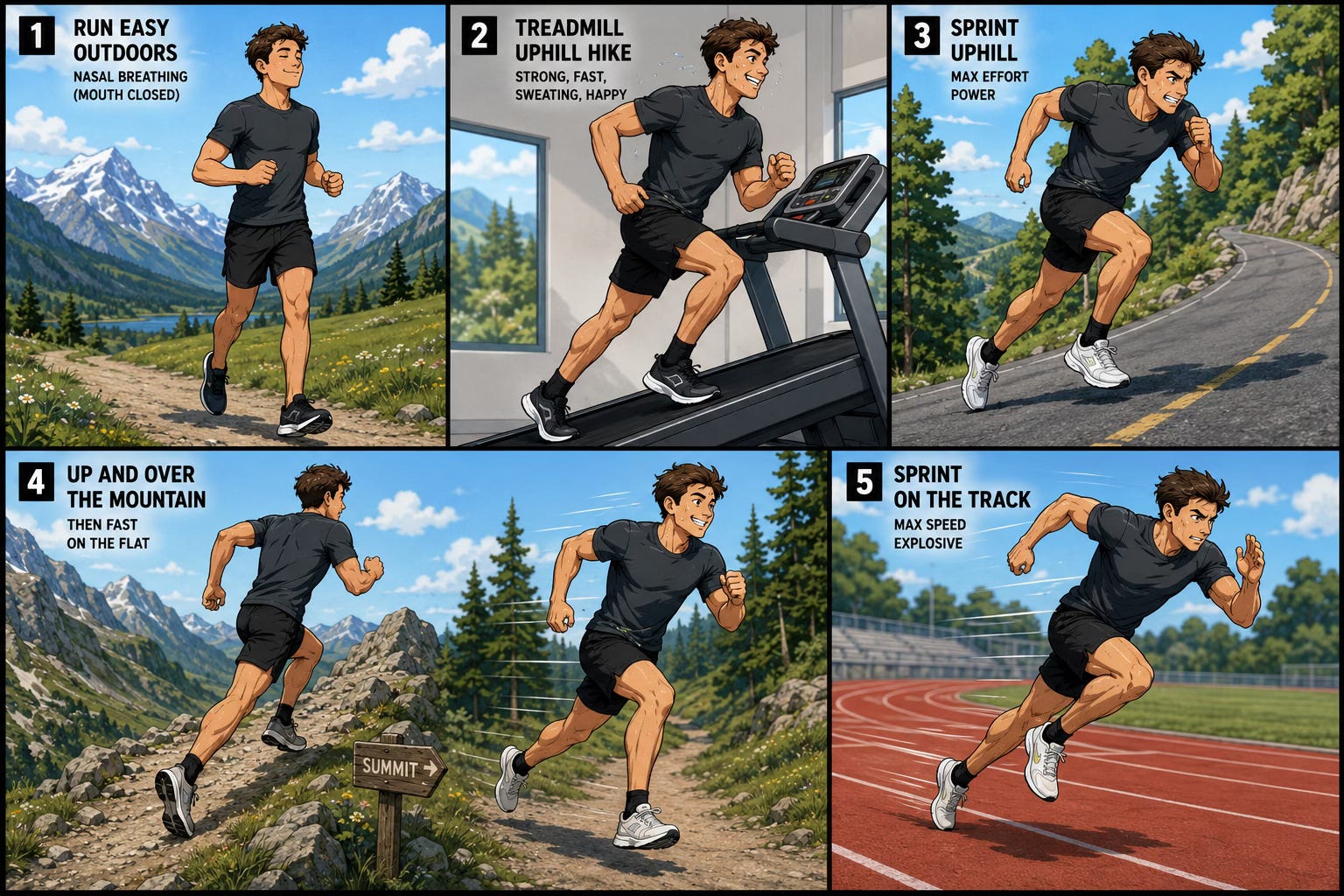
TL;DR: the five-workout progression:
Nasal-breathing easy runs. Nasal breathing provides two crucial benefits: it regulates the effort enough to be true (“Zone 2”) aerobic training, and it facilitates greater diaphragm utilization: activating and strengthening a breathing muscle for long and fast running, and a key core stability muscle, to boot!
Treadmill uphill hiking. This, too, provides multiple benefits including: easy-run caliber aerobic work without impact, working key postural (hip hinge) and propulsive (glute, calf) elements without impact, and training for vertical climbing…without the punishment of the return downhill!
Short uphill sprints. These are the safest way to introduce high-intensity: hard anaerobic work without the orthopedic strain of flat (or downhill) running. Uphill sprinting is also a great way to challenge and reinforce running efficiency: including forward hip hinge posture, downward/rearward hip extension, upward/forward hip flexion and a fast, strong arm swing.
Up-Down-Flat training. With the foundations of metabolic and mechanical efficiency in place, the most “efficient” way to work on trail racing specificity is an “Up-Down-Flat” workout:
• a prolonged uphill (hike or run)
• a prolonged downhill (focusing on descent efficiency and speed), then:
• a flat-and-fast segment: a mile or two at “race pace”
This latter element practices finding one’s efficient stride, and forcing a faster race pace, after the ups-and-downs of a mountainous trail race.Short (1-2 minute) track repeats. Finally, short track repeats are a great way to work top-end speed and reinforce — if not “re-discover” — optimal running form. Ultramarathon-specific long runs and vertical sessions can make us stiff and inefficient; a weekly flat-fast session will challenge our ability to re-establish an efficient system.
Got it? Good, now get to work!
Victory Friday. Fascial Front & (Low) Back Freedom. I’m on a hot streak in treating low back pain right now: several new clients with stubborn, sensitive, and severe low back pain are getting better, faster, and with more sustained and robust relief.
What’s different?
For each back patient I still do my customary systems-based treatment, including:
• addressing whole-spinal efficiency: not just lumbar, but thoracic — vertebral and ribcage — and cervical.
• optimizing hip and pelvic efficiency: restoring hip and pelvic alignment, motion and strength. This often includes a significant but often overlooked element: pelvic rotations and torsions4.
But where I’ve had the most rapid and sustained success has been the consistent application of two additional, fascial mobilization strategies:
Visceral mobilization: moving the tissues — organs, connective tissue and surrounding fascia — that are located beside, or rest within, the lumbopelvic area.
This is by no means a new strategy: I have been treating visceral restrictions in all lumbar spine cases for over six years.
But my treatments are more thorough and multi-dimensional, including key structures like the aorta and iliac arteries5.Posterior pelvic superficial fascia mobilization: freeing the fascial layers directly over the low lumbar, sacrum and lateral pelvis, in particular, over the sacroiliac joints.
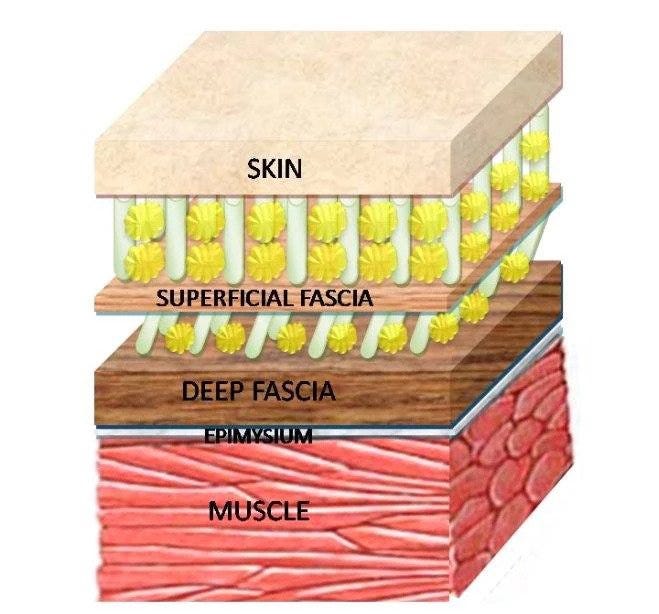
Freeing superficial fascia is nowhere near a “new idea” for me — I’ve used it extensively for both thoracic6 and lumbar pain relief7 — performing focused assessment and treatment of the fascia directly over the sacrum is novel.
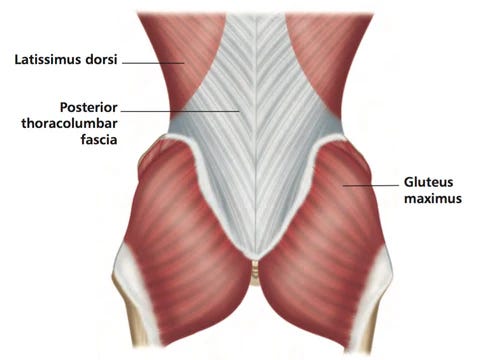
It could be a simple omission; but often these omissions are driven by awkwardness: working this tissue requires, quite frankly, a hand on one’s bare sacrum that may feel intrusive for both patient and practitioner.
But once I began to assess this area — which is the very inferior-most aspect of the thoracolumbar fascia8 — I found all sorts of restrictions, often directly related to a motion loss at the sacrum.
In the same way that sacrum motion is often altered or restricted by “sticky guts” on the front side of the bone, so, too can the best sacroiliac joint mobilizations and self-stretching techniques be thwarted by sticky superficial fascia!
So, after first clearing the periphery — the upper spinal (and fascial) elements, and hip and pelvic mobility — performing these “front and back fascia” treatments to the lower lumbar-sacrum area has provided some huge wins!
Takeaways. Free the Front and Back Fascia! The best focal treatments — mobilizations, strength exercises and motor control strategies — can easily be thwarted by sticky fascia on either the front side or back side of the back and pelvis.
Put even a small amount of time and effort to assess and free these layers and see what Victories might be in store for you and your clients!
Issue 136 is a wrap!
Help people move, function and feel better: please share this publication!
Thanks for reading, and have a great weekend,

Issue 19: The Mobility-Strength Continuum is the idea that all movement lies in a continuum between purely passive (full range, minimal contractile) motion, and pure strength (mid-range, maximal load and muscle contraction). Touching all aspects of the mobility-strength range is key for optimal health. But combined, nearly-full motion and active strength may be the most functional.
Issue 58: Don’t Fear the Flexion: Jefferson Curls! While lumbar flexion can be risky during the acute phase of disc injury or nerve irritation, prolonged avoidance often leads to reduced mobility, increased stiffness, and compensatory dysfunctions. Controlled loaded flexion exercise via Jefferson Curls can be a highly effective way to restore spinal, posterior chain and neurofascial mobility.
Issue 60: More Ribs & Rotations (Joe’s Jefferson Curls). I published a version of the exercise that keeps the shoulder blades well-connected to the ribcage, avoiding any neck strain. That video demo is here.
Issue 101: The Things I Know: The Torsion Rule. Pelvic Torsions Create Many Lower Body Dysfunctions & Must Be Corrected for Full Resolution. Pelvic torsions (and rotations) can create chronic dysfunction both below (in the legs) and above (in the spine). Their origins can be local (elements of the pelvis) or regional/global (thoracic, cervical or even cranial). Sustained relief in any spine or leg pain requires a pelvic torsion be resolved.
Issue 123: Sneaky Sticky Aortas (in Hip & Back Pain)! Restricted (“sticky”) abdominal aortas can contribute to stubborn hip, pelvic, back, and neurogenic pain by limiting mobility and alignment despite comprehensive treatment. In three patients with trauma histories, aorta mobilization quickly improved lower-quarter mobility and alignment, often reproducing familiar symptoms during treatment. Blood vessels, especially the major ones, need to move freely: restrictions here may drive compensatory orthopedic and neural tension to protect blood supply.
Issue 134: Another Aorta Achievement! Restrictions in major blood vessels such as the abdominal aorta and iliac arteries can contribute to persistent pelvic asymmetries, lateral shifts, hip pain, and gait dysfunctions by creating mechanical tension on surrounding tissues. A case of persistent pelvic shearing and spinal side bending in a runner was significantly improved after aorta and iliac artery mobilization.
Issue 105: WD-40 For the Body: Thoracic Superficial Fascia Wins! Superficial fascia tension over the thoracic spine and ribcage is frequently overlooked but can significantly restrict joint and functional motion. Restoring its multi-directional glide with shallow, specific manual techniques can produce notable improvements in neck/shoulder pain, scapular motion, ribcage stiffness, and even distant issues like hip or pelvic dysfunction.
Issue 108: Fascial Freedom: Scar Mobilization Restores Lumbar Motion & Core Strength. Post-surgical scar tissue and adhesions in the superficial fascia of the lumbar spine can mechanically inhibit deep abdominal (core) activation, leading to compensatory overuse of the lumbar extensors, persistent stiffness, and chronic low back pain. Gentle three-dimensional mobilization of these superficial scars can quickly restore core function, lumbar mobility, and reduce symptoms — even when deeper or more traditional interventions have provided only limited results.
Issue 96: Thoracolumbar Fascia for Stiff Hip Freedom! The upper and lower body have a tissue and force-transfer connection via the thoracolumbar fascia — a fascial structure that criss-crosses the ribcage and connects the scapula to the opposite hip and pelvis. Restrictions along this structure can significantly inhibit the lower quarter.