
Victory Friday | Issue 138
Orthopedic Insights: Integrity is Repetitive (Anyone Can Be an Idiot Every Other Day) • Triple TMJ Tension Tamers • Pain in the Butt: Considering the Coccyx • Track Wins & Zero Wounds

“I remain whimsical and silly in combat against the weight of the world and I do not plan on stopping.” ~ Lena Darkley
Victory Friday is a weekly digest of reflections, insights, and tools from the world of functional manual and performance medicine. It is a free weekly publication. To support Victory Friday with a paid subscription, click below:
Happy Friday! This week we’re celebrating the fact that true progress isn’t flashy… it’s frequent. We unpack why being able to train day after day beats heroic every-other-day efforts, plus some of Dr. Lin’s killer TMJ relief moves, a coccyx (not that-)deep-dive that might just fix your stubborn aches, and the proud tale of our distance track kids stacking PRs with almost zero injuries. Enjoy!
What I’m Into: Integrity is Repetitive (Anyone Can Be an Idiot Every Other Day). When returning a client to full function — whether running, throwing, weight training, or occupational activities — one of my first priorities is activity frequency.
Why? Because frequency is the ultimate metric of integrity. It reveals two key things:
Is the injured tissue sufficiently healed?
Is the movement pattern minimally efficient?
Too often, I hear return-to-activity stories where people can “perform,” but only every other day or less.
That information alone means little to me—especially if that single session (a run, lift, throwing session, or workday) is symptomatic, and those symptoms linger or worsen:
for the rest of the day,
that night, or
the next day.
It’s usually this lingering response that requires the extra day of rest.
However, during the baseline return-to-activity phase, where:
volumes and intensities are small (e.g., a 2–3 mile easy run, a light strength session, playing catch instead of competitive pitching, or a moderate workday)
And:the activity is one we expect to be able to do perform daily (or most days)
then an inability to do more frequently than every other day signals a problem: in either tissue health or movement efficiency.
Anyone can push too hard, too soon, with sloppy technique every other day.
Show me consistent activity on two consecutive days, and you’re showing me real progress.
But if it still causes pain? That tells us the job isn’t finished.
Cool Exercises I Like. Dr. Lin’s Triple TMJ Tension Tamers. Jaw (temporomandibular joint, TMJ) dysfunction can be one of the most painful and disruptive issues. We use it to talk, eat, and breathe, so painful movement and opening and closing limitation can be life-altering.
TMJ can also be profoundly challenging to treat and resolve. One of my favorite physios, Justin Lin, PT at Rehab & Revive, shared another gem recently:
Three exercises to relieve TMJ pain and restore motion!
The big three:
Front-of-Ear Canal (posterior joint) Pushes
Ear (Fascia) Pulls
Resisted Jaw Open & Close
In just three exercises you get a comprehensive Systems & Dimensions treatment: a joint mobilization, fascial system mobilization and neuromuscular re-education of this dynamic joint.
But if this doesn’t work — and you have a head trauma history — the root cause and potential area of treatment may be the cranial bones1.
Joe’s Articles. Considering the Coccyx. That little tailbone at the bottom of the pelvis can create much havoc. Bruising (or even breaking) it can be incredibly painful, but that bone — and its expansive fascial connections — can create and sustain stiffness, weakness and pain in the pelvis and beyond!
I learned to treat it nearly fifteen years ago and I still evaluate and (externally) mobilize it on most of my clients.
And here’s why. From iRunFar.com,
Pain in the Butt: Considering the Coccyx
TL;DR:
Why It Matters:
Keystone of the Pelvic Floor: All pelvic floor muscles attach (directly or indirectly) to the coccyx; dysfunction leads to weakness, hypertonicity, poor core stability, and issues like incontinence or pelvic/hip/low back pain.
Nervous System Connection: The dura mater (nerve sheath) attaches to the coccyx tip; malalignment or stiffness restricts neuro-fascial mobility, causing widespread stiffness (especially hamstrings, back, trunk, neck) and chronic pain that doesn’t respond well to usual stretching/strengthening.
Common Causes of Dysfunction:
Direct trauma (falling on butt)
Pregnancy/childbirth
Postural/movement imbalances over time
Assessment & Treatment:
Performed externally (over clothing preferred) by a skilled manual therapist via palpation for alignment and mobility.
Involves firm pushes/pulls to restore position and motion; can be tender but effective.
Self-assessment is difficult and requires experience.
Signs You May Have a Coccyx Issue:
Direct tailbone pain (especially after fall or childbirth)
Pelvic floor dysfunction (pain, incontinence, sexual issues)
Persistent “weak core” despite training
Global stiffness (hamstrings, back, neck) unresponsive to stretching
Chronic injuries or nerve pain that don’t resolve with standard care
Key Takeaway: A dysfunctional coccyx can undermine strength, mobility, and recovery efforts; addressing it through manual therapy (e.g., Functional Manual Therapy) often unlocks improvements elsewhere in the body. Runners with stubborn issues should seek a skilled practitioner for assessment.
Victory Friday. Track Wins & Zero Wounds. The high school track season ended last week. Lots of big wins among our two dozen distance kids.
Every one of our runners ran at least one personal best time in the last two weeks of the season: at our final home meet, the district meet, and/or the state championship.
That isn’t easy to do. It requires a well-planned and executed training and racing plan. And more than anything, it requires the kids stay healthy.
50% of all runners get injured — requiring time off running to rest or cross-train — in a calendar year2. To stay healthy, while training and racing around a hard rubber(-on-asphalt) track, as adolescents is even more challenging.
That said, of all the wins — the performances, the championships, the personal bests, the laughs and good times — here is the victory I am proudest of:
• # of distance runners: 24
• # of training days per week: 6
• # of weeks in the season: 12
Total “Kid Running Days”: 1728.
Total Days Lost to Injury: 5.
Five total days lost3, and zero competitions missed.
How We Did It. There were four keys that were crucial in a near-perfectly healthy season:
1• Mobility. We performed twice-weekly foam roll and stretch mobility sessions.
Notably: we performed at least one mobility session the day after a heavy-volume track workout or meet.
Often significant aches and pains were borne a day or two after hard efforts. This was after myofascial structures were heavily loaded…then got really tight.
Restoring mobility and efficiency to stiff and sore fascia before going for a run ensured all the tissues were mobile prior to loading.
2• Strength. Banded hip stability work occurred twice a week. Religiously. No matter how busy we were4.
We did two, six-exercise variations of Joe’s Six Pack5. We did each exercise on a 25-second timer: this “disincentivized” the kids from rushing through repetitions, and (rather paradoxically) also allowed them to chat and have a little fun6, without having to constantly count.
Most sessions were three rounds of six exercises, but that tapered to two rounds at season’s end: just enough to reinforce efficient core and hip stability, as well as efficient ball-in-socket hip control.
Additionally: we performed deep abdominal facilitation, “waking up the abs”, before most practices — and in particular, immediately before fast running and racing.
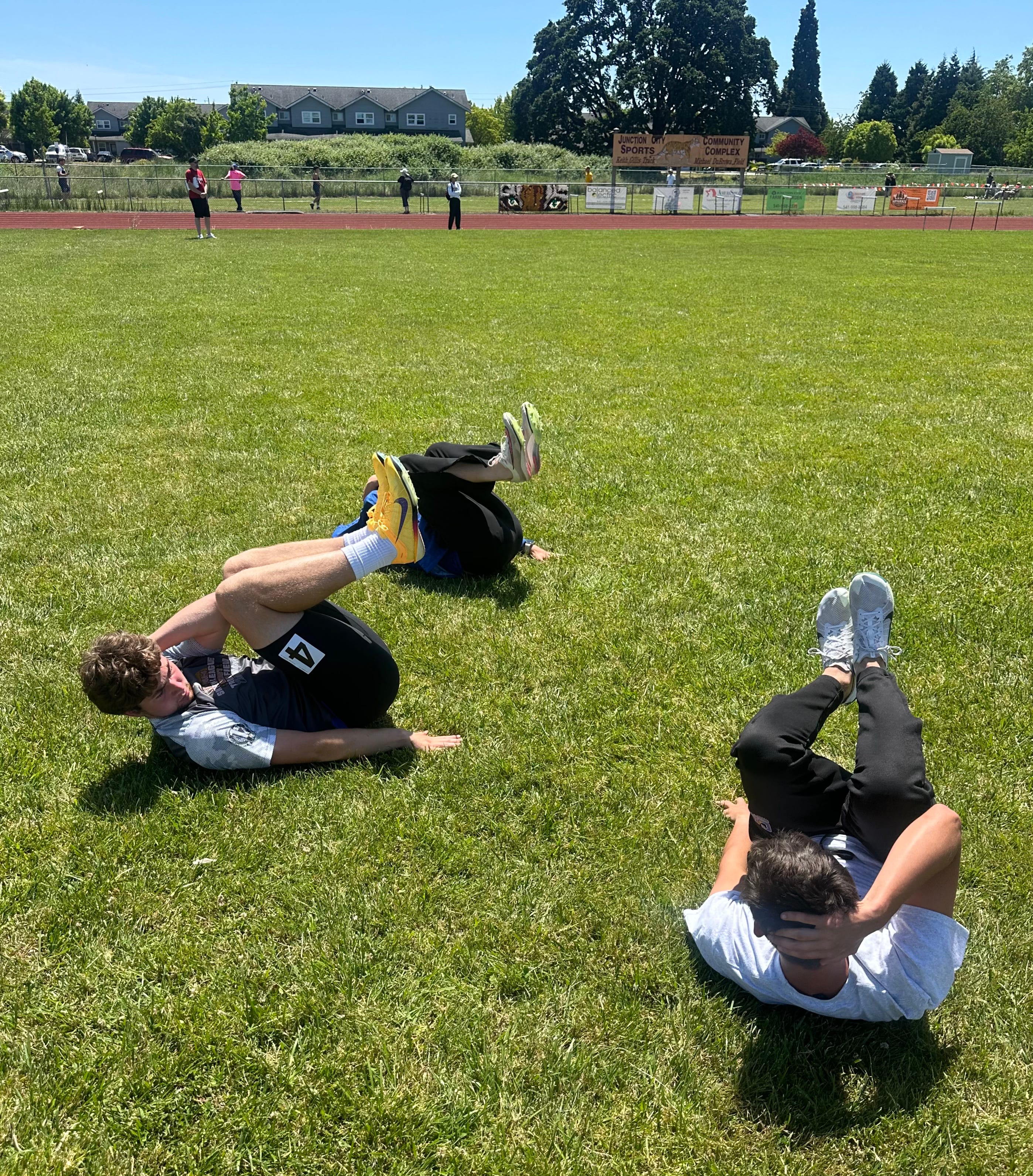
We called it, “One-Minute Abs”, but its name is The Diagonal Chop7.
3• Efficiency. I was relentless with form coaching and correction:
• posture
• propulsion
Some elements — like hip hinge posture and pawback — were instructed and practiced as a group, early on. Then, I worked with individuals, as needed.
And as it should be: form should be monitored and (artfully) tweaked as necessary. Like we do with all other sports.

Efficiency is crucial for performance: turning energy into propulsion.
But it is even more important for injury prevention: avoiding turning energy into tissue strain.
4• Commitment. Finally, much credit goes to the kids. They were high-agency, taking control of key elements of their health and performance, including:
• communication: letting me know when something was bothersome (before pain was significant)
• at-home care: they took mobility skills learned in practice and applied them, as needed, at home — at night, in the morning, and even during the school day.
• attention to detail: they also got adequate sleep, nutrition and hydration, which are all critical elements of tissue health.
Takeaways. Go Hard, Take Care. The biggest lesson I and our staff learned this year is that yes, as distance runners and coaches, you can have it both ways:
• train hard
• be healthy
To do both requires that commitment to mobility, strength, efficiency and high-agency commitment. It’s a modest amount of work, but the pay-off is huge.
But perhaps the greatest pay-off harkens back to my two biggest values as both a clinician and coach:
Empowerment & Inclusion
And getting kids strong and keeping them healthy, involved and competing with success? Those are the two greatest wins.
Issue 138 is complete!
Help people move, function and feel better: please share this publication!
Thanks for reading, and have a great weekend,

Issue 64: Skulls and Jaws: TMJ Correction with Cranial Mobilization. A patient’s persistent TMJ clicking and jaw deviation were caused by an underlying cranial torsion (misaligned temporal bones). Correcting the skull alignment led to immediate self-correction of TMJ movement, highlighting that addressing the cranial “doorframe” is often more effective and sustainable than only treating the mandible (“door hinges”).
Kakouris et al. (2021): “Typically, 50% of runners experience an injury each year that prevents them from running for a period of time.”
This includes: two days lost when one kid stubbed his toe on a coffee table at home; another lost a day because of “really bad chafing”. The remaining issue: two days lost for anterior hip pain.
In fact, there was one truncated practice where, due to time constraints, we did three rounds of band strength but had no time to run.
Issue 105: Joe’s (Hip) Six-Pack. A three-dimensionally strong hip will enhance not only focal strength and stability but also hip and leg mobility and overall athletic efficiency. This six-pack of exercises enhances coordination and stability in all six movements of the hip joint. Strength exercises include: prone hip internal rotation, sideplank clamshell external rotation, sidelying adduction, sideplank abduction, banded supine hip flexion and double- and single-leg bridging.
We also awarded a “Distance Athlete of the Meet”, and the winner got to assemble a music playlist to play during the sessions.
Issue 30: The Diagonal Chop is Undefeated.
Issue 102: The Undisputed Core Champ. The Diagonal Chop is a running-specific exercise that combines a diagonal crunch with a reverse crunch to deeply activate the transverse abdominis and core muscles via irradiation. Performed supine (knees bent), it involves chopping one arm diagonally downward while curling the opposite knee/elbow toward each other, followed by a forward reach, arm press into the floor, and controlled return. Best done as a pre-run activator, it enhances hip drive, landing stability, posture, and overall running economy while reducing compensatory patterns.