
Victory Friday | Issue 142
Orthopedic Insights: Perceived Recovery Pinpoints • Easy Wall Hip Opener • Autonomous (Independence) Victories

“Where your fear is, there your task is.” ~ Carl Jung
Victory Friday is a weekly digest of reflections, insights, and tools from the world of functional manual and performance medicine. It is a free weekly publication. To support Victory Friday with a paid subscription, click below:
It’s Friday again, how’s your summer going? Are you making the gains — personally and professionally — that you want and need? If not, take inventory! Stretching out that “back pocket hip” will help — with everything. Finally, why I do it: for the frisbee.
Here’s to Independence!
What I’m Into: “Perceived Recovery” Pinpoints. How do you know if you are — or your patient is — actually getting better?
Sure, we practitioners have our formal metrics: mobility, strength, efficiency, and function.
But so do our patients. And often their perceptions — of pain and function — can be quite different from ours.
Thus after several visits, when real gains have been made, I ask the following question that my mentor and first employer, Jeff Giulietti, taught me, early in my career:
“Rate your recovery on a 0-100 scale.”
I add these caveats:
• “Zero is, ‘I feel terrible and I can’t do anything’”
• “100% is I’m doing everything I want to do with little-to-no symptoms.”
This question covers two key components:
• sensation: (“I feel”)
• function: (“I do”)
“Zero pain” can be elusive. This is why I ask about function, as well as add the wrinkle, “little-to-no”.
True recovery is functional: not just being out of pain, but confidently doing every task s/he wants to do.
Inventory. Once they’ve listed a number — “20%”, “60%”, “85%” — take inventory on:
• Improvements: “What is better and what are you able to do, now?”
• Deficits: “What’s in that remaining [deficient] percent that still isn’t good?”
Therein lies the crucial information to help you both achieve 90+ percent recovery. But before we get to that…
Pinpointing. Why is this perceived recovery worth asking about? There are two profoundly helpful reasons:
First: it’s crucial to be on the same page as your patient. If, for example, the physio — who is constantly monitoring the objective measures — sees great progress, but the patient doesn’t, that disconnect becomes a jarring roadblock, and an obstacle to full recovery.
People with chronic pain have difficulty recognizing when gains are made1. They often will rate recovery far lower than the practitioner might. Having that number, and the subsequent “inventory” data, is what will get you both on the same page.
Second: the answer to the inventory questions will help pinpoint precisely where the deficits are and, often, how to resolve them.
Perceived Recovery Victory. Here’s a great recent example of how the Perceived Recovery question helped level-up client improvement:
A long-time (year-plus) client — an active woman in her early 70s — has chronic lumbopelvic and hip pain. There is a stubborn ping-pong relationship between:
• stiff, inefficient hips, and
• a compressed, irritable low back and SI joint
Nonetheless with consistent treatment her pain is reduced, she is able to go on her daily walks, and she has improved sitting, standing and travel tolerance.
However, in between overseas trips, I felt like we hit a plateau. So I popped the question.
Her answer: “60%”
That disappointed me a bit. I had hoped it would be higher, like 80%.
“What’s improved?”
She cited the standing, walking, and traveling, as well as less sensitivity and more confidence.
“OK, so what’s in the final 40% that needs to improve before you can say, ‘I’m 100%’?”
Here’s where the useful gems emerged:
• Walking: “I can walk two miles, but I really want to walk 3-5, that’s what I used to do.”
I didn’t realize that: I thought she was happy with two-mile walks.
That’s a perceptual mismatch.
Moreover, it tells me I need to look closer at walking efficiency. If she knows that walking more than two miles hurts, she’s doing something — either with fatigue, or every step - that’s sensitizing her back.
• Standing: “I have pain if I stand more than 15-20 minutes. I want to be able to cook in the kitchen without having to sit and rest.”
I had no idea that he was having pain with cooking and cleaning. She hadn’t mentioned it, but I had not asked until just now.
Again, it gives me a clue: I need to examine standing posture and cooking (countertop, sink) mechanics and ergonomics.
Armed with this new insight, we addressed both functional deficits: walking stride efficiency, and standing / cooking posture.
Both revealed deficits that we addressed with education, cueing and real strategies to try at home.
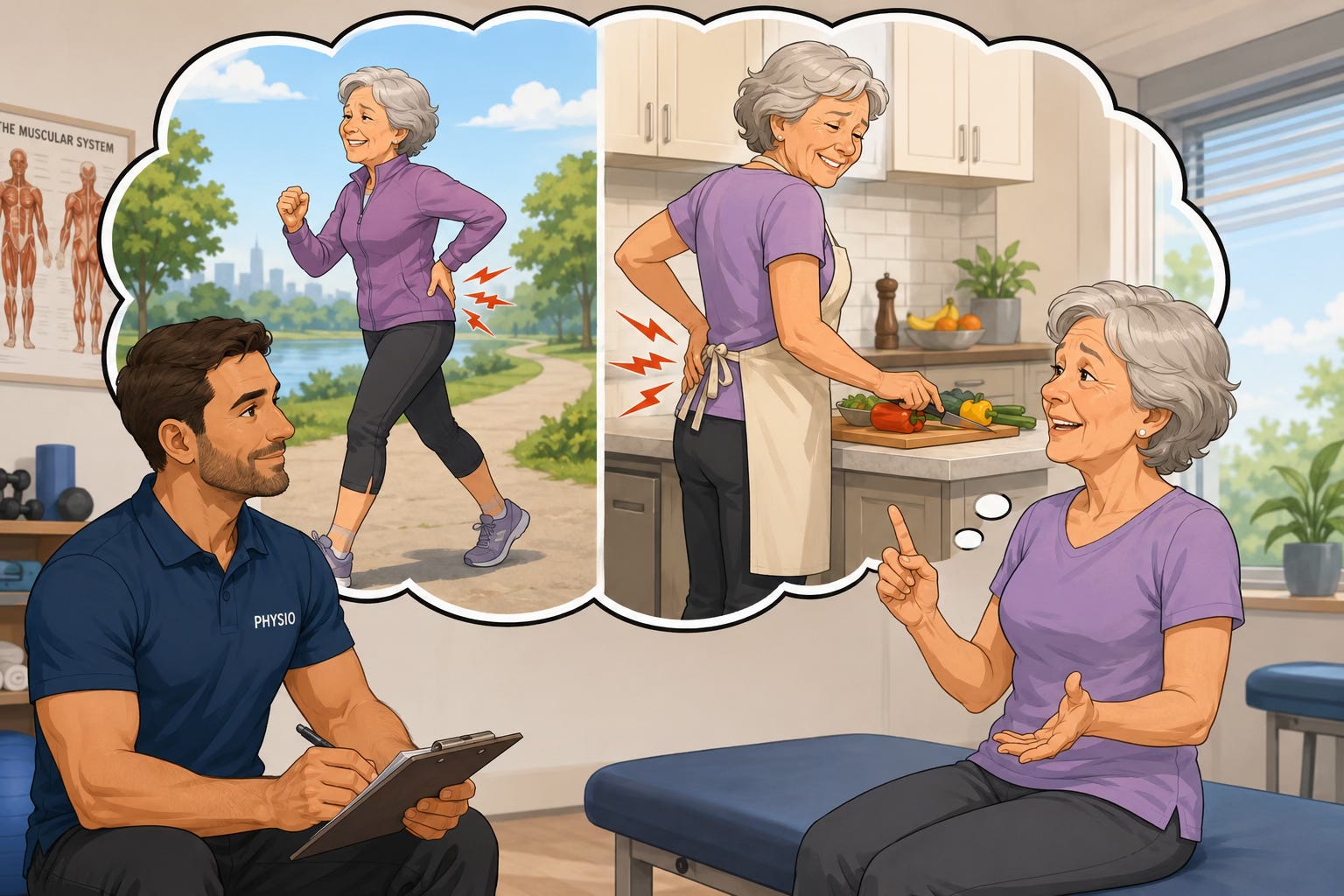
The Perceived Recovery question is like a metaphorical broom and dust pain. At the time of the question, most of the “mess” is “swept up”. The recovery question helps you collect and coalesce those remaining deficits and craft specific strategies to get that remainder swept up!
Consider this or similar strategies to help your client feel and function at their fullest!
Cool Exercises I Like. Easy Wall Hip Opener. I can hear the voices:
“Why do hips need to ‘open’, anyway?”
One answer: “Because we ‘close’em’ by sitting on them all day!”
Specifically: the key to a max-efficient, max-strength hip is a mobile, accessible posterior-lateral-inferior-corner (PILC)2: the back-outer “pocket” of soft tissue — joint capsule, ligaments, and muscle — that lies just beneath our glutes.
This key area of the hip has to be mobile enough for the femoral head to roll, spin, and posterior glide. If it can, the hip rotators and glutes are able to fully “grab” the femur and move it with precision and power!
But that PILC gets tight, easily. That’s why many Victory Fridays have been devoted to opening this key area3!
Of them all (including one I am currently developing), I must say this latest find — courtesy of physio Christine Ziade — might be the best (Low Effort, Low Pain, High Yield4), yet:
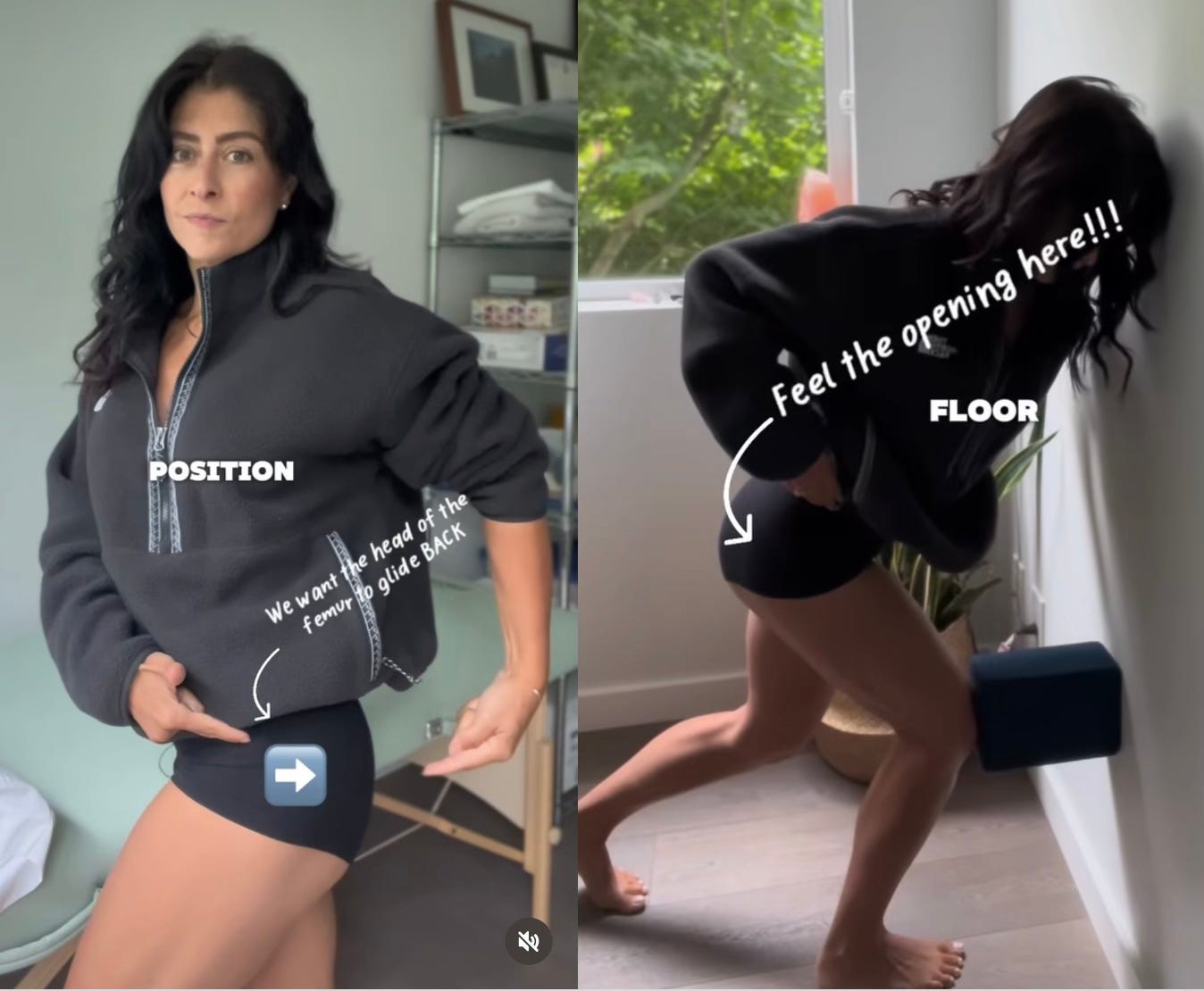
The unique effort/pain/yield benefits:
• easy position: in standing (no kneeling on a patella)
• modest effort: the yoga block supports the leg
• amplified stretch force: the yoga block drives the femur more directly into the PILC for a more targeted stretch; the kettlebell in the opposite hand facilitates abduction and internal rotation to stretch that back-outer corner.
In addition to improving “pinching in the front of the hip”, try this to see how it improves:
• squat depth
• stair descent (pistol squat)
• single leg balance
Victory Friday. Autonomous (Independence) Victories. A couple issues ago I celebrated 17 years as a physio5.
This week is perhaps a bigger milestone: ten years as a private practice owner.
While the risks and obligations are real, the rewards are profound.
For me, the greatest: autonomy.
Freedom to practice how I want, where I want, when I want, as much (or as little) as I want.
That hit home in a fun way this week. The high school cross country team began summer training a couple weeks back. They run together four days a week.
I only show up one day a week in the summer: Wednesday “Ultimate Frisbee Day”.
Since we get so many kids attending, we field two full games, featuring four teams of 6-7 kids.
And me.
And it’s a blast. While most of us became runners for a reason (a dearth of hand- and foot-eye coordination), we all make up for it with extra hustle and a few dashes of humor.
As I (relatively) sprint and cut up, down and across the field, leaping for catches and delivering back- and forehand throwing with both hands, I had the sudden — and delightful realization:
“It’s 9:45 in the morning on a Wednesday,
and I get to play ultimate frisbee with a bunch of high school kids.”

As I caught my breath, an even bigger smile broke out on my face, as I wiped the sweat off it.
I often say, “Adulthood is wasted on adults”: we work so hard for education, experience and income…only to be shackled just as rigidly as when we were little kids.
But not me. Not today, at least.
This, in large part, is why I advocate for private practice ownership. Let’s all do our best work in the best way we know how, that provides the best quality of life.
Win-win-win. Fitting for an Independence Day weekend.
Here’s to (at least) ten more years, and 250 more for the USA. Cheers. 🇺🇸🍻
Issue 142 is a wrap!
Help people move, function and feel better: please share this publication!
Thanks for reading, and have a great weekend,

Changes to longstanding pain and dysfunction are usually very slow and gradual. I often forewarn clients in these cases, saying, “improvement is often like watching a receding tide”: difficult to see in the moment, but measurable and significant, eventually!
Issue 2: The PILC. The posterior-inferior-lateral aspect of the hip joint capsule is the area of the joint — the “back-bottom-outside corner” — that needs to be accessed to put the glute musculature at ideal stretch, while helps activate the group for optimal use.
Previously shared exercises focused on opening this hip area include:
• Issue 3: Banded Hip Traction
• Issue 12: (Kneeling Crosslegged) Miracle Butt Stretch
• Issue 78: A Perfect Hip Hinge.
• Issue 125: Conor’s Crosslegged Hip Opener
• Issue 127: Roll-on-Wall Hip Airplane
Issue 128: “Low Effort, Low Pain, High Yield”: Gold Standards for Mobility Exercise. When prescribing mobility work, prioritize exercises that are low-effort, low-pain, and deliver immediate, measurable results. This often requires the development and use of “side door” strategies: multidimensional techniques that unlock restrictions indirectly for better, more sustainable gains with less discomfort.
Issue 140: Lessons from 17 Years of Physio. Key practices for physio career longevity: great mentorship (clinical, business, life balance); consistent strength training, daily exercise (incl. lunch breaks), nutrition, sleep, and stress management; avoid burnout with sustainable hours, in-session charting, and boundaries; build elite skills for cash-based practice; leverage boredom to innovate; chase effective “magic” techniques; find your ideal clients; and mentor early to sharpen your own expertise.