
Victory Friday | Issue 144
Orthopedic Insights: Take a Hike (& Forget The Run)! Fitness & Health-Maxx Using Treadmill Uphills • 8-Point Foot & Ankle Mobility Plan • More Ankle Dorsiflexion Achievements: Unlocking Hip Extension

“An idiot in motion goes farther than a genius at rest.” ~ Anon
Victory Friday is a weekly digest of reflections, insights, and tools from the world of functional manual and performance medicine. It is a free weekly publication. To support Victory Friday with a paid subscription, click below:
As a lifelong runner and physio, I’m here to confess: uphill treadmill hiking just might outperform flat running for health and fitness. Pair it with my new 8-point foot & ankle mobility plan and targeted dorsiflexion work to unlock better hip mobility, and you’ve got a winning recipe for resilient, efficient miles. Happy Friday, let’s dive in!
What I’m Into: Take a Hike (& Forget The Run)! Fitness & Health-Maxx Using Treadmill Uphills. It’s been a while since I shared an article. This one isn’t directly from Gregg1, but it’s validating data for something I strongly believe in:
Uphill treadmill hiking is better for health and fitness than running.
That may seem blasphemous coming from a lifelong runner, but has a veteran physio who’s treated runner for nearly two decades, I’m surprisingly lukewarm on running as a fitness activity.
In fact, if a 40+ year old were to ask me, “What’s the best exercise for fitness?”, my current rankings are (in order):
Strength training2
Uphill hiking
Yoga
(The very best: all of the above in a given week).
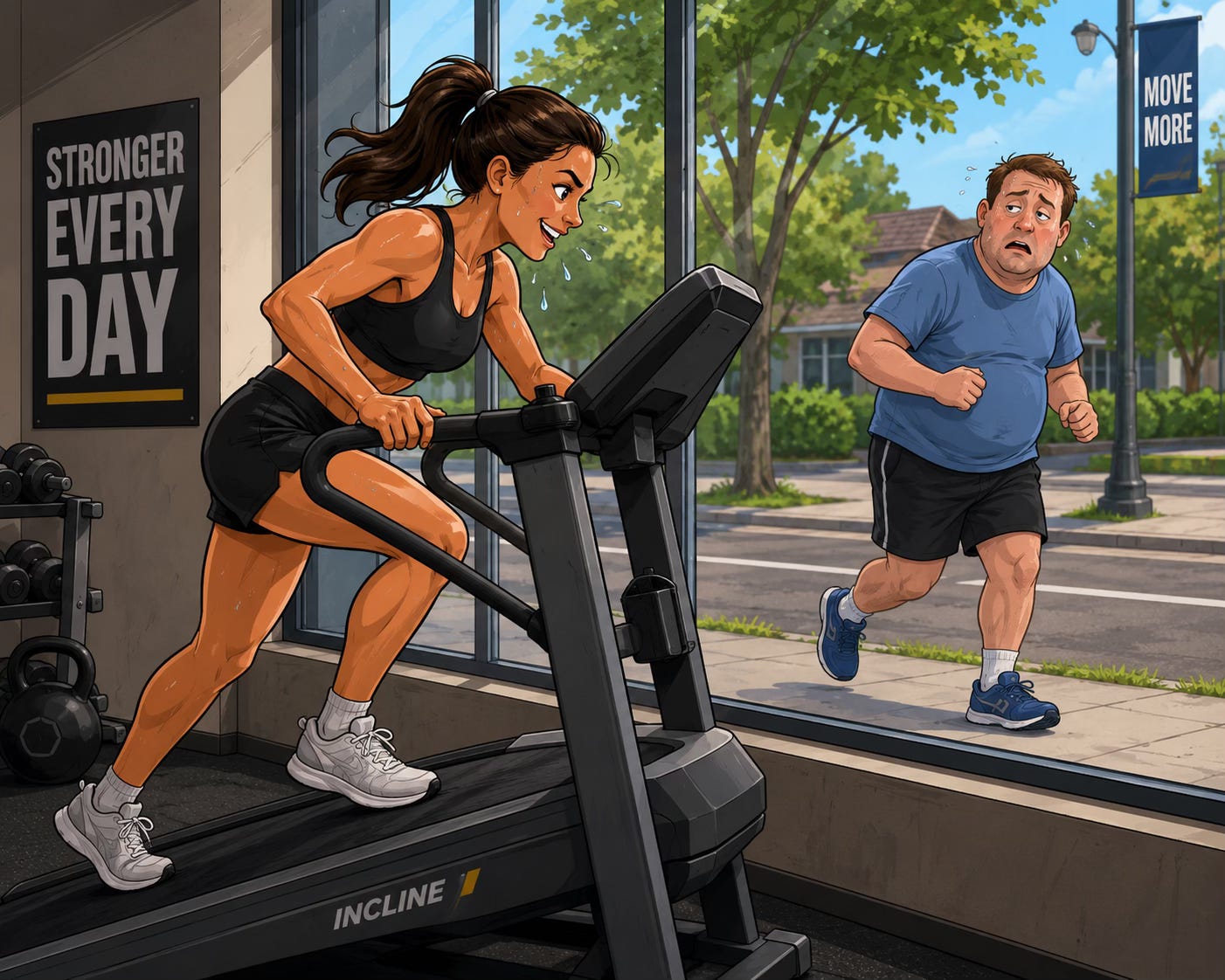
So I love to see research-based data, from the following study, that backs my clinical, coaching and athletic experience: that uphill hiking is as good, if not better, than running:
Predicting the Metabolic Cost of Incline Walking from Muscle Activity and Walking Mechanics
This study analyzed both the neuromuscular and metabolic effects of uphill hiking workouts on treadmills. Variables ranged from:
• incline: 0-40% — but most commonly, 10-20% grades
• speed: 1.5 - 4 miles per hour, or “self-selected”
• duration: as little as 5 minutes, but more commonly, 20-30 minute workouts
They then compared their hiking findings to previous studies on treadmill running to answer the question: how does the fitness value of walking on an uphill compare to running?
The Findings. When comparing uphill hiking to historical measures of flat running, the authors found:
• Equivalent intensity. Oxygen consumption (VO₂), heart rate (HR), energy expenditure (EE), and rating of perceived exertion (RPE) were all similar to flat running — during “isocaloric bouts”.
In other words, for the same calories’ worth of running, the intensity measures were similar — if not equivalent — with relatively high-incline (10-15%) hiking.3
• Similar (but different, if not enhanced) muscle activation. Steeper uphill hiking activated more posterior chain muscles (gluteals, hamstrings; gastrocnemius, soleus) than running but less of other groups.
Those were the statistically-significant findings from this study.
But I’ll add my experience:
My Perspective. Years of prescribing (and personally training with) treadmill uphill hiking has informed me of these significant benefits:
• Duration-equivalent intensity. Performing an uphill treadmill hike at 10-15% at moderate speed (2.5-4.0 mph) results in equivalent effort — heart rate and breathing rate/volume — as a typical “easy run”.4
No need to go longer, no need to “push harder” on the treadmill to “make it equal to running”.
• Similar muscles activated — but with higher-intensity. When performed with a strong hip hinge posture, treadmill hiking promotes hip loading and glute utilization, quadriceps activation in mid-stance, and lower leg plantarflexion strengthening — all similar to running.
However, because of the sustained incline, treadmill hiking can recruit more gluteal, quad and hamstring activation than flat running.
How can you activate more muscle with hiking at the same heart rate as running?
My theory: hiking heart rate is responsive to the muscle demands of the incline, while a substantial proportion of running heart rate is due simply to absorption of ground impact5.
• Less impact, less soreness. Because it lacks impact, uphill treadmill hiking results in less soreness, making it ideal for injury sensitivity and/or faster recovery, compared to running
• Uphill (and a little slower) is less stressful than flat (and faster) walking. One of the lone downsides to walking is…a lot of people walk inefficiently!6
• Less chemical stress. Hiking has less metabolic and hormonal stress: even at the same effort (heart rate and breathing) intensity. Why? With less impact, there is less tissue damage, less necessary “repairs” and thus less cortisol and cytokine release associated with hiking. (Cortisol is well known to, at least temporarily, blunt anabolic hormones such as growth hormone and testosterone)
• Enhanced weight loss. Because of: less impact, less soreness, less chemical stress and more muscle activation, fat-burning weight loss is enhanced with hiking.
The biggest factor: moderate-intensity hiking is more hormonally-friendly. And healthy hormones — avoidance of cortisol and promotion of growth and sex hormones — results in better fat metabolism.
Conversely, many people — namely those over 40 years old — struggle to lose, or even maintain weight with running as their primary mode of exercise. I suspect it is because, as we age, the hormonal stress associated with running increases.
Takeaway. Don’t let your ego fool you: Take a hike! Uphill hiking is every bit as good — if not better — than running for general health and fitness!
Joe’s Articles. 8-Point Foot and Ankle Mobility Plan. Attention trail runners! And hikers, walkers, and anyone who wants healthy, athletic efficient feet!
Hot off the presses, from me at iRunFar.com: a new, easy routine to get and keep your feet, ankles and lower legs mobile, supple and efficient.
An 8-Point Foot and Ankle Mobility Plan for Efficient Running
TL;DR:
The eight key exercise strategies:
8 strategies from the article:
Toe Spreaders and Sock Pull: Simple techniques using toe spreaders and pulling a sock to dramatically improve superficial fascia mobility on the plantar foot and lower leg.
Plantar Foot Tissue and Joint Mobilization: Horizontal rolling with a ball (dense or soft) on the plantar foot, followed by full-weight stepping to mobilize soft tissues and joints, with emphasis on the lateral border.
Midfoot Stomp: Oscillating heel pressure on the medial midfoot arch to restore neutral pronation and dynamic foot mobility.
Belt Ankle Stretch: Uses a belt to apply posterior glide to the ankle joint, restoring dorsiflexion mechanics.
Kneeling Plantarflexion Mobilization: Kneeling position with body weight or hand pressure to stretch and mobilize plantarflexion, balancing ankle motion.
Shin Smash: 360-degree foam rolling of the lower leg (posterior/medial and anterior/lateral compartments) to release myofascial tension.
Foot-on-Wall Calf Stretch: Angled foot against a wall for a full posterior chain stretch (toes through calf), enhanced with oscillations and rotations.
Standing Anterior/Lateral Shin Stretch: Lunge position with toes pinned to stretch the anterior/lateral shin compartments, with added oscillations and rotations.
Victory Friday. More Ankle Dorsiflexion Achievements: Unlocking Hip Extension in Runners & Walkers. I have covered the importance and impact of ankle dorsiflexion on athletic efficiency before, including how:
• it is crucial in reducing excessive knee joint torsion and shear associated with knee pain
• its neuromuscular connection to facilitate anterior core (hip flexion) activation7
and:
• it’s evidence-based connection to improved athletic function: stiffer dorsiflexion resulted in poorer jump and sprint measures8.
If that wasn’t enough evidence, a couple cases the past two weeks have yet again reinforced the power of ankle dorsiflexion: this time to restore strong, symmetrical hip extension by improving ankle dorsiflexion.
Three clients:
• all runners (teenage boy track and cross country runner, 30-something female runner, 50-something triathlete)
• all experiencing repetitive aches and pains on the “ipsilateral” leg (often in a “Whack-a-Mole” pattern9)
• all demonstrating a significant hip extension mobility and strength deficits in the contralateral (opposite to painful) leg.
And, most interestingly:
All had concurrent deficits in ankle dorsiflexion on the hip extension-limited leg!
I have seen this pattern before. But for the first time, I noticed something new:
• restoring ankle dorsiflexion resulted in partial to complete resolution in the ipsilateral hip extension deficit
In other words: the single “stone” thrown at the tibia and talus of the ankle “knocked down the birds” of ankle dorsiflexion and hip extension (and not the other way around).
This has been a hard-fought lesson: previous attempts with at least one of these clients to address only the hip extension without restoring ankle dorsiflexion resulted in only temporary improvement in hip function.
I had to restore ankle dorsiflexion to free and maintain hip extension!
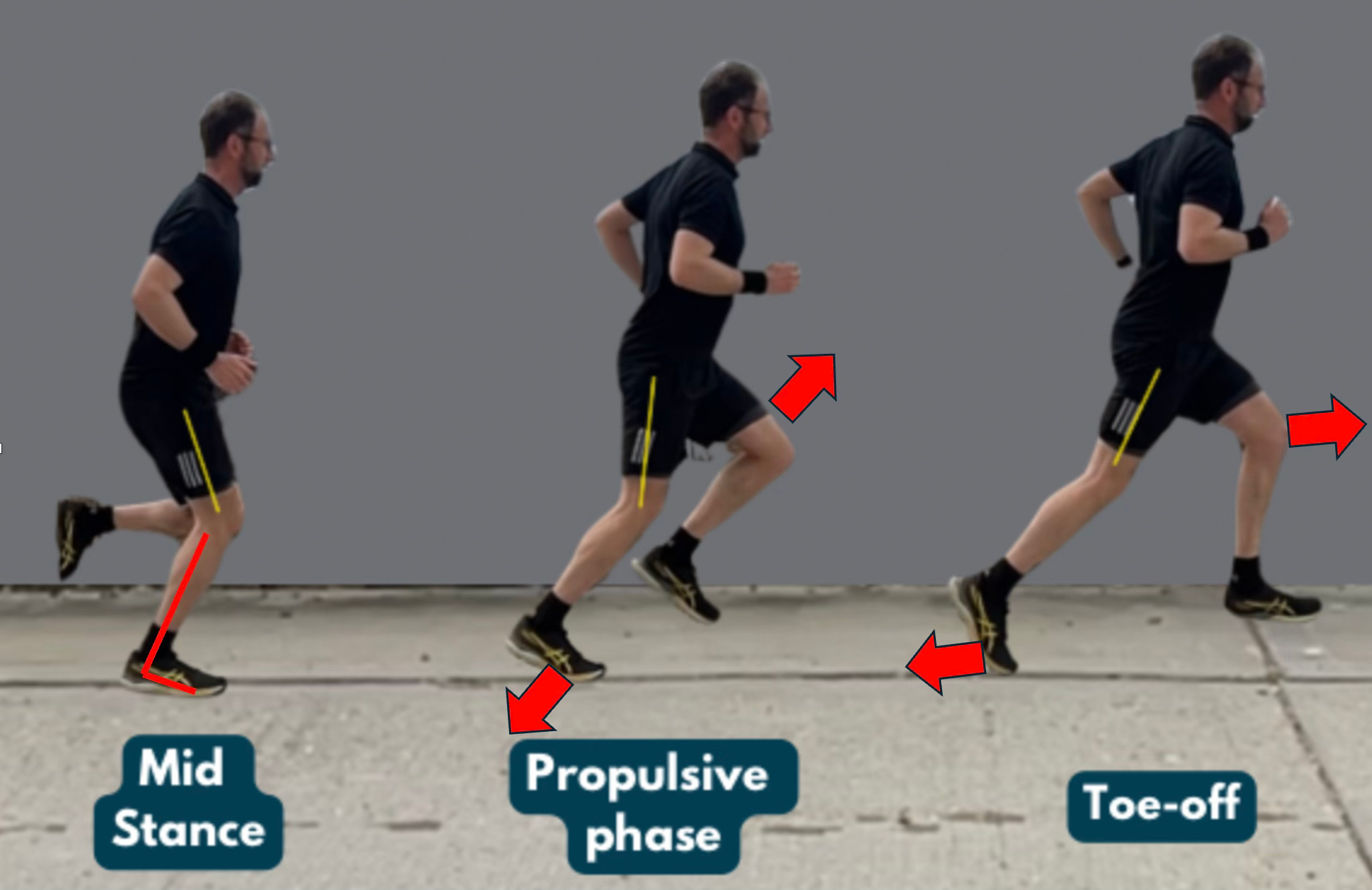
Takeaways. The Ankle & Hip Biomechanical Bookends. This is an important implication because:
• I believe most running-specific injuries stem from an asymmetry and imbalance of reciprocal hip flexion and extension10 — the propulsive running motion.
• But to sustainably restore and maintain both hip flexion and hip extension…requires restoring and maintaining ankle dorsiflexion, above all!
No amount of hip mobility - including aggressive manual therapy - maintained hip extension better than ankle dorsiflexion.
Have I discovered a new top of The Pyramid of Why11 for running and walking?
Stay tuned.
Issue 144 is complete!
Help people move, function and feel better: please share this publication!
Thanks for reading, and have a great weekend,

My mentor and Institute of Physical Art Founder Gregg Johnson sends daily journal article abstracts and summaries to the IPA Google Group.
Moderate-to-high-intensity weightlifting with full rest. (This is different, if not exclusionary, from modalities like CrossFit and Orange Theory, which emphasize high-speed/low-rest)
This sometimes — but not always — meant walking for longer (say, 30-45 minutes) to burn the same calories as as shorter (20-30 minute) run.
These parameters are different for everyone based on ability and fitness. For me, what it looks like:
• 30-minute treadmill hike @ 15% grade, 3-5-4.0 mph
is equal to:
• 30-minute flat run @ 7.5-8.0 mph (7:40-8:00 minutes per mile)
Ever wonder why, when you cross-train in other modailities, such as swimming. cycling and elliptical that it take far more “effort” (RPE) to achieve a “running heart rate”? I believe it is because those modalities lack impact stress — and that stress, alone, is responsible of a large fraction of the heart rate level associated with running.
Additionally: heart rate can be markedly high with sustained downhill running (increased impact force) while RPE is very low.
Issue 143: Ribcage Renewal for Low Back Pain Relief. A case study of a 60s male with 20-year chronic LBP : fast, flat walking with absent ribcage rotation and high lumbar impact stress contributed to his back pain and flare-ups. Interventions to improve thoracic spine and hip mobility, with exercise and cueing for ribcage, scapular and hip utilization during walking gait improved efficiency and decreased low back pain.
Issue 7: “Growing Abs” by Restoring Ankle Dorsiflexion. Case study of a client with complex trauma, hip/pelvic pain, and left ankle stiffness, where manual restoration of talar/tibial posterior glide and dorsiflexion immediately improved hip flexion strength (from ~3+/5 with poor initiation to 4+/5). This highlights how ankle restrictions can inhibit abdominal core strength and function, and that addressing proximal inhibitions often yields rapid, multi-level gains with extremities.
Issue 26: The Power of the Ankle. Limited ankle dorsiflexion ROM correlates with poorer sprinting and jumping performance in young athletes, consistent with prior links to altered gait, muscle activation, biomechanics, balance, and even upper-extremity injuries. Reduced dorsiflexion may also inhibit deep core activation and hip flexion power. Monitor and restore ankle dorsiflexion even in the absence of pain.
Issue 139: Whack-a-Mole Leg Pain: The Contralateral Culprit. In chronic, migratory leg pain (e.g., shifting between knee, hamstring, calf, IT band, shin, or foot), the root cause is often in the opposite leg : often a deficit in functional push off, namely hip extension mobility and strength, causing compensatory overload on the symptomatic side. This “reciprocality rule” shifts focus from chasing isolated symptoms to addressing systemic inefficiencies for lasting relief.
Issue 101: The Reciprocality Rule: Inefficiencies in One Leg Will Result in Equal & Opposite Stresses in the Other Leg. Most “landing stress” pains (plantar foot, shin, knee, anterior hip, and lumbopelvic) are driven by subtle stability or push-off deficits in the opposite leg. True resolution requires assessing and restoring efficiency in the contralateral limb rather than chasing symptoms in the painful leg alone.
Issue 5: The Pyramid of Why. A root-cause treatment concept that describes how potentially multiple different — and often disparate complaints (pain, stiffness, movement issues, dysfunctions — both orthopedic and non-) are driven by a singular — and often distal and “quiet” — root cause. And only by treating “the Top of the Pyramid”, are all those issues sustainably resolved.