
Victory Friday | Issue 145
Orthopedic Insights: Hip, Knee, or L3? Leg Pain from Upper Lumbar • Copenhagen Twists • Decompress It! TYO Low Back Pain • Hip’s Connected to the Ankle’s Connected to the Foot...

“A lot of arrogance is just cowardice disguising itself as certainty.” ~ @SovereignIM
Victory Friday is a weekly digest of reflections, insights, and tools from the world of functional manual and performance medicine. It is a free weekly publication. To support Victory Friday with a paid subscription, click below:
Happy Friday! This week we’re tackling a curious orthopedic plot twist: that sudden, severe, “OMG my knee/hip is dying” pain that has zero mechanism… that might actually be your upper lumbar spine pulling the strings. Don’t be fooled…
Plus: Copenhagen Twists to unlock thoracic rotation, a full “decompress-it” low-back toolkit, and a Victory on how efficient gait (happy hips and mobile ankles) begins with the ball of the foot and big toe! Let’s go.
What I’m Into: Hip, Knee, or L3? Leg Pain from Upper Lumbar. If you or a client ever experience severe, sudden, and random (non-traumatic, no-mechanism) knee and hip pain, and leg instability: is it the knee and/or hip pathology?
Or is it the upper lumbar spine acting up?
Many people — including orthopedic surgeons who love to replace hips and knees — are easily and quickly fooled by upper lumbar spine dysfunctions.
Here’s how it happens:
Most low back pain is pretty straightforward: an irritated lumbar spine results in pain in the low back and the pelvis.
When it is bad, it will refer pain into the leg, usually the back of the upper leg, usually behind the thigh (“sciatica”)
When it is really bad, lumbar radiculopathy will refer pain — and/or paresthesia and weakness — affecting the lower leg.
This sort of low back pain with referred leg pain nearly always involves the lower lumbar spine: L4, L5 and the sacrum (S1 segment).
Of “low back pain” etiology, the majority involves this lower lumbar region: about 80-90% of my clientele.
This high frequency, super-common pain is usually a result of an inefficient Functional Hip — The Four-Bone Hip System1: the hip and SI joints not moving enough (or moving in an inefficient, stressful way), causing excessive or stressful movement at L4, L5, and S1.
But what happens when the upper lumbar segments — L1, L2, and L3 — are irritated?
Different story, in two key ways.
First, let's look at the sensory and muscles affected by the lower versus upper lumbar spine:
Lower Lumbar — L4, L5, S1 (& S2):
• pain and parasthesias: back of the thigh, lower leg (front and back), foot and ankle (front and back).
• strength: weakness in the hip, hamstring, lower leg (calf, shin), foot.
Upper Lumbar — (T12 &) L1, L2, L3:
• pain and parasthesias: thigh — front and inner; hip — front, back, outer; knee — front, outer, back.
• strength: weakness in the anterior and lateral hip, knee; and a general sense of “instability” (unable to bear weight) through the hip.
So when the upper and mid-lumbar spine is stiff, malaligned or simply not moving right, it can express itself as significant hip2 and knee pain and weakness:
“OMG, my knee hurts so bad!”
“The front of my hip has stabbing pain!”
“I can hardly put any weight through my leg!”
“I have burning pain in the front and outside of my hip!”
In some cases, the complaints are so severe and focal — often without any low back co-symptom — that it’s impossible to consider that it could be caused by anything other than knee or hip joint pathology.
Concurrently, knee and hip joint pathology is so ubiquitous in older, “wear-and-tear” populations such as 40-70+ year olds that it’s easy to:
• jump to conclusions of knee and hip joint pathology, and
even worse:
• get quick — and often false-positive — “confirmation” of joint pathology from simple x-ray, or even MRI data, of the knee and hip.
And you can imagine where things might go from here3.
So how do we know if that severe hip and knee pain is from those joints, versus referred lumbar pain?
Clues That Knee & Hip Pain is Referred Upper Lumbar Dysfunction:
• Leg pain is fast-onset without (leg) mechanism. Neurogenic pain — both nerve and spinal vertebrae irritation — can come on quickly. Conversely, degenerative “arthritic” pain is nearly always slow and insidious.
Thus when someone is otherwise “fine”, then suddenly feels acute-onset knee or hip pain without a mechanism — in other words, they didn’t do a “couch-to-Mount Everest” hike, or lift a small car off a child — that is a strong clue that the pain generator is spinal-neurogenic, not orthopedic.
• Leg pain is severe and random, poorly correlated with activity. Neurogenic pain is often severe at rest: certain spinal and nerve tensioning positions can be most painful while sitting or lying down. Conversely, doing a lot of even strenuous activity can feel fine.
That is antithetical to orthopedic pain. True hip and knee joint pain is mostly non-existent at rest4.
• Leg pain is modulated by spinal position and movement. The hip and knee pain can be triggered, or relieved, by movements and positions of the spine. This is a classic sign of spinal and neurogenic pain.
Conversely, with joint position and loading held constant, true hip and knee joint pain will never modulate. For example: pain from an inflamed knee while sitting will never change by flexing or extending the spine.
• Leg pain is unaffected by leg treatment strategies. No standard orthopedic treatment plan (including: mobility, strength, alignment; rest, ice, heat, or (local) anti-inflammatories) improves spinal or neurogenic leg pain.
(Note: systemic anti-inflammatories, particularly compounds like prednisone, may be extremely helpful, as irritated spinal joints and nerves respond favorably to corticosteroids.)
• Leg imaging is boring or mediocre… X-ray and MRI data show “mild to moderate” degenerative changes in the joint. These finding correlate to gradual, chronic stresses.
Especially if leg pain is acute and severe, such gradual degenerative imaging findings correlate very poorly to these symptoms.
and, most importantly:
• …Lumbar imaging reveals relevant upper lumbar pathology. This is the biggie.
If you — as clinician or patient — have leg pain that:
is acute and severe
is randomly bad (and, at times, fine)
has no (leg-overuse) mechanism
is unresponsive to orthopedic treatment strategies, and
has “boring” joint imaging findings…
…it’s time to consider lumbar spine imaging.
Here is an example of a “Victory in Progress”: a client with severe hip and knee pain. This is her lumbar x-ray:
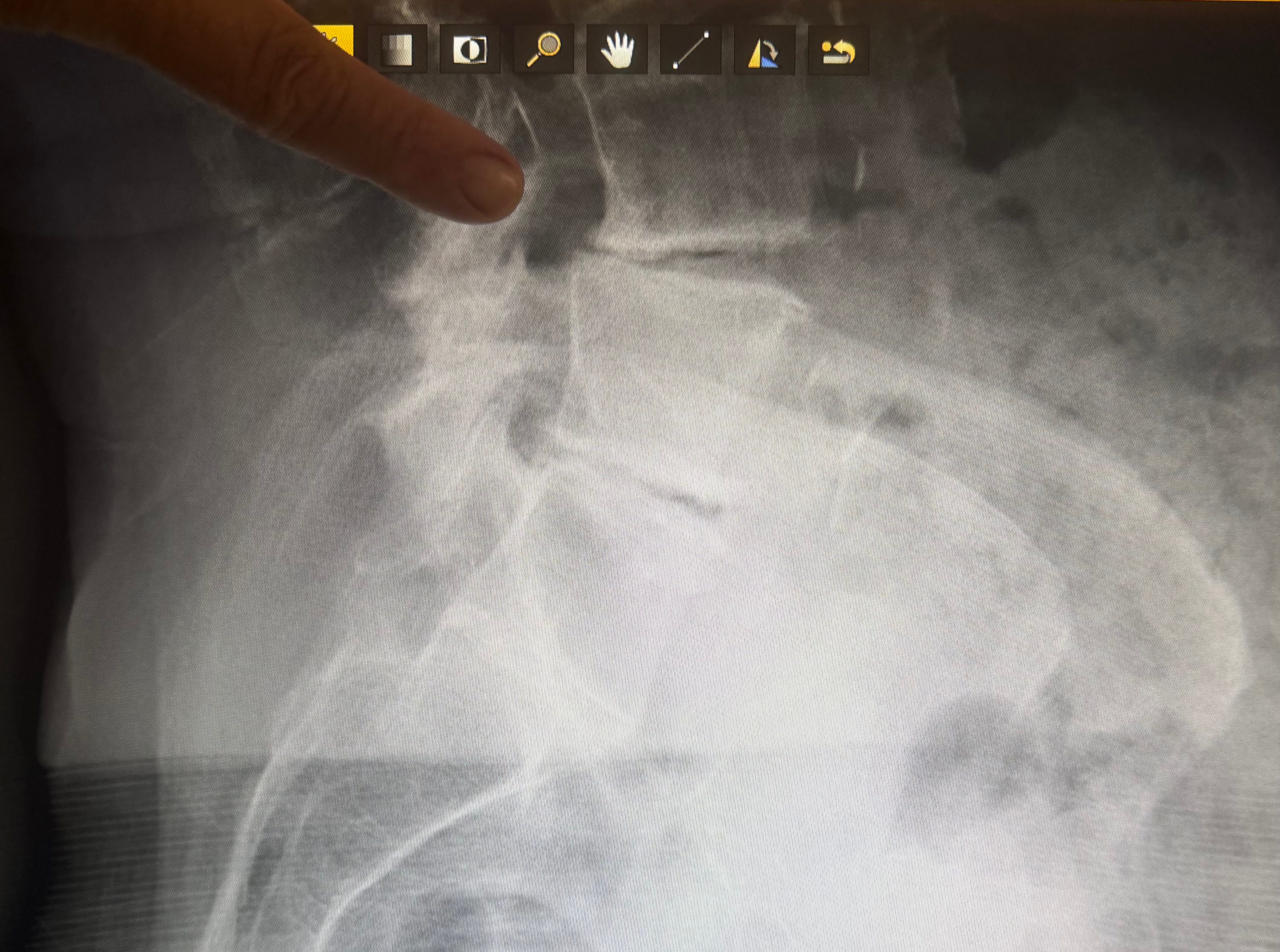
In this client’s case: experiencing leg weakness and instability, in addition to “hip and knee pain” that has — for a long time — been unresponsive to hip and knee treatment, this L3 anterolisthesis is profoundly correlative to her pain.
Given this information, we have zeroed-in our treatment on the respect and care for mid-lumbar, via mobility, strength/stability, and efficiency — supporting and protecting this segment.
Stay tuned for the outcome. In the meantime:
Takeaway. Upper Lumbar Dysfunction Hits Different. Lower lumbar pathology and its symptoms are more common and familiar. Recognize what the upper and mid-lumbar segments do, and how different referred pain feels from this part of the spine.
And if you or someone you care for begins to have severe, unexplained and unresponsive hip and knee pain, consider the (upper) low back!
Cool Exercises I Like. Copenhagen Twists. One cause of upper lumbar stress: poor or uncoordinated rotation through the thoracic spine.
This exercise, from Calvin Knor (@calvinknor), is a great way to combine trunk, pelvic and hip frontal plane stability plus a healthy dose of transverse plane, whole-spine rotation!
This high-level strength exercise is great when followed by:
Joe’s Articles. Decompress It! TYO Low Back Pain. If you have an upper (or lower) lumbar spine problem — and highly-specialized, “treat only the painful spot”, strategy hasn’t helped you — try this whole-body, decompressive routine!
From iRunFar.com,
Treat Your Own Low Back Pain: Decompress your low back with these self-mobility techniques.
TL;DR: The seven self-mob strategies:
Thorax foam rolling: side-to-side, up-and-down, arch-over, and diagonal rolling on a foam roller to restore ribcage and thoracic mobility while protecting the low back.
Pelvis boogie board stretch: seated side-sit on the heels to decompress and create space between the lumbar spine and pelvis.
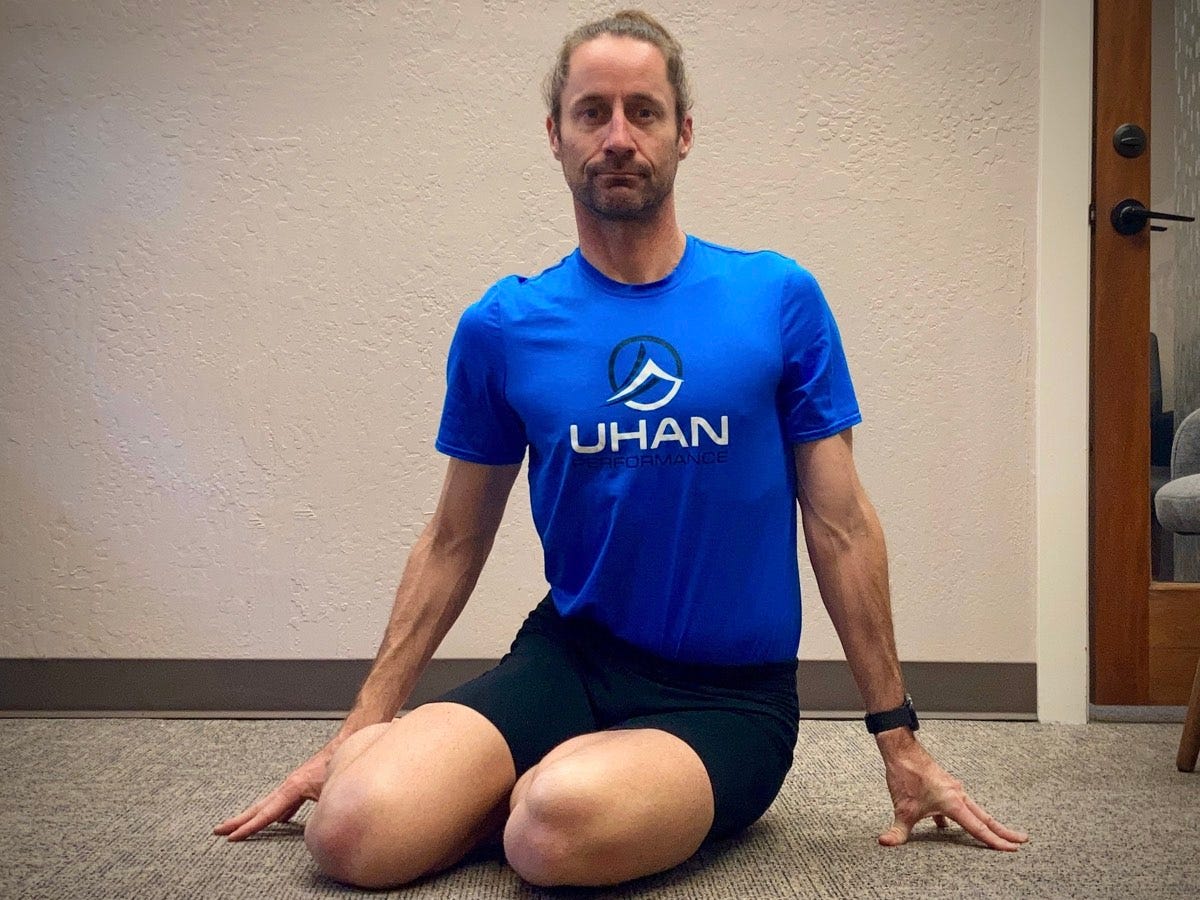
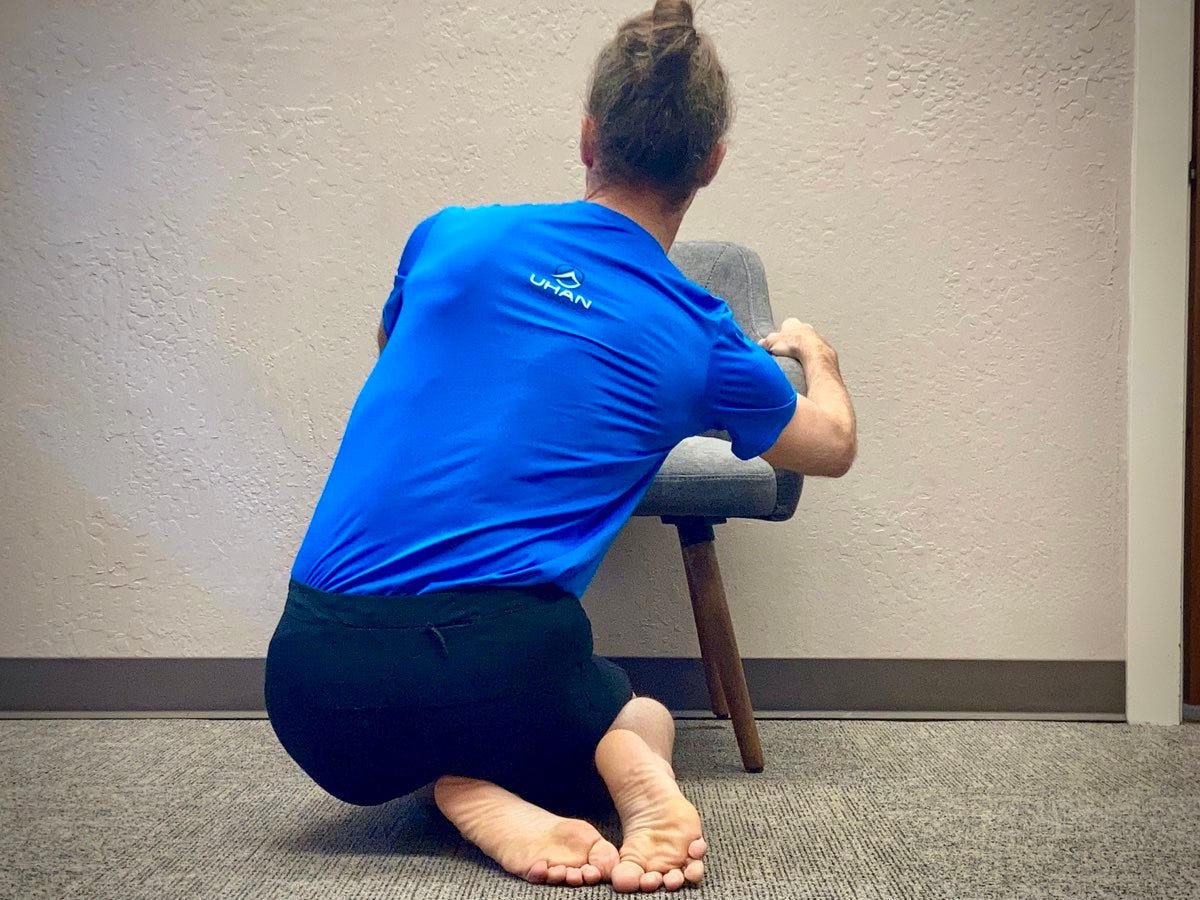
Child’s pose with traction: kneeling forward fold with hands anchored and hips sinking back to create longitudinal traction through the spine and pelvis.
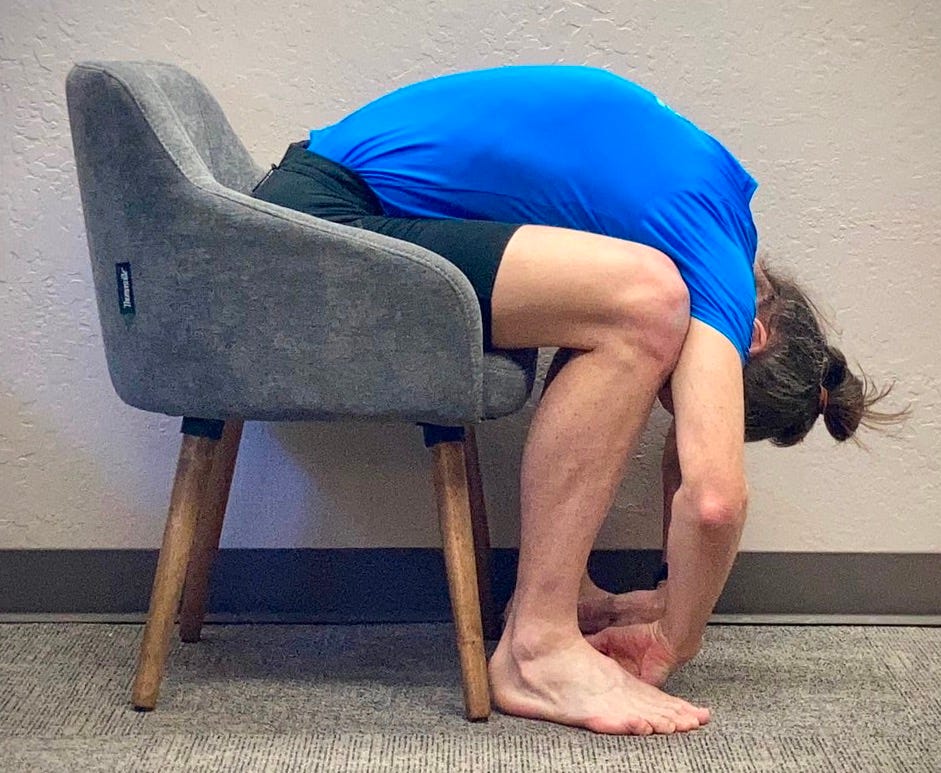
Seated toe touch: segmental flexion from the head downward while seated, adding hand traction under the feet, which creates both posterior fascial lengthening and a decompressing effect to the low back and pelvis.
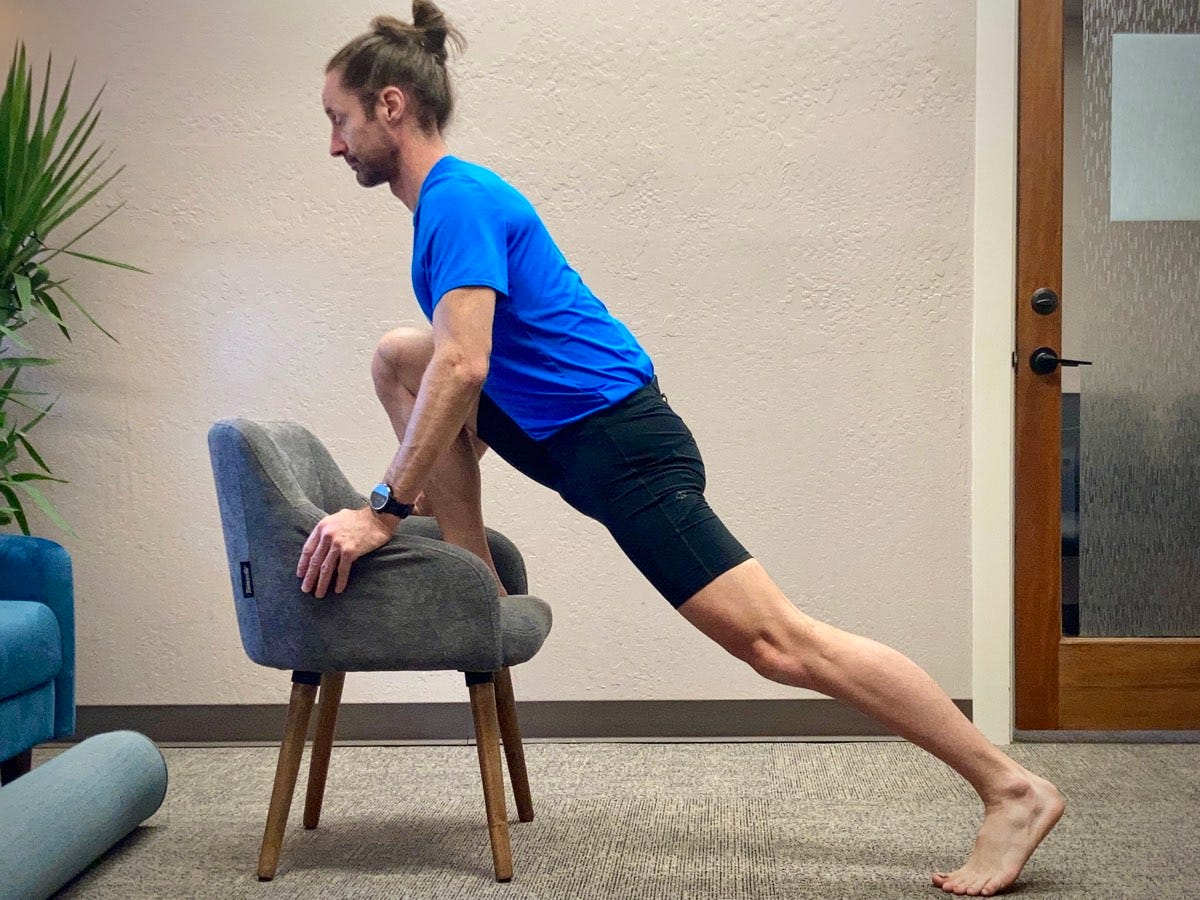
Runner’s lunge: emphasizing both full hip and pelvic flexion, coupled with full extension, all the while holding (protecting) the lumbar spine in neutral
Trunk rotation: supine knee-to-chest and across-body rotation to free the thoracolumbar junction and reduce potential cluneal nerve irritation.
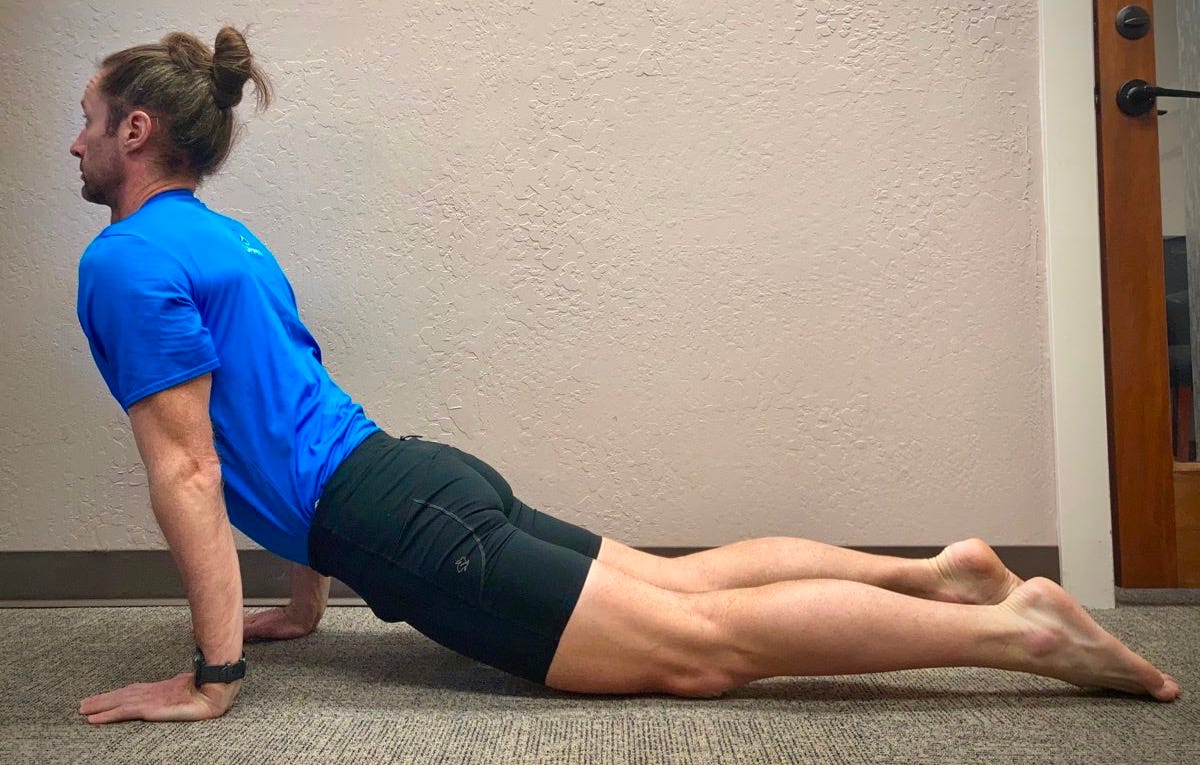
Traction-assisted upward dog: prone press-up performed with a deliberate rearward push that drags the toes slightly, combining extension with lumbar decompression
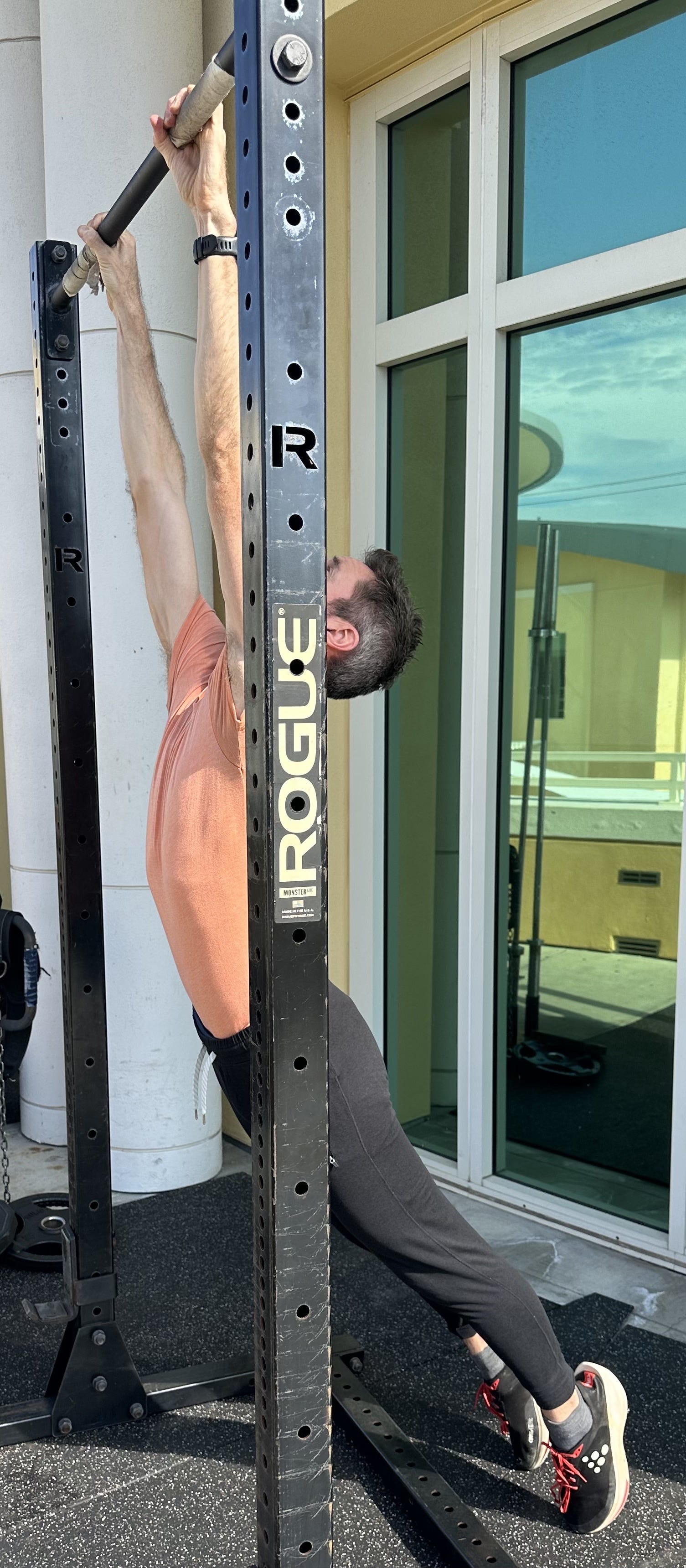
Since this article is from 2022, today I would also add both:
extension-based traction off an overhead bar5:
flexion-based traction using a 45-degree bench:
Victory Friday. Hip’s Connected to the Ankle’s Connected to the Foot: Climbing the Pyramid of Gait Efficiency. A short-and-sweet Victory this week, building on an efficient propulsive leg system.
Last week I wrote about the importance of ankle dorsiflexion on hip mobility, strength and gait efficiency6.
But how do we maintain efficient ankle dorsiflexion?
The finding — clinically-tested using three clients in the past week:
Engagement of the first ray — using the ball of the foot and big toe — results in efficient, balanced ankle joint dorsiflexion.
Loading, then pushing off the first ray, that powerful medial part of the foot, is what functionally mobilizes the crucial (and often restricted) medial aspect of the ankle joint.
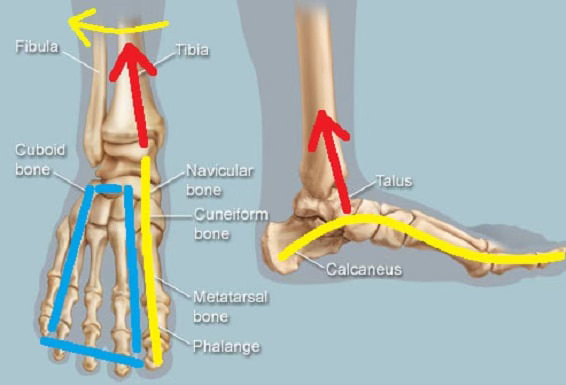
For all of these clients — including those mentioned in last week’s Victory — their hip extension deficit was driven by medial ankle stiffness that was created (or at least perpetuated) by deficient utilization of the medial foot arch, ball of the foot and big toe!
Strategies to Engage the Medial Foot. These included:
• comprehensive foot and ankle mobilization (many of which can be found here).
• weight bearing exercise including weight shifts and calf raises with active loading of the first-ray structures.
• walking, and running, with first ray engagement (“get on, then push off, the ball of the foot and big toe!”)
Takeaways. Strong Strides Do, Indeed, Start at the Foot. Be sure your clients can and do actively and athletically use their feet.
But there’s a postscript:
Might there be another factor that could inhibit
the natural, mechanical loading of the medial arch?
There may be. But you’ll have to stay tuned for that: the next (upward) climb on the Pyramid of Why7!
Issue 145 has concluded!
Help people move, function and feel better: please share this publication!
Thanks for reading, and have a great weekend,

Issue 12: The Lower Quarter “Four-Bone System”. The functional hip is made up of four (primary) bones: femur, pelvis, sacrum, and lumbar. Each bone needs to move its share (but not too much) for efficient function without pain. A common cause of low back pain is a juxtaposition of these motions, where the hip (femur-on-pelvis) moves inadequately (or inefficiently), causing the sacrum and lumbar bones to move excessively.
Issue 131: Double(-Crush) Hip Crossed! A case study of how sitting posture created anterior hip nerve compression and pain. A runner with stubborn left anterior hip pain and neuralgia improved substantially with hip, pelvic, trunk, and nerve mobilization plus stride optimization—yet residual symptoms resolved only after she stopped prolonged narrow cross-legged sitting at work. That posture created a mild double-crush of the femoral and lateral femoral cutaneous nerves (compression/tension at the hip plus sustained lumbar sidebending), illustrating how everyday prolonged postures can perpetuate neurogenic pain.
Theory: a significant fraction of knee and hip pain that begets replacement is actually lumbar referred pain. Yet: the replaced joint — in large thanks due thorough strength and mobility rehab, post-operatively — is more efficient. This decreases strain on the lumbar spine: so the (referred lumbar) pain resolves. For most people (stay tuned for more on this).
The definition of Pain at Rest: “experiencing symptoms with zero movement”. Inflamed or arthritic joints can be very painful with movement, while in resting positions: rotating a hip or flexing a knee during sleep and experiencing pain, for example. But this is not considered “pain at rest”.
Issue 145: (Extension) Hangin’ Around. A description of flexion- and extension-biased traction using a 45-degree bench and overhead bar, respectively. Traction creates joint and tissue space in addition to lengthening fascia in both directions. Regular traction helps counteract the compressive forces of daily life and impact activity.
Issue 144: More Ankle Dorsiflexion Achievements: Unlocking Hip Extension in Runners & Walkers. Ankle dorsiflexion deficits frequently co-occur with contralateral hip-extension weakness in runners and walkers; restoring dorsiflexion has repeatedly produced lasting recovery of hip extension (and reduced ipsilateral pain), whereas isolated hip work yields only temporary gains—underscoring ankle mobility as a foundational “bookend” for sustainable hip drive and injury resilience.
Issue 5: The Pyramid of Why. Describes how potentially multiple different — and often disparate complaints (pain, stiffness, movement issues, dysfunctions — both orthopedic and non-) are driven by a singular — and often distal and “quiet” — root cause. And only by treating “the Top of the Pyramid”, are all those issues sustainably resolved.
I’ve been in Eugene all week. Wish I could have seen you for a consultation…
🤔. Reading my mind “What I’m Into: Hip, Knee, or L3? Leg Pain from Upper Lumbar. If you or a client ever experience severe, sudden, and random (non-traumatic, no-mechanism) knee and hip pain, and leg instability: is it the knee and/or hip pathology?”