
Victory Friday | Issue 148
Orthopedic Insights: Life-Saving Plyos • Fall(ing) Practice! • Returning to Training After a Fall • Myometric Wins: The Importance of “Landing” Training in Impact Athletes.

“Those who don’t jump will never fly.” ~ Leena Ahmad Almashat
Victory Friday is a weekly digest of reflections, insights, and tools from the world of functional manual and performance medicine. It is a free weekly publication. To support Victory Friday with a paid subscription, click below:
Welcome to another Victory Friday, where we outline the kind of training that optimizes athletics…and might keep you alive! This week’s mix — on plyometric and loading training for safety and high-performance — is equal parts hop, catch-yourself, and controlled crash-landing—because stronger bones, faster reactions, and knowing how to fall are the ultimate fun — and life — insurance policies. Jump in!
What I’m Into. Life-Saving Plyos. Plyometrics and impact training is useful for more than just athletes. When working with my older, non-athlete but still highly-active clients, I always push plyometric and impact training near the end of their care.
Here’s why:
Stronger bones. Progressive plyometric and impact training builds bones! And those bony improvements take very light input, with little hops:
Or, plyo/impact training can even be done in sitting!Faster (life-saving) reactivity. When I work plyometrics with my non-runners, here’s what I tell them:
”If a runaway bus comes careening down the road, I want you to be able to jump out of the way!”
That gets their attention…Fall prevention. …but the much more real and probable risk is a simple fall. Falls end in fractures for so many older adults that can be both debilitatingly life-changing.
And life-ending:
Falls resulting in hip fracture in adults over 65 have a
one-year mortality rate of over 20%1.
Plyos and impact training can prevent falls, strengthen bones, and — in combination — save lives.
What I do. Most of my hops are small and light, including this exercise, well-demonstrated by trainer Ted Ryce (@Ted_Ryce):

The beginner-level — or “return to impact” training — hops I frequently use include:
• double footed forward-back hops
• double footed side to side hops
• single leg lateral hops (this, also from Ted):
Then, only when those are executed with light and quick control, and pain-free, do I progress to single leg and higher-vertical jumps.
Takeaway: Hops needn’t be huge to help! To incorporate this crucial training, start small, then work up, to keep that spring in your (and your client’s) step!
Cool Exercises I Like. Fall(ing) Practice! Related to the importance of plyometrics for older adults, so, too is…knowing how to (prevent a) fall!
Here are two novel ways to “train falling” for older clients (and ourselves)!
First, pre-fall prevention begins with a self-righting response. Back in Issue 69 I discussed the best practices to improve balance, which included the importance of a self-right response2:
Self-righting response: the body (and brain’s) ability to detect a loss of balance and create a quick physical reaction that regains balance in an upright position.
Here is a great, relatively safe and easy way to work on self-righting, courtesy of physio, Jill Zimmerman (@drjillzimermanpt)3:


Second, there’s legit falling practice! Leave it to the hardcore Singaporeans to actually practice striking — and rolling — on the ground! If you have a super-soft playground surface — and some guts — you might try these “backward rolls”, from the adult Parkour (and fall training) folks at Movement Singapore (@movement.sg).


It may seem extreme, but training to fall might be some of the best physiological life insurance a person can have!
Joe’s Articles. Returning to Training After a Fall. Everyone falls, even if you’re young and athletic.
A fall that doesn’t cause immediate and severe injury can still create lasting problems: tissues lose mobility, the neuromuscular system can become inhibited, and efficient movement patterns can break down.
This was a paired share nearly three years ago and worth a repost, from iRunFar.com:
The Fall Guy: The Long-Term Treatment of Trail Running Trauma
Part 1 is a bit of a misnomer: it covers neuromuscular inhibition — a common short-term problem after an acute fall — and how to help re-activate key muscles in the running system.
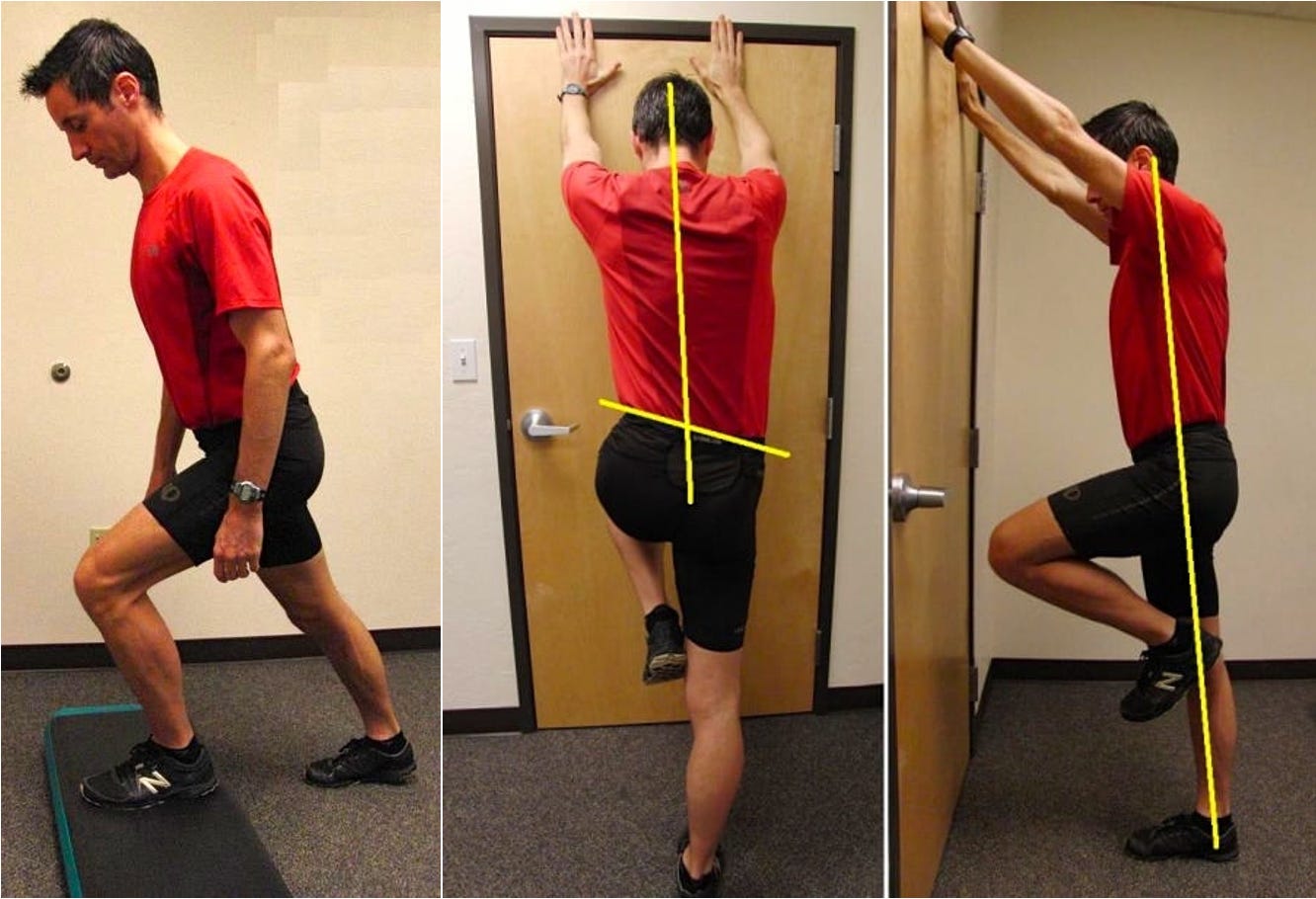
It also provides return-to-running guidelines after a hard fall (spoiler: don’t run if you can’t walk without a limp!)
Part 2 covers some of the under-appreciated (body) Systems and (tissue) Dimensions4 that can become impacted (literally or figuratively) by falls — and how these body areas and tissues can perpetuate dysfunction unless treated.
That list includes:
• hips and pelvis
• coccyx
• visceral (abdominal organs)
Falls hurt…but their long-term system effects can perpetuate pain, or cause new pains!
Try to prevent them, but when they happen, be sure all the pieces are moving correctly before resuming activity!
Victory Friday. Myometric Wins: The Importance of “Landing” Training in Impact Athletes. On the theme of plyometric and landing training is the importance of controlled landing training in runners:
Can athletes, with speed and energy, land on a single leg — and control that energy absorption without excessive — or straining — movement?
Interestingly, our example this week of geriatric self-righting training is one of the techniques taught in last month’s Strategies to Optimize Performance (SOP) course: the ability to securely land on a single leg.
Only for runners, single-leg controlled loading with both speed and load is the key test. Here is a key exercise, from the SOP course, that’s helped multiple runners this past month:
It’s simple but, for some — including those with pesky foot and ankle, knee, hip and low back pain — it can be hugely challenging!
Why? This controlled landing exercise represents a unique system loading challenge.
This “sticking the landing” training is:
• faster (and higher energy) than standard stepping or squatting exercise
• slower — and thus more demanding — than the quick on-off pattern of running
In running and other impact sports, loading integrity — the ability to maintain optimal alignment with ground impact — can be obscured by the quick (or not-so-quick) “bounce” that is the running pattern.
But if that third-of-a-second, load-unload run gait cycle is poorly controlled — resulting in excessive or aberrant movement — that can be an insidious source of tissue strain and pain.
Trainer and movement coach Ken Vick (@coachkenvick) recently addressed the unique need for loading training: a stimulus similar to, but ultimately different from true plyometrics — which are landing-then-instantaneously-jumping.
He identifies these controlled, “stick-the-landing” stimuli, myometrics:

In his article on the topic, Vick writes:
[Landing training/myometrics] matters because athletes do not begin every movement from a controlled position with the sole objective of producing more output. They enter movements with velocity. They land. They collide. They cut. They get pushed out of position. Before they can produce anything useful, they have to manage what is already coming into the movement.
What often separates the best athletes from those who are merely good is not only how much [force/energy] they can produce. It is how well they manage those inputs and how effectively they organize the next action.
The same may be true of the athletes who remain durable and injury-free over long careers.
I contend this applies to all athletes, even ultra-endurance athletes who must conserve and produce energy with every foot strike.
Controlled Landing Cases. The following client cases were greatly helped by this myometric single leg training this past month:
• A 40s year old woman with chronic left knee pain — secondary to a left ACL repair 20 years ago, and a severe right ankle injury. Alignment, mobility, strength and running efficiency were improved enough for her to return to running. But she continued to suffer from right ankle and left knee pain, particularly with downhill trail running.
Both the right ankle and left knee were deficient in controlled landing stability, with load. Working on this exercise decreased pain and improved downhill tolerance.
• A 60s year old man with a 40-year history of left knee pain with running. His knee was largely fine with all other activities. Except running. Since college! Conventional physio care — including mobility and strength — failed to improve it.
Upon running evaluation, his cadence was low (<150 steps/minute) and his left knee demonstrated dynamic knee valgus — both of which are deficits of loading stability.
Light plyometrics and lower leg strengthening partially helped. Controlled landing training resulted in even greater running — efficiency and tolerance — gains.
• A 40s year old male runner with chronic (>15 year) ankle, Achilles and lower leg pain history. Higher running volume — as well as hilly terrain — caused painful stiffness during (and much worse, after) runs.
Ankle and lower leg stability was deficient in loaded landing, resulting in excessive dorsiflexion. Additionally, trunk control was deficient, possibly resulting in increased lateral lower leg loading (due to excessive sway).
Controlled loading training improved stability, and with it, running and terrain tolerance.
Takeaways. Train to Control Energy! As is a tenet of the SOP course:
first learn to be stable, then learn to maintain stability in
increasingly athletic positions and movements!
Doing so is the key to both peak performance and pain and injury prevention!
Don’t forget the plyos, but consider adding some “myometrics” to your training, too!
Issue 148 is a wrap!
Help people move, function and feel better: please share this publication!
Thanks for reading, and have a great weekend,

Johannesdottir F, Roberts JE, Kiel DP, Tsai JN. Hip Fractures: A Review. JAMA. 2026;336(6):496-507. doi:10.1001/jama.2026.11895
Issue 69: Balance (vs “Falling”) Training. Balance training is most effective when it first optimizes the underlying systems — joint mobility (especially proprioceptive input from the feet, ankles, knees, and hips), core stability, and visual/vestibular function — before layering on challenges. Many older adults with fall risk show not only balance deficits but a near-total absence of rapid self-righting strategies; practicing quick, unpredictable recovery steps (e.g., erratic catch or multi-task single-leg work) may be as important as traditional balance drills.
Apparently Instagram/Meta no longer supports embedding videos into Substack, sorry!
Issue 41: Systems & Dimensions. Full and sustained pain relief and recovery of function often requires a comprehensive treatment approach of multiple Systems (body areas: spine, pelvis, abdomen, pelvis, hip, knee, etc) and Dimensions (types of tissue: muscle, tendon, bone/joint, fascia, nerves, blood vessels, etc).