

"Whatever must happen ultimately should happen immediately." ~ Henry Kissinger
Victory Friday is a weekly digest of reflections, insights, and tools from the world of functional manual and performance medicine. It is a free weekly publication. To support Victory Friday with a paid subscription, click below:
Welcome to Victory Friday! Today we have a special theme: knee valgus and how to correct it.
Knee valgus is, on the surface, a “knee-in” alignment problem, where the leg fails to maintain straight alignment from foot to pelvis:
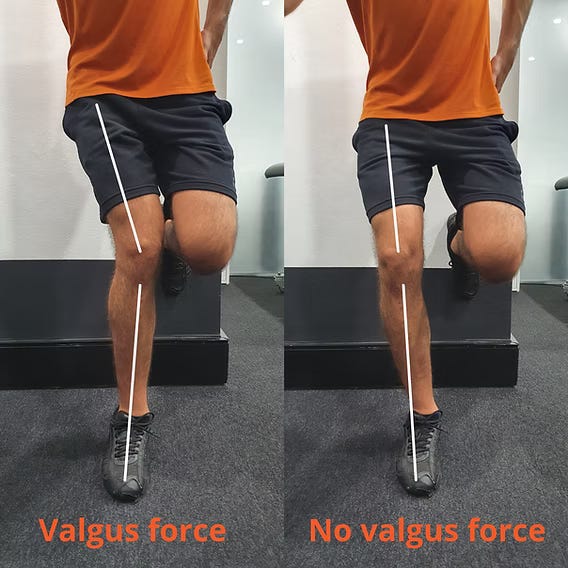
But it is a systemic issue, with deficits — and compensations — at the foot, ankle, shin, hip and pelvis.
And while the origins can be argued like chicken-egg —Is it a strength issue? A mobility deficit? — it ultimately creates a multi-joint, compensatory malalignment that I call, “The Unholy Rotation”:
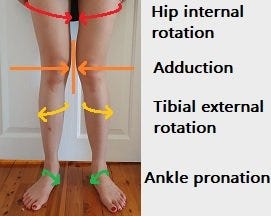
This week we outline a key player in knee valgus — the lower leg — and how valgus correction can be obtained from twisting the tibia and massaging and smashing the fibula!
If that sounds like a treat to you, dig in! 😋
Joe’s Articles. Joe’s Running “Knee-Out” Alignment Two-Fer. We start at the finish: how knee alignment affects running.
An efficient leg alignment is crucial for running efficiency: it is the key to both safely absorbing landing stress, as well as transmitting — then creating — propulsion for running fast and far.
The most common and problematic knee inefficiency issue for runners is knee valgus: where the knee bends inward during weight bearing:
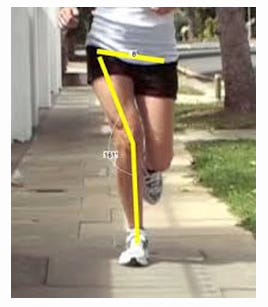
While manual techniques (see What I’m Into below) can be helpful to restore the capacity for neutral alignment, athletes in running sports must ultimately learn to stand, step, cut, jump and run with a neutral — or relative “knee-out” — alignment!
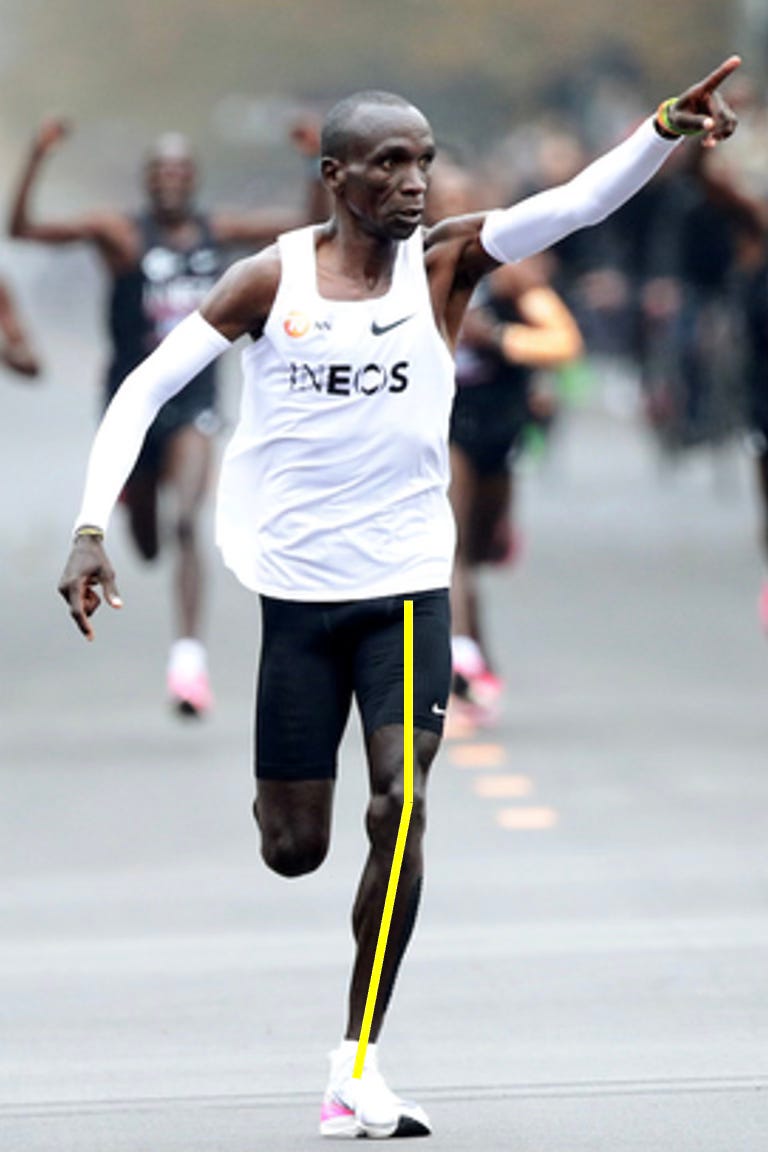
For a deep-dive into running-related knee valgus and how to improve knee alignment with running, here’s a two-part series from iRunFar.com:
Part 1: When in Doubt, Knee-Out: Knee Alignment for Runners
and, Part 2: When in Doubt, Knee-Out, Part 2: Knee-Alignment Examples and Exercises
The TL;DR’s:
Part 1:
Neutral knee alignment (patella over 2nd–3rd toes) results in minimal landing stress and maximal propulsive energy storage and generation.
Knee valgus (or “knee-in”) alignment is the result of the “Unholy Rotation” — a multi-joint compensatory mal-alignment affecting the whole leg — which drives many running injuries (hip, IT band, knee, shin, plantar foot pain).
Fix: deliberate focus on “knee-out, foot-in” alignment during all aspects of running: pre-landing swing phase, initial contact, mid-stance and push-off.
Train efficient (knee-out) with progressive running-specific exercises, including: squats/deadlifts, step-ups/lunges, Ice Skater, 100-Up (Runner Hops).
Payoff: fewer injuries, and better stability, top speed and endurance!
Part 2:
Provides real-life stride examples and video break down explanations
Outlines restorative exercises to help correct “The Unholy Rotation” (of orthopedic compensations), including mobility, strength, and drills that focus on ideal knee alignment
Video demonstration of knee-out stride techniques:
Cool Exercises I Like. The “Tibia Un-Twister” (for Knee, Ankle & Foot Alignment). A key move in knee valgus correction is de-rotation of the tibia: decreasing the excessive tibial external rotation that is a part of the “Unholy Rotation” (see Joe’s Articles, above).
For years as a physio I didn’t think this was possible.
But it is! It can get better and stay better.
If you free the soft tissue around the lower leg — sufficiently and in all directions — (see What I’m Into, and this week’s Victory), you can simply…“untwist it”.
Conor Harris (@conorharris) knows this. In fact, he offers this DIY technique!
This is a terrific way for athletes and clients to:
assess if adding this rotation improves knee alignment, mobility (knee and ankle), strength, pain relief and ease in athletic movement
reinforce a comprehensive manual therapy correction, done first, in-clinic.
In the clinic I perform a similar technique: where I internally rotate the tibia (at the knee and the medial ankle) while the client slowly lunges forward and back (see this week’s Victory).
But if you:
• have a “knee-in” and/or “foot-out” problem
• suffer from stubborn knee stiffness and pain
…give it a try!
What I’m Into: Fibula Smash Frees the Twisted Tibia! Avid readers of Victory Friday know that I’m a big fan of fibular mobilization. It is vitally important for full recovery from severe and chronic ankle sprains1, neutral foot weight-bearing, and knee mobility and pain relief.
I perform a lot of tibial de-rotation (internal rotation) mobilization in practice (similar to the Exercise above). It is a key move for improving mobility, decreasing pain, and improving valgus.
But recently I discovered that among clients with significant external rotation there was a paired mobility loss of the fibula.
The fascia on either side of the fibula — between the tibia and fibula (anterior and interosseous) and anterior/lateral (peroneal muscles) — was very dense, not only restricting fibular movement but potentially affecting the alignment and movement of the tibia.
So for the last few weeks I’ve been running an experiment: for every client with excessive external rotation of the tibia (which is very common in my orthopedic athletic practice), I also pair the de-rotation of the tibia with fascial mobilization around the fibula: to the tissue between the tibia and fibula, with emphasis on opening and freeing the anterior space between tibia and fibula.
The idea: releasing this fascial tension would not only free the fibula, but would also provide greater freedom for the tibia to get into — and stay in — a more neutral/internally rotated position.
The specific techniques include:
Aggressive cross-friction massage to the tibialis anterior area with emphasis on anterior-posterior mobilization of the fibula
3-D localized mobilization: pushing or pulling the fibula any place it needs to go (anterior, posterior, superior, or inferior)
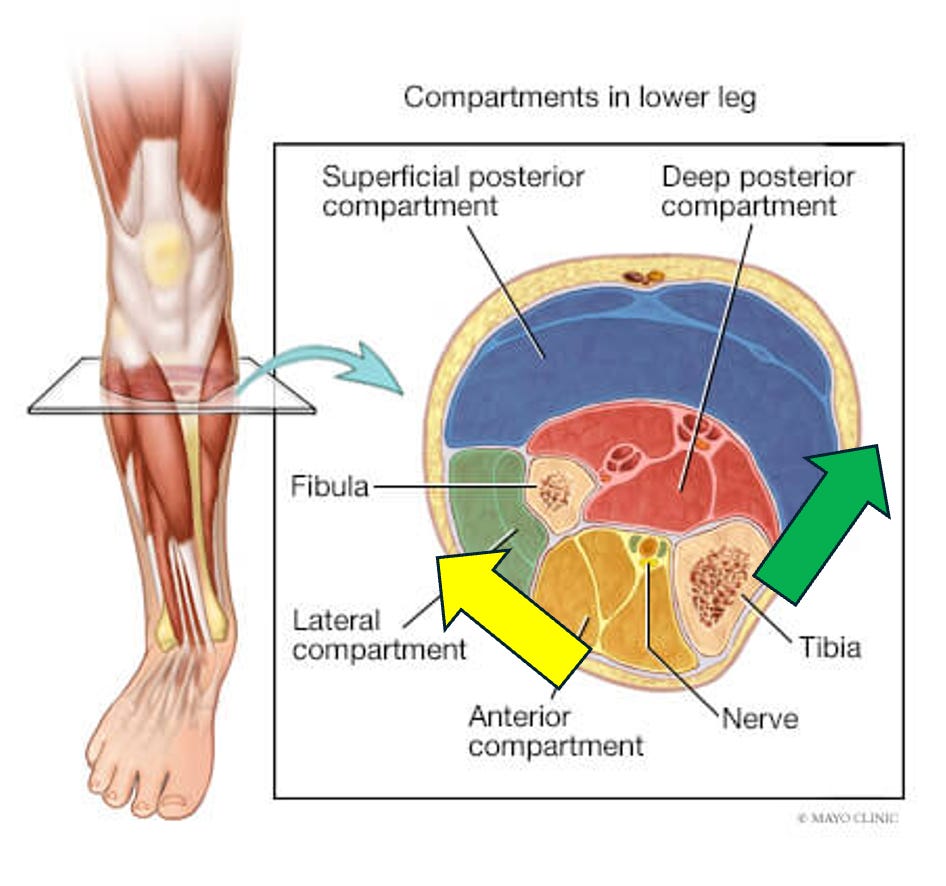
I do most of this treatment with the patient in sidelying, the treated leg on top, supported by a bolster and pillows.
This soft-tissue work can be painful and intense at times (though less than aggressive calf or medial shin work), yet it is well tolerated and provides quick results.
So that’s what I did. And the results have been outstanding — with greater magnitude and more sustained improvements in:
Sustained tibial neutral (internal rotation / decreased external rotation)
Improved fibular position and alignment (affecting knee mobility, alignment, and the foot)
Significant improvement in range of motion and knee-pain relief!
But I had yet to try it on a significant knee-valgus and foot-external-rotation case… until this past week.
Victory Friday. Athlete Optimizing: Fixing Knee-In, Foot-Out. Here’s a fun case study of using 3D lower leg mobilization — including this new fibula strategy — to help a young athlete look, feel and perform better.
A 14-year-old male soccer player and his family came to see me this summer with the primary issue of “looking and feeling uncoordinated” while running.
He noted that over the last year or so he has felt less fast and agile on the soccer field. His parents observed that he looks less coordinated and a little awkward compared to a year ago, and compared to his teammates. They also note he grew significantly (2–3 inches) in the last year.
Two key features emerged in his exam:
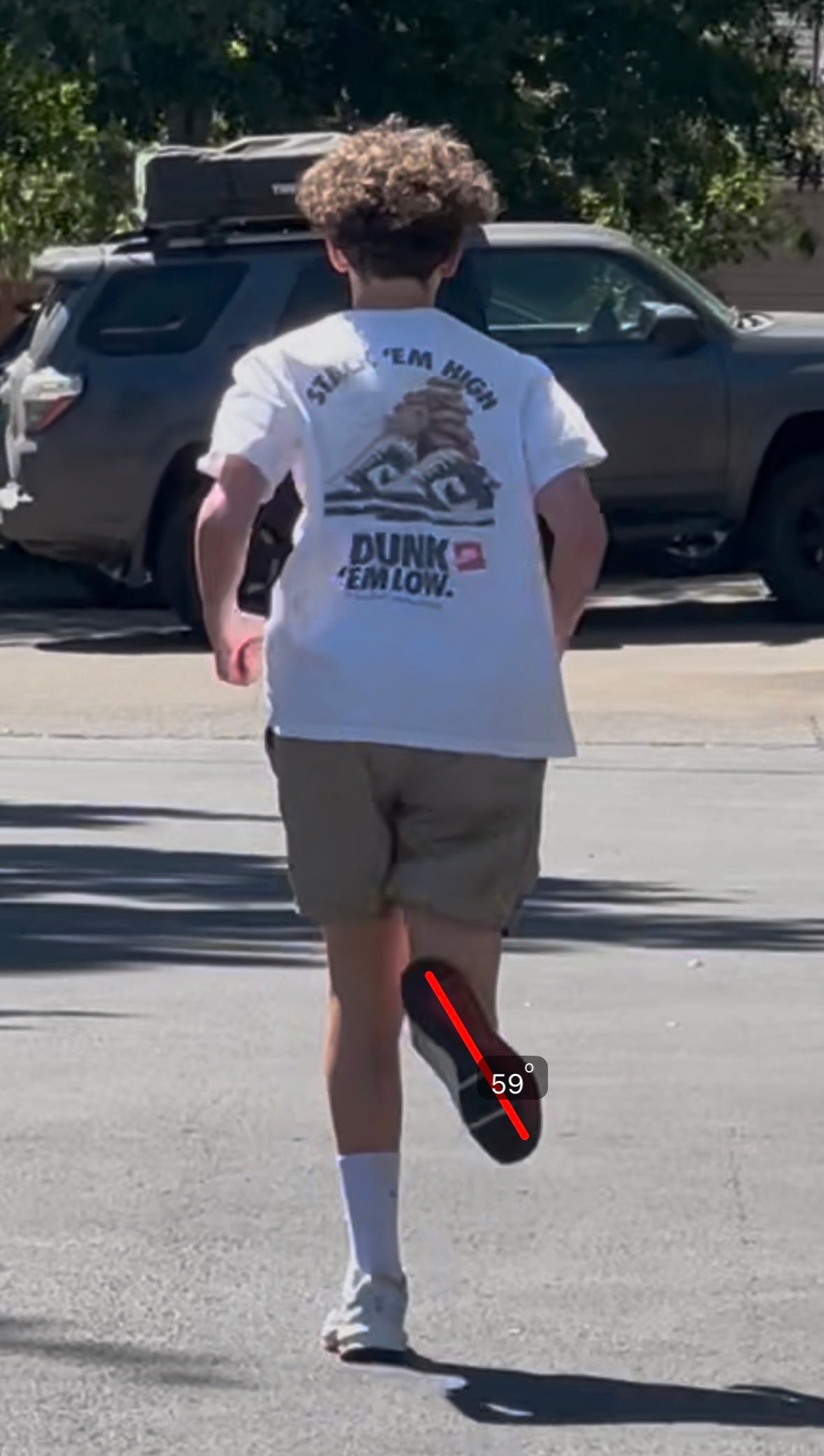
Significant externally rotated feet (right far more than left) during running push-off.
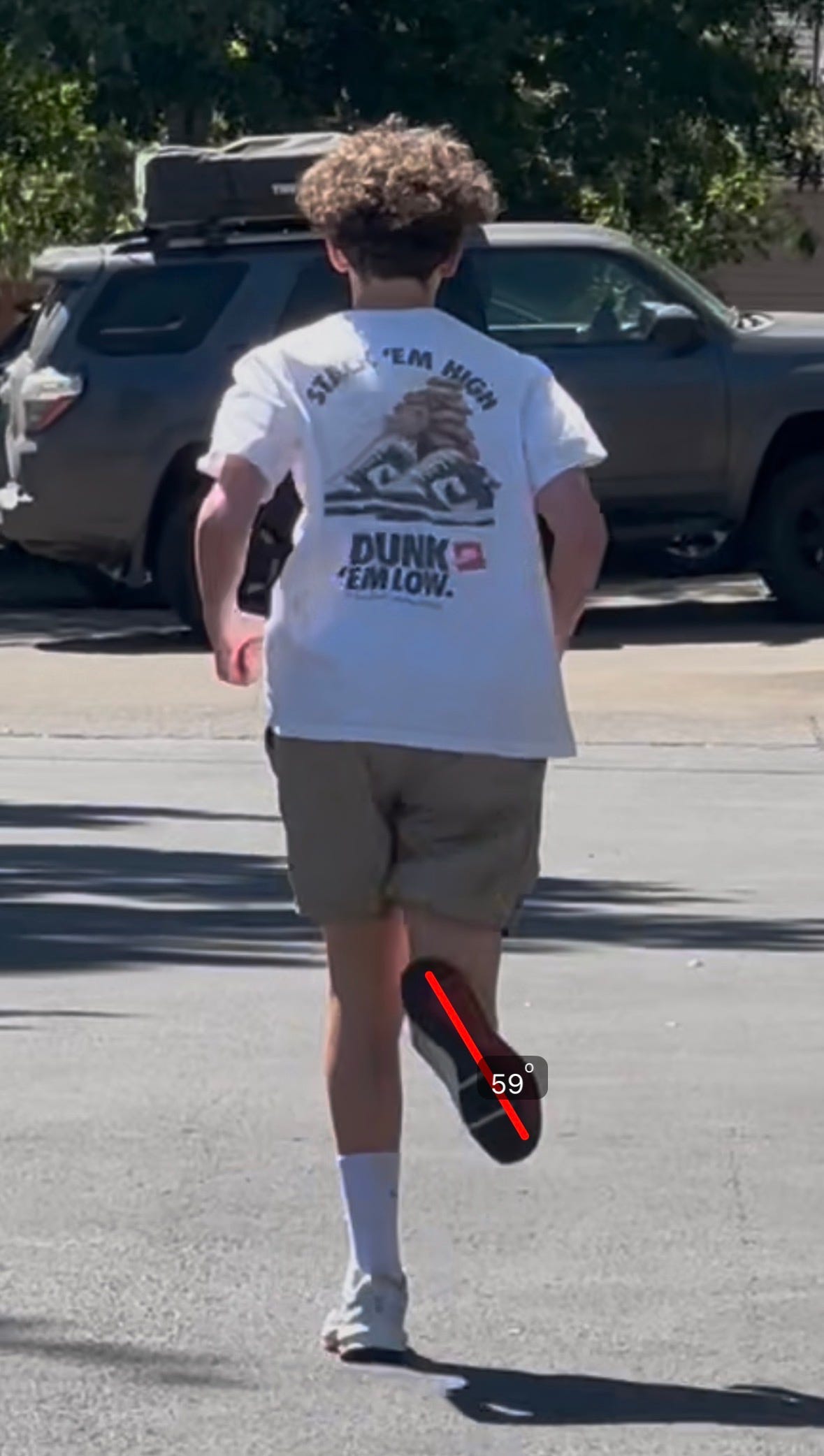
Significant knee valgus with single-leg exercises, including step-ups, step-downs, and jumping and landing.

(Bonus: He also demonstrated thoracic spine and shoulder blade/arm-swing deficits and asymmetry—two significant contributors to lower-leg dysfunction.)
Cases like these are very interesting because there isn’t necessarily any pain — yet.
Thus our treatment strategy is often more challenging: to assess and optimize the system for efficiency; addressing any and all relevant inefficient elements.
To begin his athletic system optimization, we actually started at the top: the rib cage and the shoulder blade: a key contributor to lower leg function.
It involved:
3D mobilization of the ribcage — of not just the ribs, but intention to the lungs and diaphragm — reinforced with foam-roll techniques at home2
Scapular mobility and dynamic, run-specific strengthening, in both pull and push motions:
“Old (younger, less experienced) Me” would have ignored the upper body and hyper-focused on the obvious visual elements below. But “New Me”, through trial-and-error, knows better and recognized the importance of the ribcage and scapular function for maximum athletic efficiency.
We got that going and had him working on that, before moving to the legs.
In the lower body, we worked on:
3D pelvis mobilization: facilitated with trunk and scapular work, reinforced with hands-on strategies and hip mobility exercises.
Hip rotational efficiency mobilization, emphasizing “on-axis” motion of external rotation in particular3
The key and most important work involved the foot and lower leg:
Efficiency work to make his foot a more athletic, mobile, and neutrally balanced weight-bearing structure: including Joe’s 8-Point Foot and Ankle Mobility Plan4
Ankle dorsiflexion mobilization with both hands-on techniques and at-home mobilization using a belt
And then the key was hands-on:
Hands-on work to de-rotate both tibias. I have done this for a long time using hands-on strategies in sidelying and in weight-bearing to internally rotate the tibia.
The new strategy that was extremely effective was the paired fibular mobilization. Freeing the myofascial structures in the front and the outside of the shin suddenly made a significant improvement in tibial relative internal rotation / neutral alignment.
Again, like I mentioned above, I suspect this freeing of the anterior fascial structures allowed the tibia to be able to rotate internally (de-rotate) and maintain that neutral position. In other words, we have to free that anterior/lateral fascial tension that may be holding the tibia in external rotation!
Lastly, a lot of neuromuscular training:
Hip & core strength (including rotational efficiency work like Joe’s Hip Six Pack)5
Major focus on first-ray engagement: loading the ball of the foot and big toe (the subject of recent Victories6)
Finally, putting it together into elements of motor control:
Single leg strength: step-up and step-down work, emphasizing neutral pelvis and relative knee-out alignment (valgus prevention)
Hopping drills, particularly single-leg, emphasizing pelvic alignment and knee alignment
Then we were ready to start running.
Foot and Knee Corrective Coaching. The most visually obvious issue with this athlete wasn’t necessarily the valgus—it was the externally rotated foot (“foot out”).
It is all too easy to try to make a correction simply by telling the athlete, “Foot in!”
However, this not only fails to work, but it can actually be dangerous. When an athlete simply tries to rotate the foot inward, the movement primarily comes from the hip7. This only increases hip internal rotation, which may increase or worsen potential knee valgus, knee pain, hip pain, and all sorts of other problems.
And while we did significant systems-based work (to de-rotate and free the pelvis, hip, femur, knee, lower leg, and foot), simply cueing “foot in” while running still isn’t the best strategy to promote neutral alignment.
(I consider, in some ways, “foot in” as a sort of restrictor strategy. This tends to restrict energy rather than use it in a more efficient way.)
Thus, when we went outside to run, my only cue was:
“Push off the ball of the foot and big toe powerfully!”
The idea here is — after all the work we’ve done to restore neutral alignment, mobility, and motor control of this newly efficient system — a ground-up strategy of foot loading should, in theory, result in a strong push-off through a straight shin, producing a straighter, more powerful, athletic, and more visually efficient-looking stride.
And boy, did it look great! The receipts:
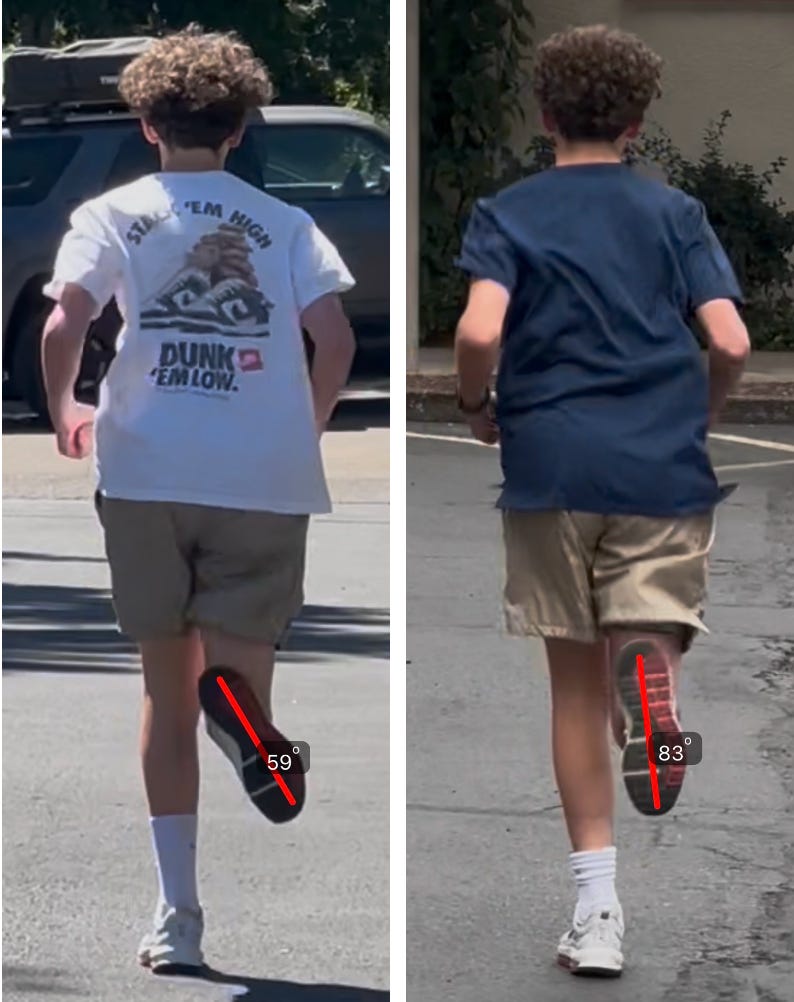
A short before-after running video is here.
Again: there was no focus on any angular changes of the foot (or any other part of the leg)! Simply a strong loading and pushing off the first ray.
Takeaways
Foot (or other focal visual/stability/alignment) issues require a whole-body (Systems & Dimensions8) approach. Half-measures only result in transient improvement—or worse, they can create different or worse pain.
This current approach to knee valgus correction represents my career progression: treating the whole body, including the importance of the upper body, (namely the ribcage and scapular connection to the pelvis) and the ability to make real changes in de-rotating certain joints and bones (femur and tibia).
Fibular fascial release frees the foot and tibia! And finally, this latest breakthrough: the powerful impact of fascial release of the front and outer shin to allow the tibia bone to de-rotate back to neutral.
So if you are like me:
A physio or sports-medicine professional who treats a lot of foot, ankle, knee, and hip pain stemming from knee-in / foot-out alignment issues
or:A runner who, yourself, has significant and problematic knee valgus and externally rotated feet.
…don’t lose hope! But know that sustained relief needs more than half-measures: it likely demands a whole-body approach to optimize the whole system.
Don’t let that overwhelm you. A little attention to each area goes a long way—you don’t need to be perfect.
To improve yours or your clients’ knee/foot alignment, start with the basics:
• fascial mobilization of the fibula
• tibial de-rotation strategies (like above), and
• a steadfast commitment to strengthening the system for neutral alignment.
And here’s the great news: a holistic systems approach will not only improve the visual alignment and decrease pain, but also turbo-charge performance. You and your clients will feel faster, stronger, and more athletic — just like my guy has.
Have fun and good luck!
Issue 149 is complete!
Help people move, function and feel better: please share this publication!
Thanks for reading, and have a great weekend,

Issue 83: Drop It Like It’s Hot: Elevating Depressed Fibulas. A high-level athlete with chronic lateral leg pain after a severe ankle sprain presented with a depressed fibula and restricted multi-planar fibular motion. Treatment combined extensive 3D myofascial release (peroneals, anterior compartment, lateral gastroc, syndesmosis), multi-directional fibular glides (bias toward superior), ankle/talar mobilization, superior-posterior compressive taping, all-day compression sleeves, and belt ankle mobilization. The result: the player returned to full competition within 24 hours and contributed to a 5-0 team record over the next six days.
Advanced Ribcage Strategies: sustained breathing mobilization of the lateral and posterior diaphragm and ribs, emphasizing rotation.
Advanced Ribcage Strategies, Part 2: working the anterior ribcage (sternum and diaphragm) using lower trunk rotation.
Issue 122: Hip Rotational Efficiency, Part 1. A primer on the concept of “on-axis” rotation required for efficient hip motion. Loss of this efficiency is often why hips stay stiff despite stretching and strength work. This publication outlines the specific anterior and posterior on-axis self-mobilizations that restore smooth ball-and-socket motion.
Issue 118: 3D Hip Efficiency Performance Win! A case study of a runner-mountaineer client with mild but stubborn hip stiffness demonstrated “off-axis” femoral patterns (right sitting too anterior, left too posterior) on a simple standing lateral-shift test. Targeted foam-roll soft-tissue and rotational work plus hands-on anterior-to-posterior and posterior-to-anterior mobilizations immediately improved alignment, end-range mobility, and perceived freedom—translating the same day into a 15–25 second-per-mile performance gain in a repeat mile workout.
Issue 144: 8-Point Foot and Ankle Mobility Plan. A complete, practical 8-point foot and ankle self-mobilization routine to restore mobility, suppleness, and efficiency in the feet, ankles, and lower legs (toe spreaders/sock pull, plantar rolling, midfoot stomp, belt ankle stretch, kneeling plantarflexion, shin smash, foot-on-wall calf stretch, and standing anterior/lateral shin stretch)
Issue 105: Joe’s (Hip) Six Pack. Six hip core stabilization exercises, each focusing on one of six cardinal movements of the hip (flexion, extension, abduction, adduction, internal rotation, external rotation) — and the fast-acting changes this routine can make to mobility, strength and function.
Issue 145: Hip’s Connected to the Ankle’s Connected to the Foot: Climbing the Pyramid of Gait Efficiency. The importance of “first ray” — medial arch, ball of the foot, and big toe — for efficient weightbearing and push-off. Loading and pushing off this medial chain functionally mobilizes the often-restricted medial ankle joint. Key strategies include comprehensive foot/ankle mobilization, weight-bearing exercises that emphasize first-ray loading, and the simple running cue “get on, then push off, the ball of the foot and big toe.”
especially if no comprehensive joint or tissue mobilization is done, beforehand. (And a “hands-off” approach to these athletes is increasingly commonplace in sports medicine rehab.)
Issue 41: Systems & Dimensions. Full and sustained pain relief and recovery of function often requires a comprehensive treatment approach of multiple Systems (body areas: spine, pelvis, abdomen, pelvis, hip, knee, etc) and Dimensions (types of tissue: muscle, tendon, bone/joint, fascia, nerves, blood vessels, etc).