

“It is a small tragedy when the student does not surpass the teacher, and a great blessing when they do, for what am I if not the shoulders for your feet, a pillar to bring you closer to heaven?” ~ Illimitable Man (@SovereignIM)
Victory Friday is a weekly digest of reflections, insights, and tools from the world of functional manual and performance medicine. It is a free weekly publication. To support Victory Friday with a paid subscription, click below:
It’s Friday again, welcome back! This week’s knotty theme: the thing that feels like a muscle often isn’t — shoulder “knots” from ribs and nerves; beginner runner tips for the newbies and crafty veterans, alike; and an almost-50K knee that flipped sides into neuro-disguised IT-band pain. Tips and lessons for everyone, dig in!
What I’m Into & Cool Exercises I Like: The Shoulder Knot Solution. Is there any soreness more ubiquitous than those pesky upper back “shoulder knots”?
There are a couple reasons why that area — at the base of the neck, the upper ribcage and the top of the shoulder blade — is so commonly stiff and sore.
• Forward head and neck posture, which can strain the myofascial tissue connecting that area.
• Upper back and shoulder overuse. Chronic shoulder hiking — with shoulder utilization, or as a habit of posture — can cause chronic over-activation of upper back and shoulder blade muscle.
Two less commonly understood mechanisms for this “shoulder” (upper back and base of the neck) soreness:
First rib stiffness. An elevated first rib — and the muscles connected to it — is stiff and painful:
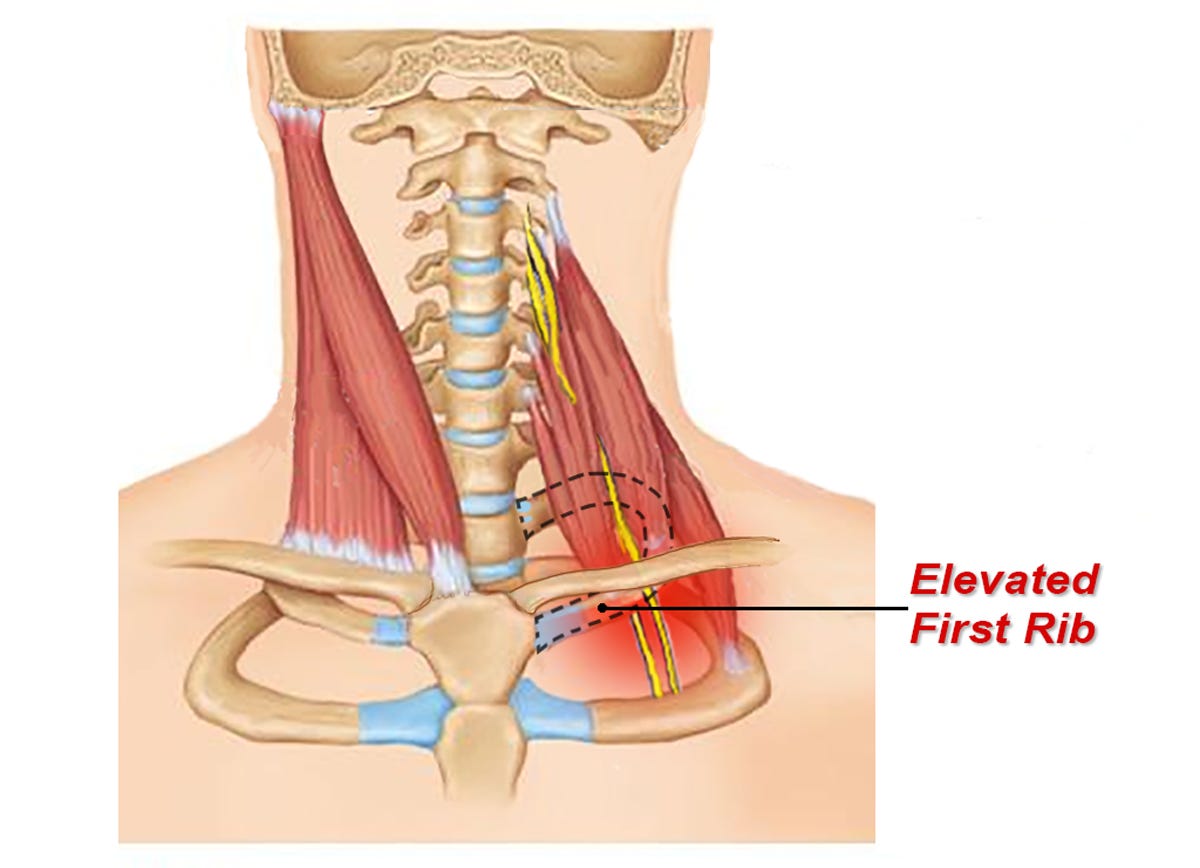
The first rib — the top ring of the ribcage — is supposed to move up and down, in conjunction with breathing. It often can get stuck in an upward (elevated, at right) position. Source: ErikDalton.com But even lesser known than the first rib:
Dorsal scapular nerve tension. This nerve, which powers two key upper back and shoulder blade muscles, can get pathologically tight.
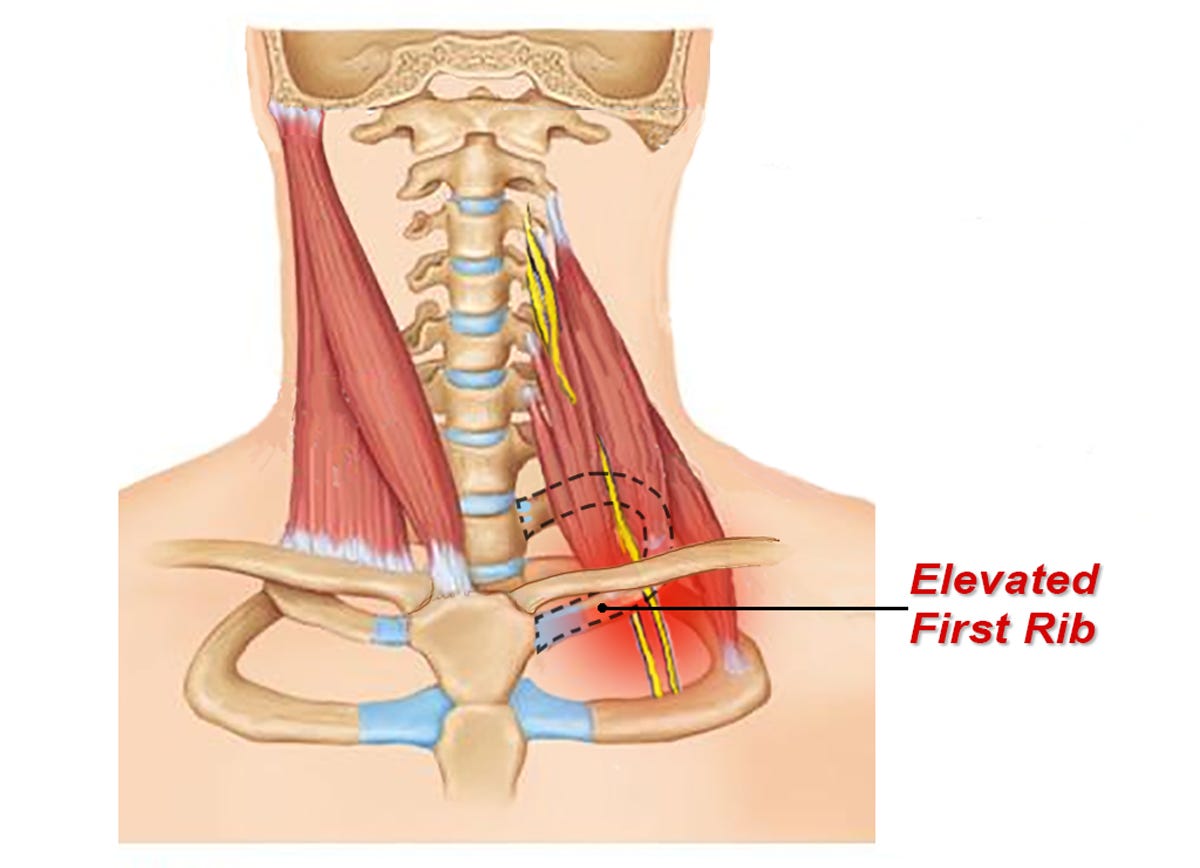
For a clearer (if not more entertaining and anthropomorphic) explanation of how the DSN creates stiffness and pain with tension:
Video courtesy of Artuvate.co
First rib tension tends to go hand-in-hand with a tight dorsal scapular nerve:
• the nerve gets tight
• to protect from further strain, the DSN tensions — shortens and elevates — everything: muscles, fascia and bones
• this also elevates — and stubbornly holds — the first rib
It’s Knot Easy: Relieving Upper Shoulder Tension. So how do we relieve tension on the DSN and free the first rib?
It’s tougher than it looks. Most cervical massage devices fail to deliver on their promises — and often create more pain than they alleviate1.
While I don’t yet have a cut-and-dry exercise strategy to mobilize a tight dorsal scapular nerve, here is a sequence worth trying
A. Mid- & Lower Neck Self-Massage. Using your hands, gently self-massage the mid to lower cervical spine:
• the back of the neck (the paraspinals)
• the sides (the scalenes)
If you find pinpoint, circular stiff-and-sore areas, those might be the intervertebral joints. Gentle-but-persistent massage work here can do wonders to relieve pressure around the nerves exiting each vertebral level.
B. Dorsal Scapula Nerve “Upward Stretch”. This small nerve is very difficult to feel, even for expert hands.
But when in doubt:
• follow the anatomy: the back-side of the neck
• gently massage upward: massage-stretching the sensitive electrical cables of the nervous system is the safest and best way to free a tight nerve.
Start with your hand at the base of your neck, at the top-inner corner of the shoulder blade, then massage-stretch upward, toward the back of the head.
Note: this is the opposite of most conventional massage strategies, which massage and stretch, top-down!
If the video above is accurate — and the tension point of the DSN is somewhere up in the neck — an aggressive, downward massage strategy might “feel productive” (likely hurting a lot!) — it’s likely to only aggravate the nerve further, and not lead to any lasting relief.
Massage/stretch gently upward!
Finally, let’s do something about that stuck-up first rib.
C. Belt First Rib Depression Mobilization. This has been my favorite go-to self-mob for the first rib, using a belt.
From Dr Jo:
Caution: be gentle with the side to side neck motions!
Give this trio a try and see if you can get sustained improvement in those pesky shoulder knots!
Joe’s Articles. Six Beginner Runner Tips…for Everyone! We’re deep into the high school cross country season, and my team features nearly two dozen new kids, brand new to running.
Successfully steeling new runners to the demands of running fast and far — while maintaining good health and good spirits — is no small task!
But working from my first-principles understanding of high-integrity running, I developed and implemented this strategy, which I shared with the readers of iRunFar.com:
Six Running Tips for Beginners…and Everyone Else!
TL;DR:
1. Run-Walk Is Better Than a Slow Jog. Slow continuous jogging is often mechanically sloppy and hard on tissues. Short run intervals with good form, plus brief walks, build both fitness and an efficient stride more sustainably.
2. Fire Up the Core. Strength isn’t enough—the core and hips have to actually fire while you run. Brief pre-run activation teaches the nervous system to stabilize so the stride stays stacked and powerful.
3. Cross Train Early and Often. Low-impact aerobic work (bike, pool, elliptical, incline hike) lets beginners add fitness without extra pounding or form breakdown, so the legs are better prepared when they do run.
4. Increase Your Cadence. Low step rate means more time on the ground and more energy absorbed by the legs. Quicker feet (aim toward ~180, or any upward move from a low starting point) reduces load and improves propulsion.
5. Light Hopping Is the Cheat Code to Efficient Running. Quick, light hops (double- or single-leg, a few per second) train the bounce and timing you want in the stride without needing high volume or intensity.
6. Look Fast and Feel Fast at All Speeds. Even on easy days, position and move as if you’re running well: posture, hip hinge, vertical hip action, quick arms and feet. Visualize and feel the efficient pattern so it becomes the default.
The results so far? So good! Few injuries, faster running and a lot of fun!
(Check back in six weeks for the end-of-season results)
Victory Friday. ITB or LFCN? Nerve Treatment Tames Ilio-Tibial (Regional) Pain. I had a “better-late-than-never” Victory recently with a favorite client.
One of my more rewarding Victories earlier this year, he’s the youthful 60 year-old male client with ultra-chronic knee pain, who ran pain-free…for the first time in 40 years!2
Left knee pain in the rearview, he was training superbly, well on his way toward starting and finishing his first 50K trail race, when he began to experience lateral knee and thigh pain…on the opposite (right) leg.
😳
The perplexity: our comprehensive knee treatment approach wasn’t exclusive to the left side. We performed efficiency work — including dynamic strength and gait training — addressing both knees!
So why was the right side suddenly problematic?
At first, I thought he may have been stressing his right leg, due to chronic weakness on the left (The Reciprocality Rule3).
However, shoring up all-things left leg — including the left ankle, knee and hip — was helpful, but multiple comprehensive orthopedic treatments failed to resolve the pain4.
He continued to experience tightness and soreness at:
• the distal, lateral quad, above (but not at or below) the knee
and also:
• the anterior and lateral hip, around the area of the greater trochanter
However, interestingly, while tissue was somewhat stiff in those areas, his “sore and tight” symptoms were difficult to palpate: we were unable to replicate it with either palpation or soft tissue treatment5.
We did the best we could, but when he toed the line at his first trail ultra in July, he made it less than halfway before having to drop out.
After a full month off running he was continuing to have symptoms: with stairs, and with even light attempts at running (short intervals, low volume).
I re-assessed his system, still failing to detect any relevant pathology: no exquisite IT band or lateral knee tenderness, no extreme tightness, and minimal inefficiency at the knee joint.
We’d covered all the bases. Heck, I’m so confident in my ability to treat IT band pain, I wrote “the article” on it. Despite addressing all those areas, the pain frustratingly persisted.
He, a fellow medical professional, thought it was time to get some imaging. I agreed.
Orthopedic MD exam and imaging revealed no relevant findings6.
The doctor theorized it could be glute tendinopathy, but found no inflammatory signs. She recommended “activity as tolerated”.
Based on those outcomes and advice, he tried both light hiking and a couple easy run-walk outings.
While mild, both activities were symptomatic: to both the distal-lateral thigh and lateral hip.
We were back at the drawing board.
Any readers from last week (and readers of the footnotes) might be seeing a similar pattern7:
• resistant to treatment (including prolonged rest)
• unable to palpate the painful areas
• no imaging findings
The one thing I hadn’t thought to check? Nerve tension.
🤦🏻♂️
Neurogenic IT Band Pain. In his case, having persistent pain without any other findings — nor any classic neurogenic pain signs:
• tingling, numbness or burning
• pain at rest
the only true “rule-in” test is femoral nerve tension.
I tested: in sidelying with specificity for both femoral and lateral femoral cutaneous nerve (similar to this client Victory8).
His were very tight, both sides, but the right in particular.
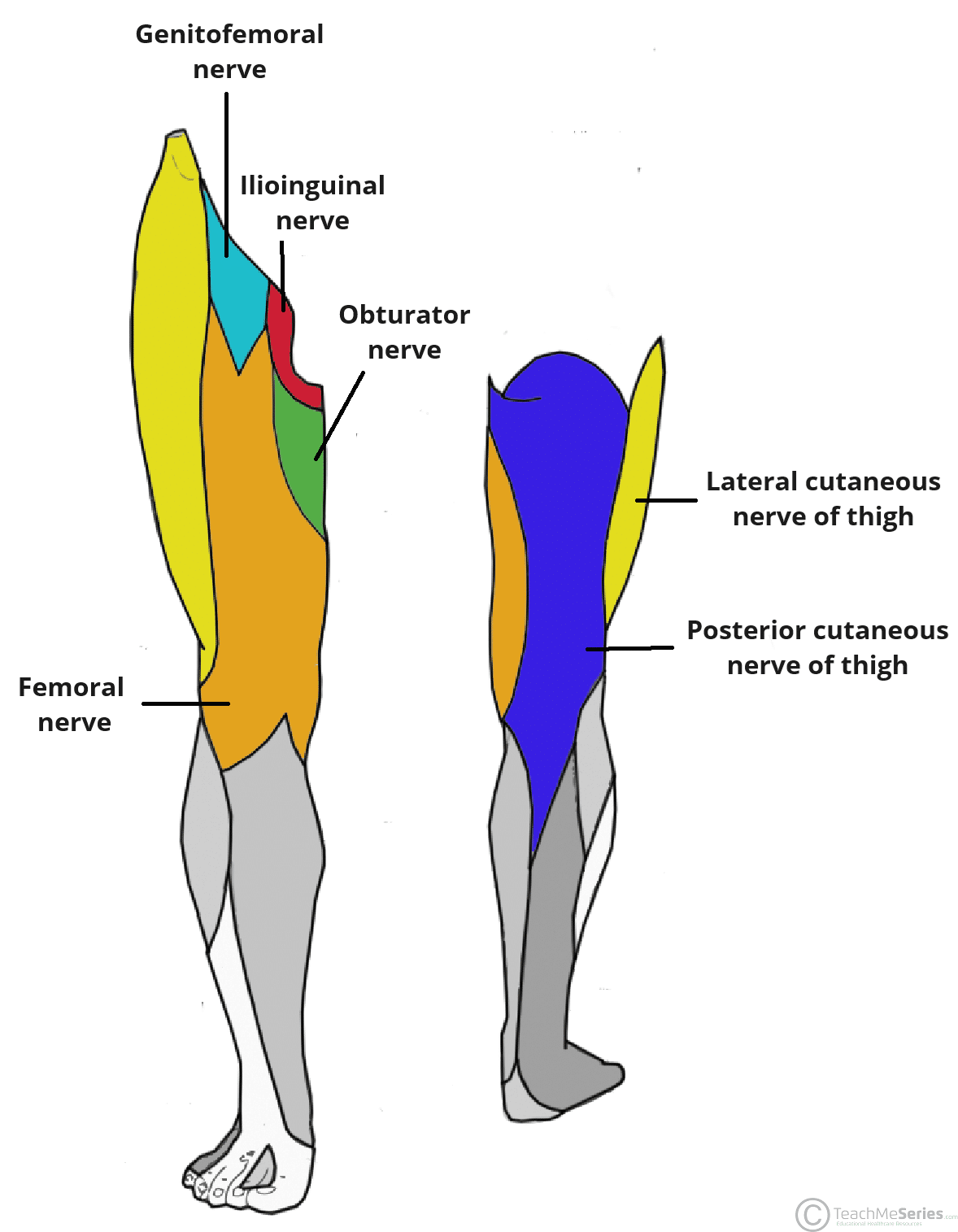
Thus began the experiment:
If I restore mobility to the nerves of his anterior thigh,
can he run, pain-free?
The Treatment Plan. I performed the following treatment in one visit:
• lumbar spine 3D mobilization (including superficial and myofascial mobilization and joint mobilization)
• visceral mobilization: freeing the lower extremity nerve roots and proximal peripheral nerves from “sticky guts”: the small and large intestine (and associated fascia), as well as the pathway through the inguinal canal.
His belly was very tight, particularly in the right lower quadrant.
• anterior thigh and pelvis: layered mobilization to the anterior pelvis and thigh.
Lastly:
• self-mobilization of the femoral and lateral femoral cutaneous nerves, similar to this technique:
Outcomes. To test efficacy, I had him run within 24 hours of the treatment.
The result. Success! While he had some light tightness afterward, the run — of similar length to previous — was pain-free.
He is now gradually increasing running, while we maintain a steady application of lumbar, belly, and anterior thigh nerve mobility!
Takeaways. Consider anterior thigh nerve tension! In cases of chronic hip, thigh and “IT band” pain conditions, don’t forget about neurogenic causes, even if the symptoms don’t “feel nervy”.
This is especially true if every other treatment base is covered: orthopedic mobility, strength/stability and efficiency!
Tease out and treat those tight nerves! At minimum, you’ll improve hip and thigh mobility, but it could be the key that unlocks their pesky pain!
Issue 154 is complete!
Help people move, function and feel better: please share this publication!
Thanks for reading, and have a great weekend,

I have no experience with and cannot vouch for the FisioRest, but I’m hopeful for future devices to safely improve multi-dimensional neck mobility.
Issue 122: Chicken or Egg? Eat ‘Em Both: Ending 40 Years of Running Knee Pain. A 60-year-old runner with 40 years of post-run knee pain, no radiographic findings, and no lasting relief from prior PT—including run-specialist care. Gait analysis showed two drivers: knee instability and a very low cadence (<150 steps/min). Efficiency work to cut rotational strain at the knee through the hip, pelvis, foot, and ankle, plus aggressive stability work and a cadence focus, returned him to pain-free running and put a first 50K back in reach.
Issue 101: (All the Things I Know, Part II) The Reciprocality Rule: Inefficiencies in One Leg Will Result in Equal & Opposite Stresses in the Other Leg. Namely: a push-off deficit on one leg will often create landing strain on the opposite leg. A stance-leg deficit in extension mobility, hip/core stability, or hip-extensor strength lets the pelvis fall back on the swing side, so the forward leg over-reaches and absorbs extra strain. Assess and optimize the contralateral leg to address chronic strain on the painful side.
Sign #1: Your Pain Fails to Respond to Conventional Treatment.
Sign #4: It is Difficult (or not Possible) to ‘Feel’ Your Pain.
Sign #6: Diagnostic Imaging Fails to Find Any Pathology.
Issue 153: Go Big or Go…Try Something Else: Neurogenic Wins in Stubborn Ortho Pain. Three women with stubborn knee pain—chronic bilateral ache, runner’s knees, and post-TKR pain—shared rest pain, symptoms out of proportion to load, and no real change after thorough local orthopedic care, so we pivoted to a neurogenic source. Each had femoral nerve tension, mid-lumbar (L3–4) mobility loss, and a trauma history at the spine, pelvis, or abdomen. 3D lumbar soft-tissue work, spinal mobilization, and femoral nerve mobilization produced major, lasting gains in pain, mobility, and function within 24 hours.
Issue 131: Double(-Crush) Hip Crossed! A case study of how sitting posture created anterior hip nerve compression and pain. A runner with stubborn left anterior hip pain and neuralgia improved substantially with hip, pelvic, trunk, and nerve mobilization plus stride optimization—yet residual symptoms resolved only after she stopped prolonged narrow cross-legged sitting at work. That posture created a mild double-crush of the femoral and lateral femoral cutaneous nerves (compression/tension at the hip plus sustained lumbar sidebending), illustrating how everyday prolonged postures can perpetuate neurogenic pain.