

“You need to be more afraid of wasting your life than embarrassing yourself.” ~ Tim Denning
Victory Friday is a weekly digest of reflections, insights, and tools from the world of functional manual and performance medicine. It is a free weekly publication. To support Victory Friday with a paid subscription, click below:
Welcome Back! The hardest cases are often the easiest, once you stop insisting on the only trail the guidebooks know.
In this week’s Issue of Victory Friday: the overlooked systems that unlock stubborn pain, a foam-roll RDL worth stealing, and a personal update from the penguin-shuffle department. My ankles have been staging a decade-long rebellion, and a loop of tape just compressed me closer to the truth.
What I’m Into: Easy, Simple, but Hidden: Winning Paths to Conquer Chronic Pain. The majority of new clients to my physio practice are special. Most of them have chronic, stubborn pain that has thwarted every other treatment approach and practitioner before me:
• online strategies and remedies
• other physios, chiropractors, massage, and other hands-on body workers
• doctors, medications, and surgery
You might think that, given the stubborn, frustrating and longstanding issues these patients present with, they are high-difficulty, requiring a great time of time, visits, and cost to get better.
But mostly, it’s the opposite.
Many chronic and complex cases are relatively easy.
Paradoxically, these folks— even those suffering for 20 years or more — are often remarkably easy for two key reasons:
• I don’t reinvent the wheel. First, after listening to their stories, I avoid treatment strategies that have already been tried and tried and tried again. If it has been done before and failed to work, it is highly unlikely to work now. (Insanity is doing the same thing over and over and expecting a different outcome.)
Thus, my thought immediately goes to,
What hasn’t been considered? What hasn’t been tried?
If these clients have been doing everything right, everything they’ve been told, yet they still aren’t better, then something else (and often something big and consequential) has been missed.
That’s where I come in.
• I optimize The System. What makes these cases easier is there tends to be a few key areas that are completely overlooked the overwhelming majority of the time.
Simply addressing, ruling in or out, and optimizing these key areas tends to get profound improvement in the vast majority of cases.
Dysfunction Systems That Anchor Chronic Pain & Dysfunction. The following areas tend to most commonly cause and/or “lock-in” (sustain and reinforce) chronic and complex pain and dysfunction.
For avid Victory Friday readers, this list should come as zero surprise:
head and the neck (craniocervical1).
thoracic spine (and internal visceral structures: lungs, diaphragm, and thoracic fascia)
abdominal visceral structures (particularly post-pregnancy, post-surgical, a history of GI issues, or simply holding stress here)
the pelvis: alignment, symmetry, mobility: namely in the correction of torsions and rotations2.
foot and ankle: stiffness, weakness or inefficiency (including key areas like the fibula3)
Simply addressing these key areas, and making them efficient — especially in the presence of a history of injury, trauma, and dysfunction in those body areas — results in Victories so frequently that simply covering these bases — with even basic mobility, strength and efficiency work — can result in massive, life changing breakthroughs, even in the most stubborn cases.
Finding the Hidden Path: Successfully Summiting Mt. Dysfunction. It’s as if health, wellness, and function reside atop a mountain summit.
There are many paths to the summit from bottom to top, but occasionally, the clearest path — the one marked on the map, well-trodden, and successful for most — happens to be riddled with significant and impassable obstacles
• rugged boulders
• downed trees, or
• slick mud
Gaining traction to the top is a frustrating impossibility.
And the conventional mountain guides — orthopedic practitioners — know this is The Path, and know of no others.
They insist on this conventional path — which works for everyone else — yet they are befuddled and without options when the occasional patient comes sliding down the mountain back at them.
What I do is simply find the hidden — and often circuitous — alternative path. These paths are often obscured: hidden behind brush, around the corner, on the other side of the mountain, or perhaps “too far out of the way” to seem worthwhile.
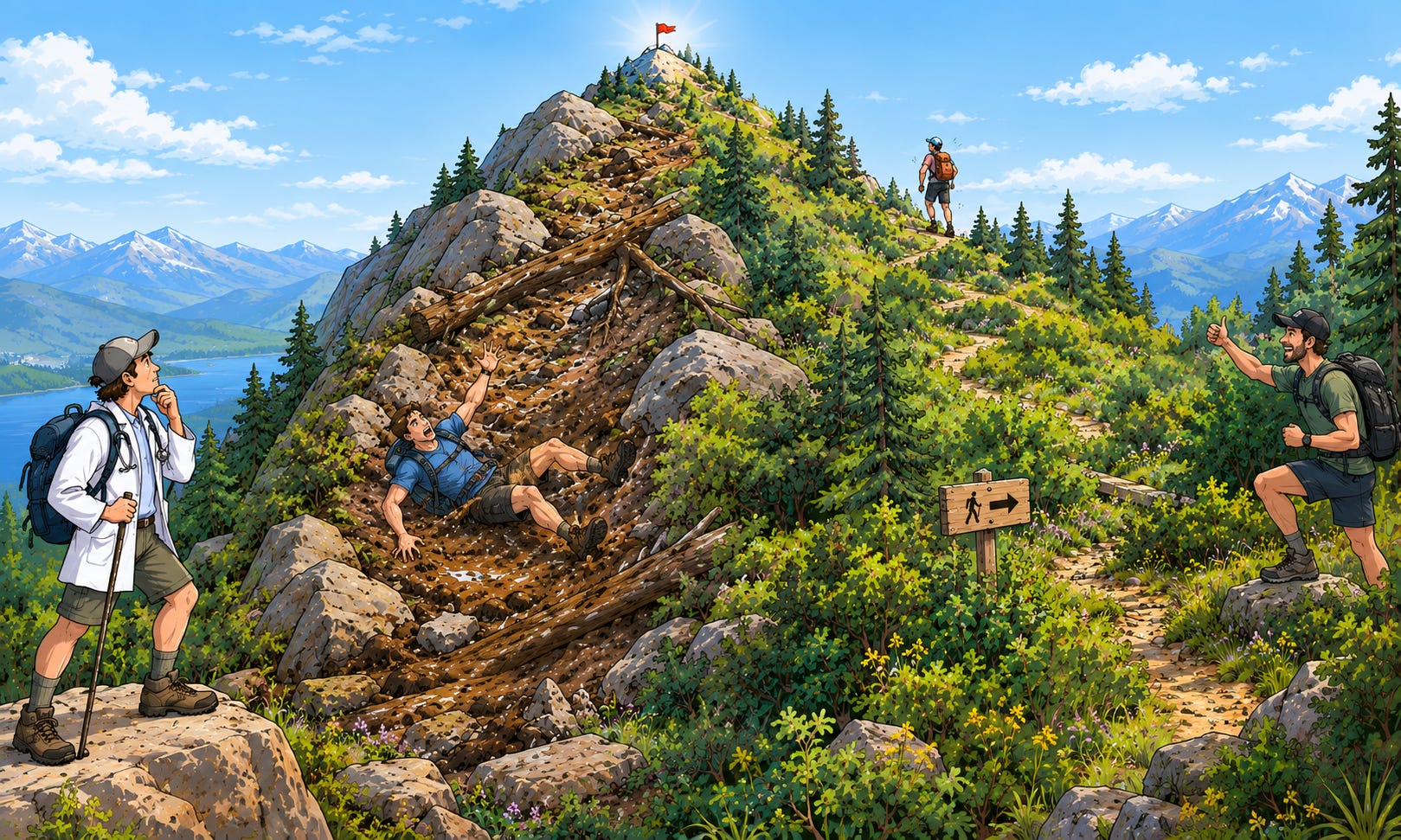
But once they find and commit to it, most find this path — though maybe longer and a bit more circuitous — remarkably easy:
• gentle switchbacks through the dry ground
• easy, built-in stairs, and
• a steady pathway to the summit
So the brilliance and science behind a lot of what I do is less about conjuring ever-more complex treatment strategies and techniques; rather, it is often employing the remarkably simple.
The difference is a bit of extra time — and extra attention — to find the alternative paths.
Indeed, I get extremely frustrated hearing stories and seeing other practitioners working so hard, and forcing patients to work even harder, on extreme paths that go nowhere.
For example, to do an hour of core exercise per day so that their lumbar vertebrae won’t “slip” a few millimeters: these joint instabilities causing debilitating pain and stiffness.
When in reality, their lumbar vertebrae are moving excessively, very simply due to compression or translation (from areas above or below the low back), or simply held in stressful directions from a sticky gut.
Long-time readers of this publication can attest to the simplicity of the vast majority of the strategies shared, and the big victories achieved herein.
Takeaways:
•The Winning Pathway is Often Simplest — But Most Comprehensive (& Pain-Adjacent). If you or your patient is struggling with a chronic, stubborn, highly sensitive orthopedic issue, the best path forward may be both the simplest and easiest. But it just takes looking around.
The best part of it all is, treating these body areas carries almost no downside. Optimizing those areas — head, neck, rib cage, belly, pelvis, foot, and ankle — at minimum will result in greater efficiency (mobility, strength, and motor control), even if they don’t result in specific breakthroughs.
• When in Doubt, Cover the (Easy) Bases. If you or your patient is struggling with chronic, complex, and highly sensitive pain and dysfunction, cover those system bases.
Make the whole body efficient and see where it gets you.
Cool Exercises I Like. Mobility-Generating RDLs. Looking for another way to open up the hip? Yes, it’s great for “internal rotation”, but exercises like these unlock The PILC4 — crucial for the most powerful and efficient hip utilization.
Here’s the latest novel variant, courtesy of Rob Schneider, DPT (@the.golf.doc):
(The original video is here5)
The two novel elements of this RDL variation:
The foam roll: it adds both challenge (preventing “cheating” into IR, as Rob mentions), but it also decreases the balance challenge, allowing for greater focus on full range of motion and muscle engagement.
The dumbbell in the opposite hand: it creates a long, heavy lever to enhance the load — increasing both the resistance and stretch intensity!
I like this one so much, I’ll be recording and releasing my own version soon, stay tuned.
Joe’s Articles. High Ankle Sprains in Trail Runners. I’ve shared versions of this article before, but this one hits even closer to home this week: the incidence and mechanism of high ankle sprain dysfunction in runners, particularly mountain and trail runners.
From iRunFar.com,
It’s Not About The Tibialis Anterior: High Ankle Sprains In Mountain Ultrarunners
TL;DR:
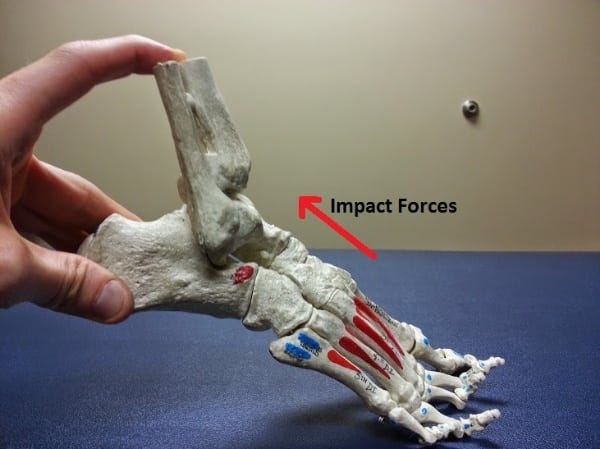
Ankle pain in mountain ultrarunners (often ascribed to “the tibialis anterior” muscle) is frequently a cumulative high-ankle (syndesmotic) sprain. Downhill running with the ankle in plantarflexion, where the talus is least locked in, and repetitive pronation6 drives it up between the tibia and fibula like a wood splitter.
The overlooked structure is the tibiofibular syndesmosis, stressed on every step and slow to heal once sprained.
Uphill needs maximal dorsiflexion; downhill flips the joint into plantarflexion. Fatigue fails the muscular cushion, pronation misaligns the talus, and thousands of strikes open the syndesmosis — a cumulative version of the compression-plus-external-rotation injury seen in contact sports.
It mimics tibialis anterior pain but is a different problem. Tibialis issues: mild plantarflexion loss, no swelling, muscle-belly tenderness, negative tests, recovery in 1–20 days. High-ankle: marked dorsiflexion loss, swelling, tenderness in the distal tibia–fibula space, positive Squeeze and External Rotation tests (mainly if severe), and weeks to months if missed.
Muscles and tendons heal relatively fast; a dysfunctional joint does not unless the mechanics are restored. Preferred care is manual therapy. If that isn’t available: rest until steps are pain-free, tape for fibular glide and compression, belt-stretch for dorsiflexion, and support the foot with an orthotic or a more stable shoe.
Red flags for imaging: can’t take four steps without limping or pain, or palpable pain in the lower three inches of the medial or lateral ankle.
Prevention: a compact stride under the center of mass, downhill stability work (plyometrics, single-leg drills, the 100-Up), and enough dorsiflexion that the knee can pass the toes with the heel flat.
Victory Friday. High Ankle Instability Acknowledgement. I haven’t reported on myself in a while. After having a great running year two years ago, including a strong, successful 100-mile trail race finish7, it’s been a rough ride.
2025 was a roller coaster of illness, a sprained SI joint8, and - when that finally healed — the challenge of hip joint instability.
Though it was a great learning year, those lessons were painfully earned.
This year? A similar pattern, but the same lesson over and over again: severe ankle pain.
My ankles have been problematic for years, dating back to the height of my ultra running career. They have confounded not only myself, but some of my most talented, experienced, and brilliant colleagues and mentors.
At times, the issues have been orthopedic: stiff muscles and joints.
Other times, neurogenic: severe nerve pain with origins at both the low back and the neck.
Other times, I have linked my chronic ankle pain and stiffness to poor running form: inefficient posture, over-striding, and — interestingly — excessive forefoot landing.
In 2026 I have tried stubbornly to progress my running. In the spring, I got up to 50 miles a week, including some robust (relatively unimpressive) runs, only to flare up both ankles, requiring prolonged downtime.
They improved this summer, only to regress with increased mileage and speed, the ankles seemingly intolerant of even modest volume and speed progression.
And leave it to me to experience true “unicorn” pain: a type of pain I’ve never seen experienced by any other clients in my 17 years of practice.
When my ankles are bad, the pain and stiffness is so severe that every morning, I literally cannot walk and flex my ankles. I hobble around like a penguin, often for hours, until they painstakingly thaw.
But even then, they still hurt.
Moreover, they are profoundly painful to any attempts to stretch or strengthen them. This could be a simple wall/calf dorsiflexion stretch, or even my go-to belt ankle stretch, a powerful solution for the rest of my clients. But not me.
Walking hurts.
Stretching hurts.
Strengthening — plantarflexing in a heel raise — hurts.
And no amount of volume decreases pain. There is no breakthrough at which time pain improves. In fact, it is almost always worse off for it.
Of course, when it is this flared up, running is an impossibility.
It is often lightly swollen. And occasionally, when very flared, it can appear lightly inflamed and tender, as well.
What could be the cause?
Nerve Pain is Weird, So… Given the bizarre severity, and the presence of nerve tension around the lower leg and ankle, I have frequently jumped to the conclusion of neurogenic origins.
Surely, only severe nerve tension could cause this sort of pain and tissue change9, especially with only modest activity and weight-bearing.
Attempts to treat the nervous system have provided only modest relief. Sometimes it works. Sometimes it seems to make no difference.
Yet there is one other theory: joint instability. What may have set all of this off, many years ago, was hardcore ultramarathon training and racing: huge miles up and over mountains, on unforgiving terrain.
Trail Running Ankle Trauma: the Origins of the High Ankle Hypothesis. One noteworthy experience occurred during a 50-mile mountain race in 2012. Near the end of the race, I began to have left anterior lower-shin pain — just at/above the ankle — in the last few miles, which featured a lot of downhill running. The pain wasn’t severe, and I was able to finish strong. However, post-race, the lower leg was painful. And as the rest of the day went on — returning to the hotel, cleaning up, going out to dinner — the pain and stiffness got progressively worse, to the point where I could barely walk.
In the ensuing days, the pain and stiffness was hardly better. Uncertain what to do, I rested, iced, and did basic tissue mobility and stretching to the lower leg and foot.
But the biggest breakthrough came from wearing compression socks. High, foot-to-knee compressive socks resulted in almost immediate relief in pain, mobility, and weight-bearing tolerance. So much so that within 24 hours, I was able to run again.
I surmised I had suffered some sort of high ankle sprain. This occurs when the connective tissue between the tibia and fibula becomes overstretched, often at the distal lower leg, at or above the ankle.
This is typically an injury only experienced with high-impact and highly traumatic mechanisms. American football players are most common, as it often requires a hard impact, coupled with a high-force rotational movement, which creates the tib-fib separation.
I didn’t have the rotational moment — nor did any of the high ankle special tests ever test positive — yet the profound improvement with compression was highly suggestive of tib-fib mortise involvement.
The tib-fib compression resulted in immediate improvements in the following:
Dorsiflexion mobility.
Plantar flexion strength.
Pain relief.
Weight-bearing, impact, and running volume and tolerance.
Studying further, I discovered that ankle compressive taping to the distal tib-fib ankle mortise was just as effective — if not more so — than compressive stockings.
This article (shared above) — with taping technique — was the additional fruit of that discovery.
As for me, a few weeks of compressive stockings and taping was enough to “get me over the hump” and return to ultramarathon training, culminating in a strong finish at the Western States 100 that year.
Ongoing - But Evolving - Ankle Pain. Following that initial injury, I seemed to have repeat incidents of this sort of pain, though the symptoms evolved.
Rather than severe pain at the anterior ankle, the pain was more vague and around the ankle and inferiorly, including the Achilles area, posterior calcaneus, the lateral ankle, and the medial ankle.
Given that evolution — and all the various areas and tissues involved — it was increasingly confounding.
“Is this high ankle, again?”
At times the tape seemed to help; at other times, the tape failed to result in pain relief like it did the first incident.
Meanwhile, there were plenty of other dysfunctions, including myofascial tissue, strength, and stability deficits, and — most confoundingly — nerve tension and nerve pain.
As such, every repeat episode was:
• a little bit different
• a little more severe, and
• a little more stubborn to resolve
Although taping relieved symptoms nearly every time, I began to question through what mechanism did taping work? Was it,
• tib-fib compression?
• the taping affecting the position of the fibula?10
Or:
• did the tape somehow fascially-slacken nerve tension atthe distal ankle?
Same(ish) $#!t, Different Day. Fast-forward to today.
My ankles have flared yet again: the left worse than the right, making running weak and painful. Even walking — as well as getting up from prolonged non-weight-bearing — can be punishingly painful.
I ran through a Rolodex of treatment strategies:
• I worked on myofascial mobility around the foot, ankle, and lower leg
• I mobilized my fibula (hoping for a big Victory like those below)
I took my own advice and “made my nervous system happy”:
• I treated my whole spine (including cervical work, the cure-all for chiros11).
Yet none of them resulted in any significant or lasting improvement.
Tried-&-True Taping Triumph. Finally, after a frustratingly painful day trying to coach my cross-country kids, and experiencing debilitating ankle pain trying to jog from point to point on the course, I fell back on the instability hypothesis.
“What if this is high ankle instability?”
That evening, I got out the Kinesio tape and looped it tightly around each ankle.
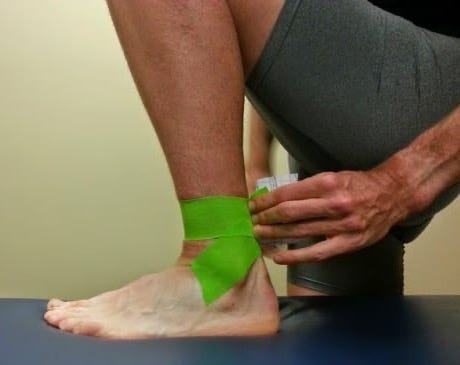
The result?
Significantly less (but not zero) pain.
And:
Substantial improvement in mobility and strength.
🤦
As I weighed the implications, I thought back to the last two years.
What have I learned — particularly about my own body?
I have learned:
My right SI joint has instability
My hips have instability
My shoulders, parts of my hips, my neck, and parts of my low back have — at minimum — relative hypermobility (especially for my age)
If it walks like a duck and quacks like a duck…
Instability Good News, Bad News. This realization is bittersweet. On one hand, it is sobering that I, at the tender age of 49, am now forced to deal with the consequences of “a life well lived” — high levels of activity and tissue loading — atop a physiology of tissue and joint hypermobility.
How do I improve and maintain stability?
I already wear an SI belt to work every single day, following the sprain from last summer. Annoying as that may be, it makes a profound difference in my day. I have zero low back pain or stiffness, and I am stronger and more athletic in everything I do.
What does this mean for my ankles?
• Do I need to wear ankle braces, compressive socks12, and/or tape every day?
• Do I have to compress the ankle and lower leg with all weight-bearing? Or just with running?
Time will tell. For now, I am markedly better in the last five days from around-the-clock compressive taping to both ankles.
Mobility is far better, I can do a heel raise without excruciating pain, and the pain is 80 to 90% better.
I’m still not running, but given the patterns of the last decade-plus, I feel like I will soon be able to return.
I do think gait efficiency is key, as well. Running with efficient posture, landing the whole foot (if not rearfoot) underneath my body, and running with active flexion and ankle action — athleticism — is going to be key, no doubt.
But as it has been for my hips and SI joint, I do think a degree of stability — if not intrinsic, then external and assisted with taping, bracing and other compression — is going to be in my future.
But if that’s what it takes to run and do all the fun stuff that I love to do, then I am ecstatic that I have found an answer and a strategy that will allow me to do that.
Takeaway. Instability is Weird, Too. One two-part central truth I shared a year ago, in issue 101, was:
Stubborn, Intractable Pain Likely Has Nerve Origins.
and,
For Extreme, Hyper-Sensitive and Unremitting Pain,
The Root Cause is Likely Head & Neck.
Perhaps there needs to be a corollary, or an additional truth:
Dysfunction from joint instability is really weird, too.
Including:
• bizarre and severe pain
• profound (if not paradoxical) range-of-motion loss
• intolerance to even normal activity, and
• extreme stubbornness to any other treatment (other than stability)
Even in the absence of hypermobility13, positive special testing, or imaging findings: clinical instability can be present.
Takeaway: When in Doubt, Try Stability. And if intrinsic (strength, stability exercise, and system efficiency work) doesn’t work, then try external stability: taping and bracing.
Even if this is a reach, the standard should still be high. Any stabilization strategy should result in immediate and significant changes in strength, mobility, efficiency, and function. If that happens with stabilization of any kind, you know it is highly relevant.
Stay tuned for more of this story: fingers crossed for a Victorious outcome. 🤞🏻
That’s wrap on #155.
Help people move, function and feel better: please share this publication!
Thanks for reading, and have a great weekend,

Issue 26: Joe’s Cranio-Cervical Treatment Strategy. My multi-dimensional treatment strategy for the craniocervical, orthopedic and neuro-fascial system: treat the layers (scalp, bones and sutures, subcranial fascia and tissue), correct the cranial torsion, then restore efficiency to the cervical spine.
A pelvic torsion is when the pelvis is rotated to one side and the pelvis is in a paired-twist: the same-sided pelvis (if rotated left, the left side of the pelvis) is externally and anteriorly rotated; and the opposite-sided pelvis (if rotated left, then the right) is internally and posteriorly rotated.
For more information on this, check out this outstanding graphic explanation.
A pelvic can also simply be rotated: both “hips” pointed to one side, but without the three dimensional adaptations. Both are problematic, but pelvic torsions tend to be older and more involved than rotations: the entire lower quarter adapts to the facially-driven rotational pattern.
My writing on torsions:
• Issue 10 (introduction)
• Issue 101 (The Torsion Rule)
Fibula resources include:
Issue 83: Drop It Like It’s Hot: Elevating Depressed Fibulas. A quick return-to-sport “Victory” of a high-level athlete with chronic lower leg pain, due to a depressed and mal-aligned fibula, occurring after a previous severe ankle sprain.
Issue 92. Fibular Freedom for Shin Splints Relief. A young hiker who wanted to run kept getting severe medial shin pain despite stride, ankle, foot, hip, nerve, and strength work, so we went after a stiff, poorly aligned fibula and the fascia tying it to the tibia. Layered mobilization of the anterior and lateral compartments, then full three-dimensional fibular mobility, immediately eased his weight-bearing tension and made single-leg hopping less painful in the clinic. Running and hiking results are still pending.
Issue 121: More Fantastic Fibula Wins! Three clients with a stiff ankle, a valgus pre-replacement knee, and lateral hip-to-calf tightness all got the same treatment: 3-D fascial work around the fibula, then mobilization until the bone sat neutral with a springy end-feel. None of it was aimed directly at the painful joint. The stiff ankle regained dorsiflexion, the pre-op knee gained about 15 degrees of flexion from fibula work alone, and the third client walked a mile with hardly any soreness right after the session.
Issue 149: Fibula Smash Frees the Twisted Tibia! Clients with excessive tibial external rotation also had a stiff fibula, and we paired the usual tibial de-rotation with fascial release between the tibia and fibula. In sidelying, aggressive cross-friction and 3-D fibular mobilization freed the anterior and lateral tissue that seemed to be holding the tibia out. The result was a more sustained neutral tibia, better fibular alignment, and clearer gains in knee motion and pain relief.
Issue 149: Athlete Optimizing: Fixing Knee-In, Foot-Out. A 14-year-old soccer player who had grown several inches in a year came in looking and feeling uncoordinated, with a foot-out push-off and knee valgus on single-leg work, and we treated it as a whole-system efficiency problem rather than a local alignment cue. We mobilized the rib cage, scapula, pelvis, and hip, freed the anterior and lateral fibular fascia so the tibia could de-rotate, rebuilt first-ray loading and single-leg control, then ran him with one cue: push off the ball of the foot and big toe. His stride looked straighter and more athletic on video, with no “foot in” coaching.
Issue 2: The PILC. The posterior-inferior-lateral corner of the hip joint capsule is the area of the joint — the “back-bottom-outside corner” — that needs to be accessed, with the femoral head and proximal femur, in order to efficiently spine, as well as fully stretch-load the glute musculature for optimal athletic function.
Reminder: Substack no longer supports direct embedding of Instagram videos. I screen record videos then share direct post and profile links.
or supination!
Issue 49: Reflections from Running A Hundred Miles. Joe finished his first hundred-mile trail race, Run Rabbit Run, by treating the event as a chosen adventure rather than a problem to eliminate. The mantra was “This is a Big Adventure: All Day, All Night”: hard and sometimes painful was expected across a roughly 33-hour effort, but constant pain was a signal to change pace, fueling, or gear. That acceptance kept the difficulty from feeling like a system failure.
Issue 84: Signs of (Severe) Sacroiliac Joint Sprains, and Subtle Subclinical Sacroiliac Strains. The signs of classic (severe) SI joint instability and more subtle, subclinical but functionally significant SI joint dysfunction.
Issue 89: “Belt it Out!”: Functional Sacroiliac Joint Instability Diagnosis & Treatment Using a Belt. Signs and symptoms of sub-clinical sacroiliac joint instability — including mobility loss, weakness and motor control deficits — and how pelvic stabilization can improve these otherwise longstanding and stubborn deficits.
Issue 101: Nerve Pain, Part I: Stubborn, Intractable Pain Likely Has Nerve Origins. Patients with stubborn, intractable pain that persists despite mobility, strength, efficiency treatment often have a neurogenic origin. The six signs of neurogenic pain include:
• a dull ache, pins and needles, tingling, or numbness
• pain that is difficult or not possible to ‘feel’
• pain at rest
• failure to respond to conventional treatment
• pain that is extremely variable and disproportionate to activity level
• diagnostic imaging that fails to find any pathology.
Even when the picture looks “hard orthopedic”—tenderness, stiffness, redness, swelling—resolving the irritated nerve is what produces full, sustained resolution.
Issue 101: Nerve Pain, Part II: For Extreme, Hyper-Sensitive and Unremitting Pain, The Root Cause is Likely Head & Neck. For issues similar to above, but even more extreme — and unresponsive to more local and regional treatment, the origins are often craniocervical, requiring treatment to that region to “unlock” the key painful area.
See Footnote #3.
Issue 153: What Chiros Know (That Many of Us Don’t). “There is a reason chiropractic is a successful and thriving profession: neck, ribcage, and low back treatment gets a lot of things better, everywhere.” The benefits of — and efficacy behind — comprehensive cervical care for all patients and cases.
I cringe at the idea of daily compression sock use, and the implications on the fascial system of the foot, ankle, and lower leg, subject to constant hyper-compression. What may be good for a joint would likely be terrible for the rest of fascia. Bad trade.
Resources on convert instability include:
Issue 133: Unstable Old Guys: Signs of Instability in Older Populations. Orthopedic instability is common in older, still-active men, even when they do not appear hypermobile. It is typically isolated to one or a few joints—most often the spine, shoulder, or hip—rather than a high Beighton presentation, and it is frequently masked by chronic stiffness. Clues include age-inappropriate mobility in some planes, compensatory tightness in complementary motions, and range that returns readily with manual treatment but does not last. When stretching fails to hold, targeted stabilization exercise is often the more effective intervention.
Issue 95: You’re Stiff Because You’re Unstable. A neuromuscular stability deficit can cause real motion loss and increased “stiffness” (higher tone and resistance, and discomfort and soreness with movement). This occurs for at least two reasons: uncoordinated muscle activation causes over-activation (“tug of war”) and increased myosfacial tension; inefficient motion places tension or strain on the nervous system, which increases tone/tension to protect itself.
Good article Joe. Sorry to hear the ankles have been giving you so much grief. I assume you've tried dry needling for the soleus? I developed some chronic left TCJ achiness a year ago (the one I sprained and you helped treat circa 2011). I thought it was a high ankle sprain. The left soleus was super dysfunctional & twitching needling, and the right was normal - seemed to resolve it in my case. The hypermobile endurance athlete is quite the paradox, and something I've been seeing more and more lately. Realized early in my career this was a challenge for me also - at 40, I can still palm the floor with bent elbows - and everyone in my family has some hypermobile/POTS symptoms. Anyways, thanks for continuing to share your knowledge and wisdom. Stay strong!
Sending you healing thoughts, comfort, and relief.