
Victory Friday | Issue 117
Orthopedic Insights: (Still) Caring About the Pelvis • Lymphatics for Looksmaxxing & Longevity • The Runner’s Pelvis • Joint Replacement Roadblock Removal

“A rational person can find peace by cultivating indifference to things outside of their control.” ~ Naval Ravikant
Victory Friday is a weekly digest of reflections, insights, and tools from the world of functional manual and performance medicine. It is a free weekly publication. To support Victory Friday with a paid subscription, click below:
It’s another Friday! Still getting your footing in the new year? Sometimes it helps to review: Re-check your pelvic mobility — minor restrictions can cause stubborn stiffness, weakness, and imbalance all over the body; And when in doubt, check (again) for those leg length discrepancies in joint replacement patients!
What I’m Into: (Still) Caring About the Pelvis. This is your semi-annual reminder that we still gotta care about the pelvis:
• its alignment, mobility, stability
• to sustainably resolve any leg issue: foot, ankle, but especially the knee and hip
To reiterate, the pelvis:
• moves at its “joints”: the pubic symphysis, the sacroiliac joint and (the most obvious but overlooked) the trunk — front, sides and back
• moves as two separate units
• is the key for maximum-athletic movements: multi-directional movement, large movements (e.g. the splits)
and:
• it is the structural base of the entire leg
• its alignment and movement profoundly dictates the alignment, movement and weight/energy transfer through the entire leg
Lastly:
• restorative surgical procedures to the knee and hip, while crucial and wildly successful — will largely do nothing to change the alignment and motion of the pelvis
• the key to maximal recovery from such surgeries — connective tissue repairs, and even joint replacements — is to restore efficiency to the pelvis
Pelvic Efficiency Resources:
• Three Dimensional Pelvic Treatments. TL;DR:
• The thoracolumbar fascia (the focus of last week’s Victory6).
• The viscera: namely the large intestine (anterior and lateral pelvis; the lower lumbar and anterior sacrum) and small intestine (low lumbar and sacrum).
• The coccyx and pelvic floor. Employing Institute of Physical Art functional mobilizations for the coccyx bones, and basic (tennis ball) external pelvic floor self-massage.
• 3D pelvic motions. Namely freeing pelvic internal and external rotation, as well as abduction and adduction.
• The Runner’s Pelvis. A how-to assessment and self-mobilization of the pelvis for runners (iRunFar.com). See Articles, below!
Cool Exercises I Like. Lymphatics for Looksmaxxing & Longevity. Content is growing on the socials related to aesthetics (“looksmaxxing”). Among them — and more popular with women — is lymphatic drainage for the head, face and neck.
These techniques are legitimately helpful — if not superior to any surgical or injection procedures — for maintaining wrinkle-free, youthful and toned faces and eyes.
Functional Medicine Practitioner and fellow Substacker, Vitally Melanie shared this nifty step-wise “Lymphatic Draining Blueprint” for daily self-treatment. It’s pretty easy but potent:
The 15-minute lymphatic drainage routine for the face:
2 minutes rubbing, tapping, gently massaging above and below the collar bones.
2 minutes rubbing, tapping, gently massaging the neck and the jugulodigastric nodes. Option to include the ears in this step.
3 minutes rubbing, tapping, gently massaging the jawline and addressing any tender spots.
4 minutes focusing on the face. Gently tapping the entire face and then proceeding to focus on draining key areas of concern (under eyes, cheeks, chin / lower jaw).
2 minutes massaging the scalp.
2 minute full body movement to further encourage lymphatic drainage from the neck down and throughout the entire body.
Looks like a lot but don’t worry: cutting this in half would still be an effective treatment.
Brain-Longevity Bonus: Did you realize that lymphatic drainage is a “Pyramid1-Topper”?
Lymphatic drainage exercise is a superior technique for both head, neck and face fascia.
But it may also be crucial for enhancing cognitive function and protecting the brain: our cervical lymphatics drain waste products from both the external and internal cranium: including the brain.
In fact, perhaps the most exciting development in dementia treatment and prevention may be this surgical procedure that helps restore and enhance lymphatic drainage of the brain, through the neck:

Take-home: massage your (collarbones), head, neck and face every day!
Joe’s Articles. The Runner’s Pelvis. Runners know that hip strength and mobility are important for performance and injury prevention.
But for efficient athletic movement, “the hip” is a lot more than femur-on-pelvis. It’s a complex Four-Bone System2 that requires balanced, interconnected mobility and stability.
Among the most overlooked parts of that system: the pelvis. The pelvis needs to move on the sacrum and the trunk, and when it doesn’t — or is imbalanced in alignment and motion — it can create a lot of problems.
From iRunFar.com,
The Runner’s Pelvis: Keep Your Pelvis Aligned and Mobile for Healthy Running
The article discusses the impacts of pelvic inefficiency on running, how the pelvis gets stiff and inefficient, how to self-assess pelvic alignment and motion and - finally - self-mobility strategies!
TL;DR:
Assessment Steps
Standing Alignment Check: In neutral standing, verify bony landmarks—are ASIS (front hip points) at equal height and pointing forward? Are PSIS (rear hip points) and iliac crests level (check front/back/side views)?
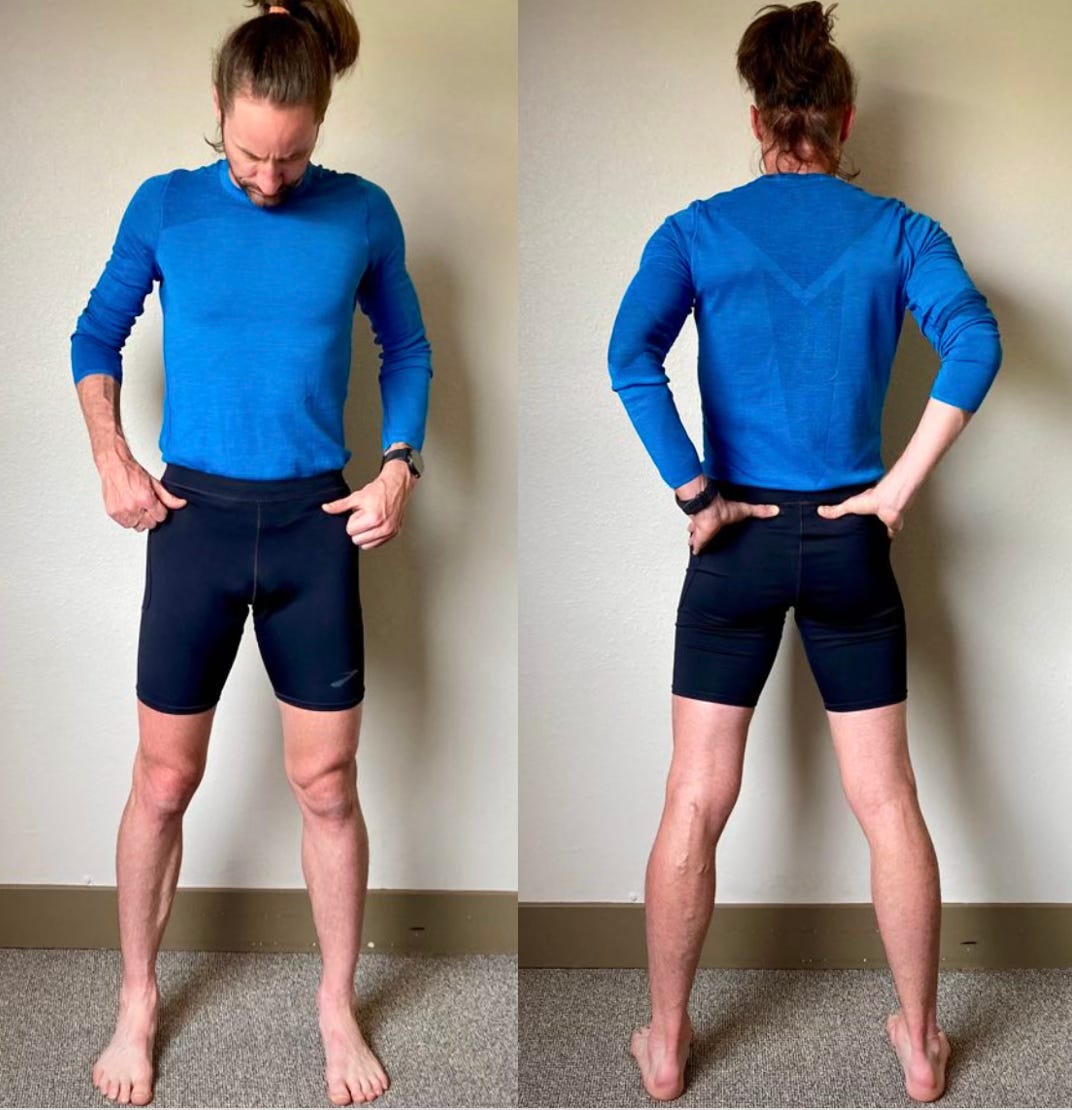
Motion Self-Tests: Test flexion/extension (knee-to-chest, runner’s lunge); abduction/rotations (hurdler stretch); note overall stiffness, side-to-side differences, or asymmetry combined with positional misalignment.
Strategies to Restore and Optimize
Self-Mobilizations: Use a firm ball against wall/floor to massage bony pelvis contours (posterior/lateral) for soft tissue release; perform gentle visceral massage (push/pull on belly or soft ball) to free abdominal organs.
Key Exercises/Stretches:
Runner’s Lunge: For flexion/extension and contralateral extension (wider stance adds abduction).
Hurdler’s Stretch: Targets abduction with pelvic opening.
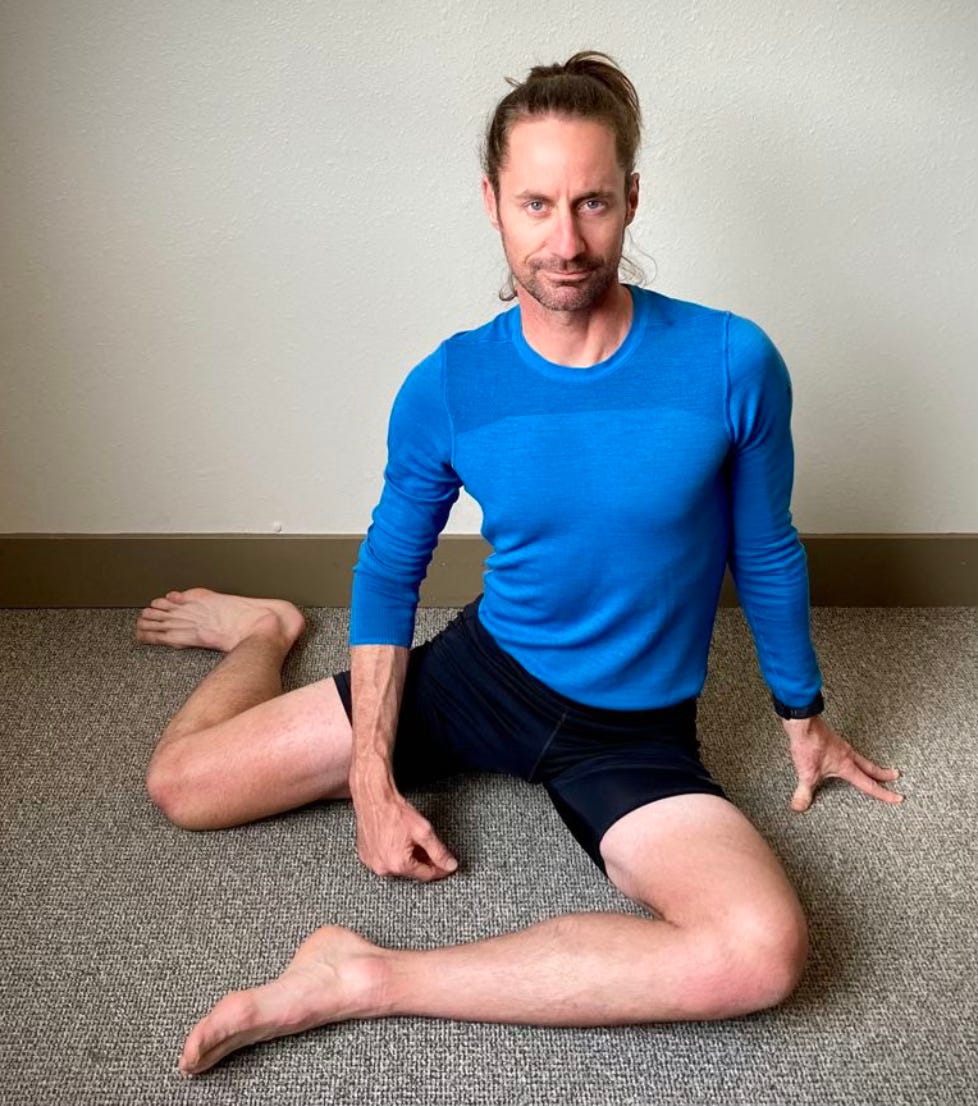
The hurdler stretch, emphasizing (right leg) pelvic abduction and (left leg) pelvic flexion and side bending/elongation from the trunk. Source: Author. Side Lunge and Ninja Stretches: Improve pelvic abduction/opening.
Boogie Board Stretch: Enhances pelvic depression/elevation and relative rotation.
General Approach: Start with soft tissue mobility work before stretching; address rigid joints via professional manual mobilization if needed.
Victory Friday. Joint Replacement Roadblock Removal. This is a fun win from another long-time, on- and off-again client.
The details:
• Early 80s female that is highly active (and a former very-long-distance walker/hiker)
• Presents two months post-operative right knee replacement.
• Our first treatment interaction: several years ago for low back and right knee pain due to a severe leg length discrepancy (LLD): she had a right total hip replacement about a decade ago, after which created a leg length difference, with the right leg nearly a centimeter longer.
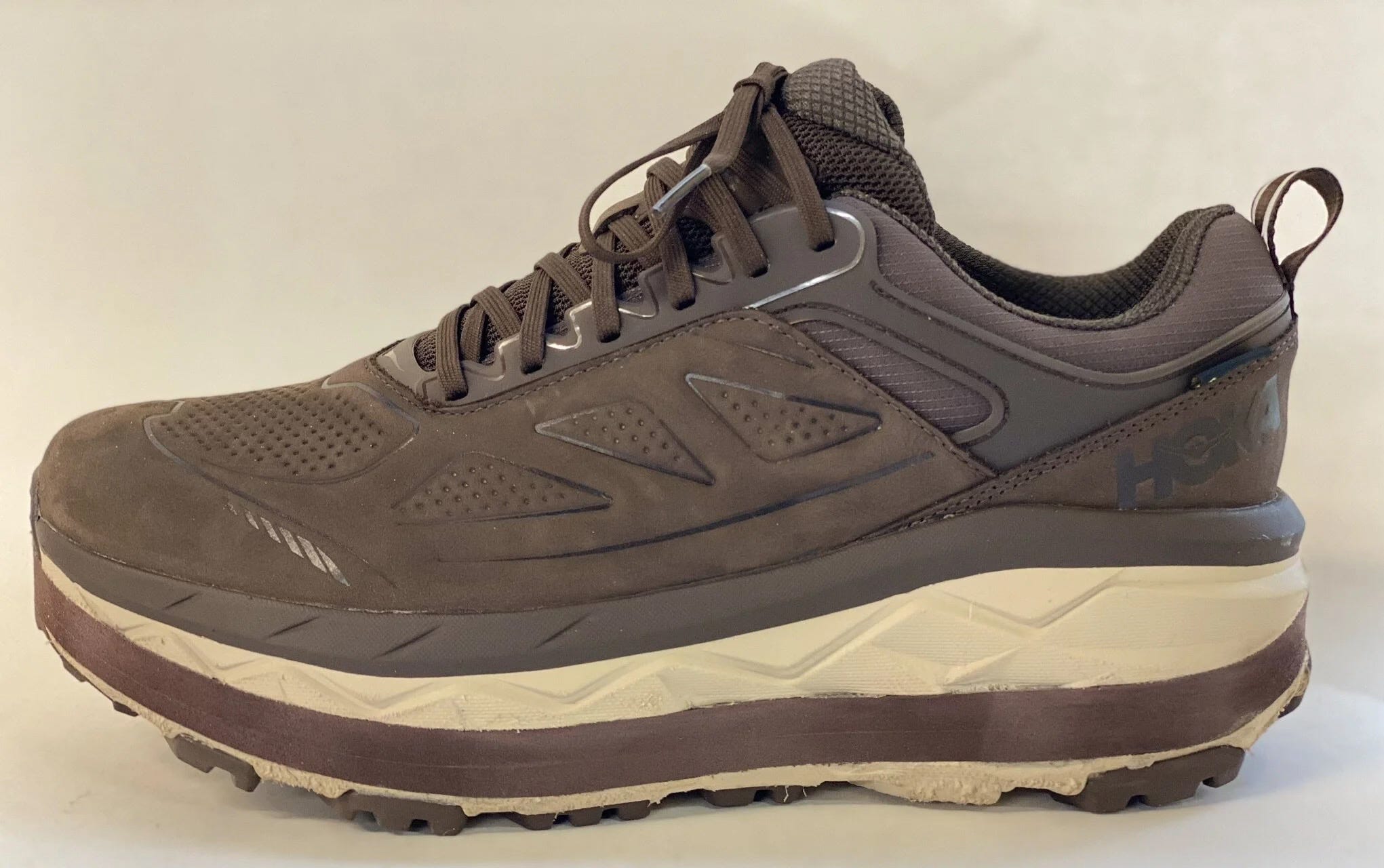
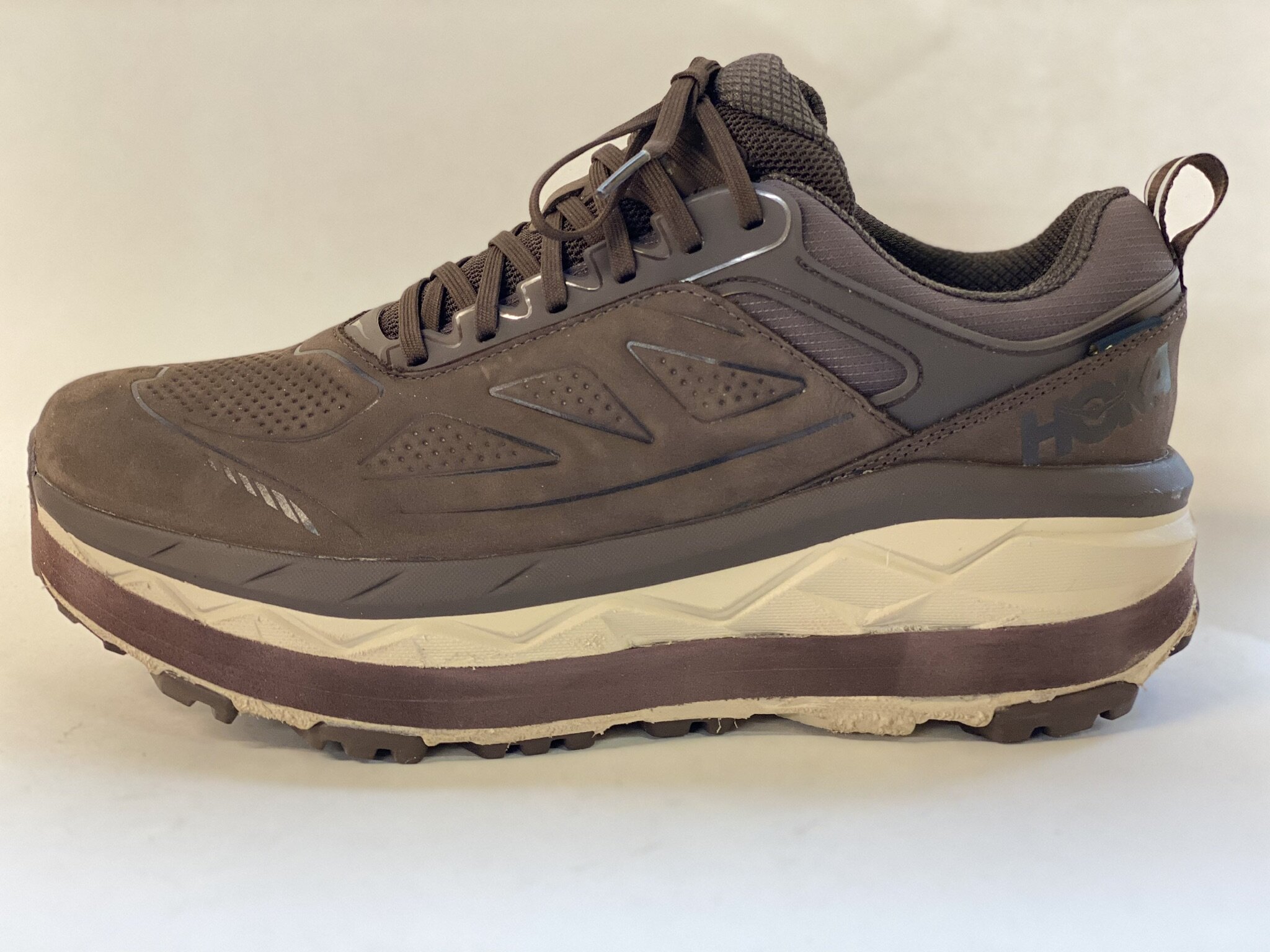
Our treatment success came largely from mitigation of that LLD3 that was large enough to necessitate an external shoe insert4: adding foam to the soles of several pairs of shoes.
• She presents two months post-op, still experiencing swelling, redness, pain, weight-bearing limitation and — most notably — severe range of motion loss in knee extension. Despite 8 weeks of twice-weekly physical therapy (at the postoperative, insurance-based clinic), she was stuck at 30 degrees short of full extension.
Lastly, and most notably:
• She had stopped using her external shoe lifts. She had previously been told she “didn’t need that much” lift. Instead she was using a much smaller heel insert (4mm), or none at all.
The Treatment: Can you guess?
We prescribed a return of the full-length, external (9mm) insert for the left shoe.
Outcomes:
• Within a week: knee extension range of motion improved 10 degrees
• Within 3 weeks: range improved another 5 degrees and — more importantly — the persistent redness, swelling, “stickiness” of the superficial fascia around the knee was fully resolved.
Most importantly:
• At 4 weeks: pain was nearly gone and — despite the lingering ROM loss5 — her weight bearing (standing, walking, stepping) tolerance and strength vastly improved.
Take-Aways.
• Check Every Lower Quarter Joint Replacement for Leg Length Discrepancy! Unfortunately, differences — even big (>5mm) ones — are very common.
And when present, they often create a major roadblock to recovery: impairing not just motion, but strength and stability, and thus functional restoration.
Perform the “six-point check”6, including functional metrics. Then, when in doubt, treat the system to restore spine and pelvic efficiency7.
If the LLD gets worse, you know it is relevant and worthy of a corrective lift.
• Most Big Victories are Very Simple (if Not Silly). This is another example of Occam’s Razor:
the simplest explanation is correct, until ruled out.
Avid readers of Renegade Orthopedics would agree: most of the our most interesting and impactful wins are not high-precision, high-complexity treatments.
Instead? It is recognizing and addressing basic elements overlooked by other practitioners, treatment approaches and philosophies.
• Treat the system
• Identify and correct basic and obvious asymmetries, imbalances and inefficiencies
and see where that takes you, first!
This week it, once again, includes:
• Check those leg lengths: especially if a post-joint replacement patient is, despite many weeks of hard work, is stalled in pain-relief, mobility, strength and function!
Issue 117 is a wrap!
Help people move, function and feel better: please share this publication!
Thanks for reading, and have a great weekend,

Issue 5: The Pyramid of Why. Describes how potentially multiple different — and seemingly disparate complaints (pain, stiffness, movement issues, dysfunctions — both orthopedic and non-) are driven by a singular — and often distal and “quiet” — root cause. And only by treating “the Top of the Pyramid”, are all those issues sustainably resolved.
Issue 12: The Lower Quarter “Four-Bone System”. The functional hip is made up of four (primary) bones: femur, pelvis, sacrum, and lumbar. Each bone needs to move its share (but not too much) for efficient function without pain. A common cause of low back pain is a juxtaposition of these motions, where the hip (femur-on-pelvis) moves inadequately (or inefficiently), causing the sacrum and lumbar bones to move excessively.
Issue 52: “Leveling Success” & Joe’s Six Metrics for Leg Length Discrepancy. A balanced approach to diagnosing and treating clinically relevant leg length discrepancies (LLD) avoids extremes of over-prescribing corrections or dismissing them entirely. Thorough assessment clusters multiple data points for high diagnostic accuracy, with full-length shoe inserts recently resolving chronic pain and restoring symmetry in two runners.
The six metrics are: Pelvic height, Pelvic mobility, Ankle length & the Supine-to-Sit Test, Greater trochanter height, Vertical Compression Test, Lumbar Protective Mechanism.
Issue 115: Leg Length Double-Victory: Indications & Bonus Metrics to Nail LLD Diagnosis. Two chronic hip pain cases in high-impact runners resolved dramatically after identifying and correcting leg length discrepancies (LLD) with shoe inserts, following failed standard local treatments.
Key diagnostic clues include treatment recidivism, relentless multi-activity pain, and positive results across multiple alignment/mobility metrics plus functional tests (e.g., improved core stability with correction).
A new bonus metric: if restorative treatment worsens the measured LLD, it confirms a true bony discrepancy by removing compensatory mechanisms.
I always prefer full-length inserts, versus heel lifts; the latter can significantly alter ankle mechanics and create negative effects throughout the system. Generally, the maximum-thickness full insert that will fit within a shoe is 6mm. For LLDs greater than that, external lifts are therefore preferred.
What remains is stubborn multi-dimensional tissue restrictions that preceded the TKA by several years. Current treatment focus is on hands-on treating these dimensions: superficial fascia, muscle-tendon structures, and joint mobilizations. And now that the joint isn’t so compressed (from excessive weight-bearing), aggressive mobilization can occur with only a fraction of the pain she previously experienced.
See Footnote 3, Issue 52.
See Footnote 3, Issue 115.
Really appreciate the emphasis on simple interventions first - the shoe lift case is such a good reminder that we overcomplicate things sometimes. The lymphatic drainage stuff for brain health is intriguiing too, dunno why more people aren't talking about that connection. I've noticed similar patterns with clients where addressing basic asymetries unlocks everything else. Great practical wisdom here.