
Victory Friday | Issue 127
Orthopedic Insights: “Baxter! Bark Twice if You’re Not Plantar Fasciitis!” • Roller Hip Airplanes • Running Optimization w/AI • Elevating the “Lowest Common Denominator”: Peak Performance w/Efficiency

“We all turn in circles, but some of us learn to dance.” ~ Anonymous
Victory Friday is a weekly digest of reflections, insights, and tools from the world of functional manual and performance medicine. It is a free weekly publication. To support Victory Friday with a paid subscription, click below:
Happy Friday! This week features a few quick (but sustainable) fixes: a simple wiggle to free chronic heel pain, leveling up your fitness using AI data, working your whole hip with one (“flying”) exercise, and personal besting with form-focus. Take your pick and have fun with it!
What I’m Into: “Baxter! Bark Twice if You’re Not Plantar Fasciitis!” One of my most popular articles ever published on iRunFar was about plantar foot pain—not plantar fasciitis specifically, but all the other structures in the foot that can become painful.
Many different tissues can cause pain in the heel and arch area, but one condition stands out because it:
• is an almost perfect mimic of classic plantar fasciitis pain (anterior-medial calcaneal pain and tenderness)
• is notoriously stubborn and long-lasting
• yet—unlike a true plantar fascia injury—can often resolve quickly when you address it correctly
That condition is Baxter’s nerve entrapment.
Baxter’s nerve is the first branch of the lateral plantar nerve, which (seemingly paradoxically1) runs along the medial side of the calcaneus.
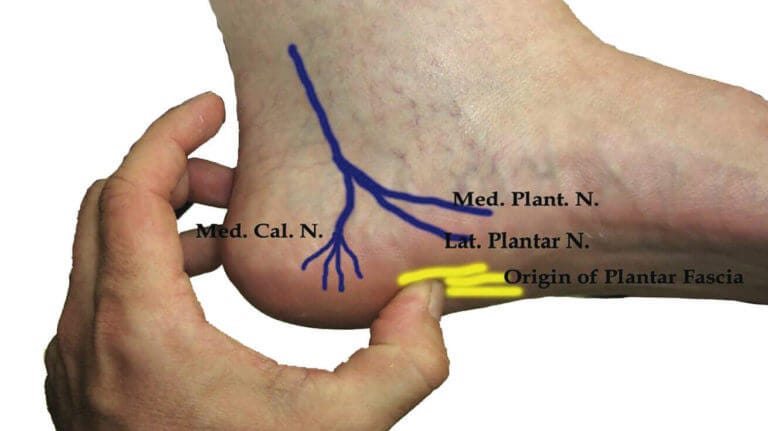
The symptoms of Baxter’s nerve entrapment are often identical to plantar fascial pain:
• medial, inferior, and anterior calcaneal pain
• heel tightness
• sensitivity to weightbearing
But there are some notable differences unique to a neurogenic pain, which may include:
• a burning sensation
• tingling or numbness
• pain or symptoms inconsistent with activity — some activity may feel fine, while other times there may be symptoms at rest (one of the six hallmarks of neurogenic pain).
Treatment Strategies for Baxter’s Nerve Pain. Like all things nerve pain, there is a bad-news, good-news situation:
• bad news: nerve pain is often complex and — when present — may involve treating anywhere on the length of the nerve: a Systems & Dimensions approach2.
• good news: the most encouraging part of neurogenic pain is:
If you can make happy the irritated nerve, even the most stubborn chronic pain can disappear immediately.
A true plantar fascia injury — torn collagen fiber on a major weighbearing structure — can take a very long time.
But if it’s nerve pain? The right treatment can remove the irritation and, with it, rapid and sustained pain relief.
For Baxter’s nerve, though a bit nuanced, this treatment is often rather easy:
1• medial calcaneus fascial mobilization. Freeing the plantar nerves along the medial calcaneus is central to resolving neurogenic heel pain. Light to medium cross-friction massage of the thin-but-tough medial calcaneal fascia and retinaculum is a key starting point.
This is much different than “plantar foot massage”. Simply mashing the bottom of the foot with ball or other object will seldom free a stuck nerve, especially if it is stuck on the “sidewall” of the calcaneus. This is a major reason why conventional plantar foot strategies fail to improve Baxter’s entrapment.
Mobilization needs to occur on the inside of the heel, just above — then along — the calcaneal fat pad, itself.
2• calcaneal fat pad mobilization. One of the most curious characters in chronic heel pain is the calcaneal fat pad. It’s like a quarter-pound burger patty that, quite literally, is a pad of fat between the bony calcaneus and the ground.
Like all tissue in the body: it has nerves flowing into it, and it requires a little wiggle mobility.
A tight, stuck fat pad is a huge player in medial heel nerve entrapment.
To mobilize a stiff fat pad, first mobilize the fascia above it. Then wiggle the fat pad with your hand:
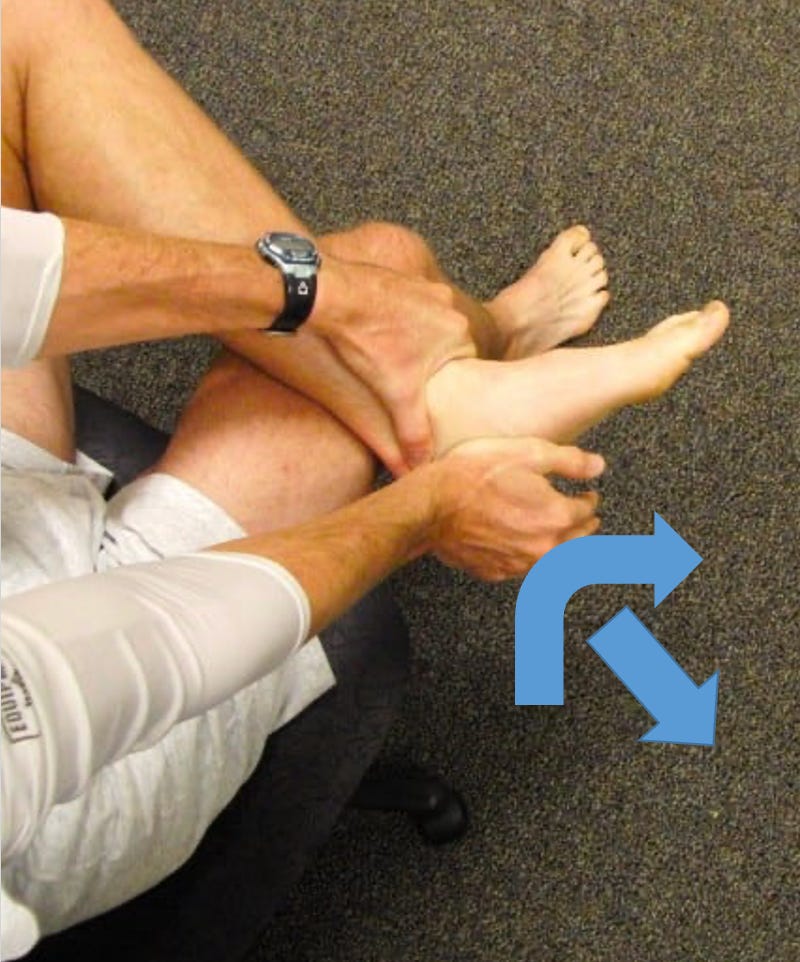
Push the fat pad inferior-medially, essentially gapping it away from the calcaneus bone (providing space for the nerves)
twist the fat pad, “forward and back”
For many, this mobilization can start out as shockingly painful but, rather quickly, feels better, and is a key pain reliever.
Lastly:
3• Foot- and ankle-centric nerve mobilizations. Standing nerve mobilization, focusing on the lower leg and ankle, is a good way to ensure those little plantar branches have some wiggle mobilty:
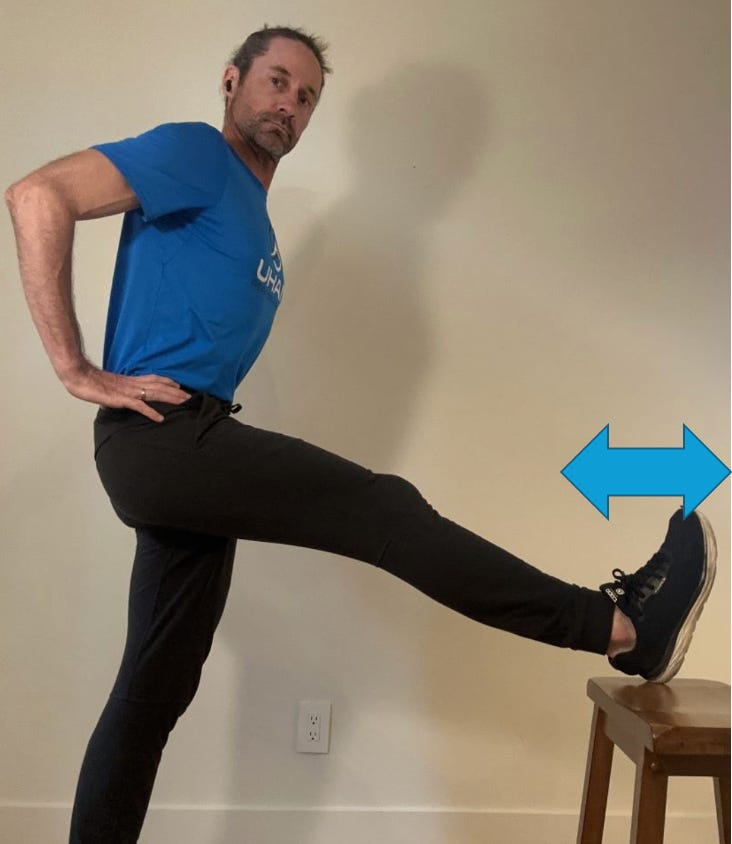
For the full video on the standing nerve wiggles:
Takeaways. When addressing chronic foot pain, I always check the fat pad and medial heel fascia, first. It’s the lowest-hanging, easiest option for rapid and sustained foot pain resolution!
Cool Exercises I Like. Roll-on-Wall Hip Airplanes! What a great way to work balance, coordination of medial arch — knee — hip — pelvis and trunk, and access that crucial “posterior-inferior-lateral-capsule” (PILC) of the hip: The Hip Airplane.
A hip airplane exercise, generally, is a single leg standing movement where the pelvis rotates on a stable (balanced) leg. Among other things, it trains and promotes leg, hip, pelvic and core stability. But primarily it trains the deep hip rotators to coordinate a rotational movement between the hip and pelvis.
In short, it is a standing, oscillatory version — and a useful functional progression — of what is trained in “Joe’s Six Pack”3
This version, from the physios at Myokinetix Physical Therapy (@myokineticx), adds an interesting wrinkle — foam roll resistance:
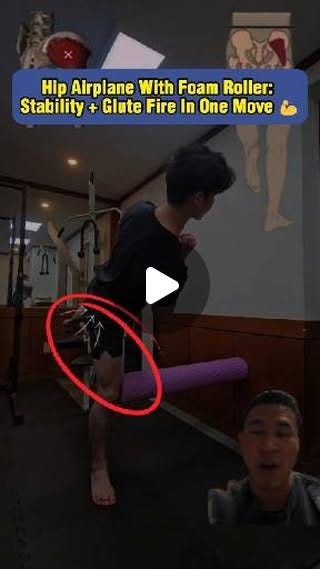
Using a foam roller on a wall provides two key benefits:
it removes some of the (often excessive and prohibitive) balance challenge, and
the foam roll resistance enhances hip adductor and internal rotation muscle activity.
Give it a try!
Joe’s Articles. Running Optimizations Using AI. Athletes have been using biometric data for ages. But what starting with heart rate monitors and simple bathroom scales has progressed to heart rate variability, sleep and recovery scores, and now, even glucose-level monitoring.
The rapid emergence of AI for data analysis and task optimization has inevitably — and excitedly — moved into athletics: not just running, but all fitness activity.
I discuss a few of those emergent uses in this new post, from iRunFar.com:
AI-Powered Optimization: The New Frontier in Peak Running Performance
TL;DR:
Three potential uses for AI technology:
Training load optimization. New AI tech can analyze biometric data from wearables (e.g., heart rate, sleep, load) to provide tailored training plans and early injury risk warnings (tools like Zone7, Garmin Connect, Hexis).
Nutrition optimization. AI-powered apps can now combine training and recovery analytics with nutrition data (including macros derived from scanning pictures of meals!) to deliver real-time, personalized nutrition advice based on training demands (apps like Lumen, Fitia, Fuelin, MacroFactor).
Biomechanical optimization and injury prevention. The latest AI-driven apps can performs running gait analysis from uploaded running videos, assessing posture, joint angles, cadence, and injury risks while suggesting improvements (tools like Ochy, Movaia).
Limitations and cautions: AI can produce errors or “hallucinations”; many tools are still early-stage or team-oriented rather than fully individual; overreliance risks ignoring human intuition and judgment.
Overall outlook: When used responsibly and with critical thinking, AI represents an exciting frontier that can help runners reach peak potential while minimizing burnout and injury.
Victory Friday. Elevating the “Lowest Common Denominator”: Peak Performance Through Efficiency. For the first time in eight years, I’m coaching high school track and field. Just three weeks into the season, I’ve already challenged my two dozen distance runners in several key ways:
Dynamic-paced workouts: Running fast is good, running even-paced is better, and running fast–slow–fast again is next-level.
Disciplined strength work: Slow, mindful repetitions focused on core activation, hip stability, and coordination.
Stride integrity: Can you run (relatively) fast while holding the most efficient possible form?
A terrific victory emerged this week—one several weeks in the making—with one of my senior boys.
He’s a strong runner, but not our most talented. Last fall he placed second overall as a junior varsity runner at the cross country district championships. He’s good, but only the 8th-best on our team.
This winter he was determined to finish his high school running career strong: he attended most winter workouts and added morning strength sessions.
Beginning this winter, I noticed a couple of notable habits. When he fatigued—in the middle of hard workouts—one or both of two things would happen:
He would lose his forward posture (hip hinge), and/or
His run cadence would drop dramatically: from an ideal high 170s (steps per minute) to as low as 150 or worse!
In other words, he’d start leaning back and slowing his legs—two brutal habits that destroyed his pace.
A couple of months ago I mentioned posture. But like most form cues, it takes time and repetitive feedback to improve. When he stayed “in his hips,” he maintained pace with far less extra effort.
Two weeks ago, with the season in full swing, we did our first short-speed, short-rest endurance session: 8 × 200 m at 800 m race pace, with only 2 minutes rest.
Impressively, my guy ran shoulder-to-shoulder with our top distance runner from cross country for reps 1–3. They were hitting between 29 and 30 seconds per half-lap—a strong pace!
But as the workout went on, he fell back significantly in reps 4–5. This isn’t unusual: many runners—especially young ones—are often too ambitious early and fade when their fitness runs out.
In those reps he dropped to 5th or 6th overall and 34–35 seconds per half-lap—a big slowdown.
Watching rep 6, I saw the reason: he lost a bit of hip hinge, but more damagingly, his cadence plummeted to around 150.
During the rest jog back to the start, I told him one simple thing:
“I don’t care how hard you push—just move your hands and feet faster.”
In other words, I didn’t care about the outcome (pace or effort level)—I just wanted him to execute the efficient process: restoring quick cadence.
He did. And seemingly with little extra effort, he finished the final two reps in 31 seconds.
Me: “How much extra effort did that take?”
Him: “Not much!”
Me: “But you got a lot in return!”
He nodded and smiled in agreement.
Personal Bests Through Processes. Fast-forward a couple weeks to yesterday: our first meet. For all the kids, the racing emphasis was on finishing strong—running deliberately slow (even absurdly slow) in the first half to speed up over the final lap.
My guy was entered in the 800 m, his focus event. His personal best from a year ago was a modest 2:11. Typically a runner does best with the first lap only slightly faster than the second—maybe a 2–3 second difference.
Like many kids, he struggled to hold on in the second lap. So this week our focus was: go intentionally slow, then finish with a “goal pace last lap.” For him we targeted 64 seconds or faster (aiming for a great PR around 62 + 64 = 2:06).
He agreed to the plan. On race evening, as he toed the line with three teammates—all on a similar strategy—I gave him one quick reminder: “Hip hinge, quick feet!”
As planned, he and his teammate went out controlled—almost too easy. He hit the first lap at high 67.
Then he took off! He and his teammate crushed the final lap. While his teammate (with a much faster PR) eventually passed him in the home straight, I could only laugh incredulously as the clock ticked barely over two minutes while he blazed to the finish.
Finish: 2:10
First lap: 68
Second lap: 62(!)
He was pumped. But I might’ve been more excited than he was.
This was the outcome of a process of integrity: working hard, yes, but ultimately committing to high-integrity, efficient movement that maximized top speed, conserved endurance, and minimized wasted energy.
That small investment in efficiency and disciplined execution of the “easy first, hard later” strategy—unbelievably—delivered a personal best.
I talk a lot about Lowest Common Denominator Form:
What’s the worst your form gets when you’re tired?
That’s the form that matters most. No one needs perfect form. But when we fatigue—which we all do—it needs to stay “pretty good.” The best runners—in high school and the world—have only a small drop-off between fresh form and their “LCD form.”
For my guy, the biggest change was elevating the “floor” of that LCD form. It took little more than heightened awareness and a bit of extra energy: trading “one unit” of effort for about 5× the return in speed and endurance.
When he felt that payoff two weeks ago in the workout, it really clicked. Yesterday he put it into practice.
Take-Aways: Efficient Processes Create the Greatest Return. Skill development is so important in high school sports: teaching young people how to move optimally to get the best outcomes from their efforts.
But it’s just as important for every person—every client—in pain or limited in work or play.
More work (stretching, strengthening, exercising) isn’t always the answer. But doing the activity better is always an option. Until that “LCD form” is optimized, efficiency should be the primary focus for any pain relief or performance goal.
I hope I can keep these coaching Victories coming—they’re a blast!Issue 127 is a wrap!
Help people move, function and feel better: please share this publication!
Thanks for reading, and have a great weekend,

the lateral plantar nerve eventually crossed the bottom of the foot to supply the lateral plantar foot. (This whole-foot traverse is likely a factor in its susceptibility to irritation)
Issue 41: Systems & Dimensions. Full and sustained pain relief and recovery of function often requires a comprehensive treatment approach of multiple Systems (body areas: spine, pelvis, abdomen, pelvis, hip, knee, etc) and Dimensions (types of tissue: muscle, tendon, bone/joint, fascia, nerves, blood vessels, etc).
Issue 105: Joe’s (Hip) Six-Pack. A three-dimensionally strong hip will enhance not only focal strength and stability but also hip and leg mobility and overall athletic efficiency. This six-pack of exercises enhances coordination and stability in all six movements of the hip joint. Strength exercises include: prone hip internal rotation, sideplank clamshell external rotation, sidelying adduction, sideplank abduction, banded supine hip flexion and double- and single-leg bridging.