
Victory Friday | Issue 141
Orthopedic Insights: Balance Raw Materials: Get Mobile & Strong! • “See Something, Say (& Do) Something!”: Stride Coaching Is (Sometimes) Everything

“The older I get, the more I suspect action is intelligence disguised as recklessness” ~ Troy Francis
Victory Friday is a weekly digest of reflections, insights, and tools from the world of functional manual and performance medicine. It is a free weekly publication. To support Victory Friday with a paid subscription, click below:
Happy Friday, all! This week we explore the bookends of the athlete experience — and in both cases, the answer is the same: “Be a better athlete.”
On one end: smarter, more effective ways to maintain balance and prevent falls as we age. On the other: the dramatic, performance-changing power of stride coaching, shown through the season-long breakthroughs of two high school 800m runners.
Be inspired to move better — at any age!
What I’m Into: Balance Raw Materials: Get Mobile & Strong! I saw a geriatric neighbor in the gym this week. She was diligently working on balance. This included:
• standing on one foot
• backward walking
I am an advocate for balance training for older adults. But as I’ve written before, I believe our approach to geriatric balance training needs more than…balance1.
Someone who wishes to run a fast mile does more than…merely race a bunch of fast miles. They might improve somewhat but will plateau quickly, and possibly hurt themselves.
Instead they usually undergo:
• large volumes of easy running
• short repetitions of very fast running
• mobility and strength work
• race-specific training
What I saw from my neighbor: she was sorely lacking in key aspects of mobility:
• ankle dorsiflexion
• hip three-dimensional motion
and of strength
• lower leg and foot plantarflexion
• knee extension
• hip extension and abduction
Mobility and strength are the raw materials of good balance. To maintain upright and survive surprise perturbations — tripping, uneven ground, push-shove forces (from pets to grandkids) — people first need basic joint and tissue mobility. Then they need active and frequently-used core stabilization and strong mover muscle groups.
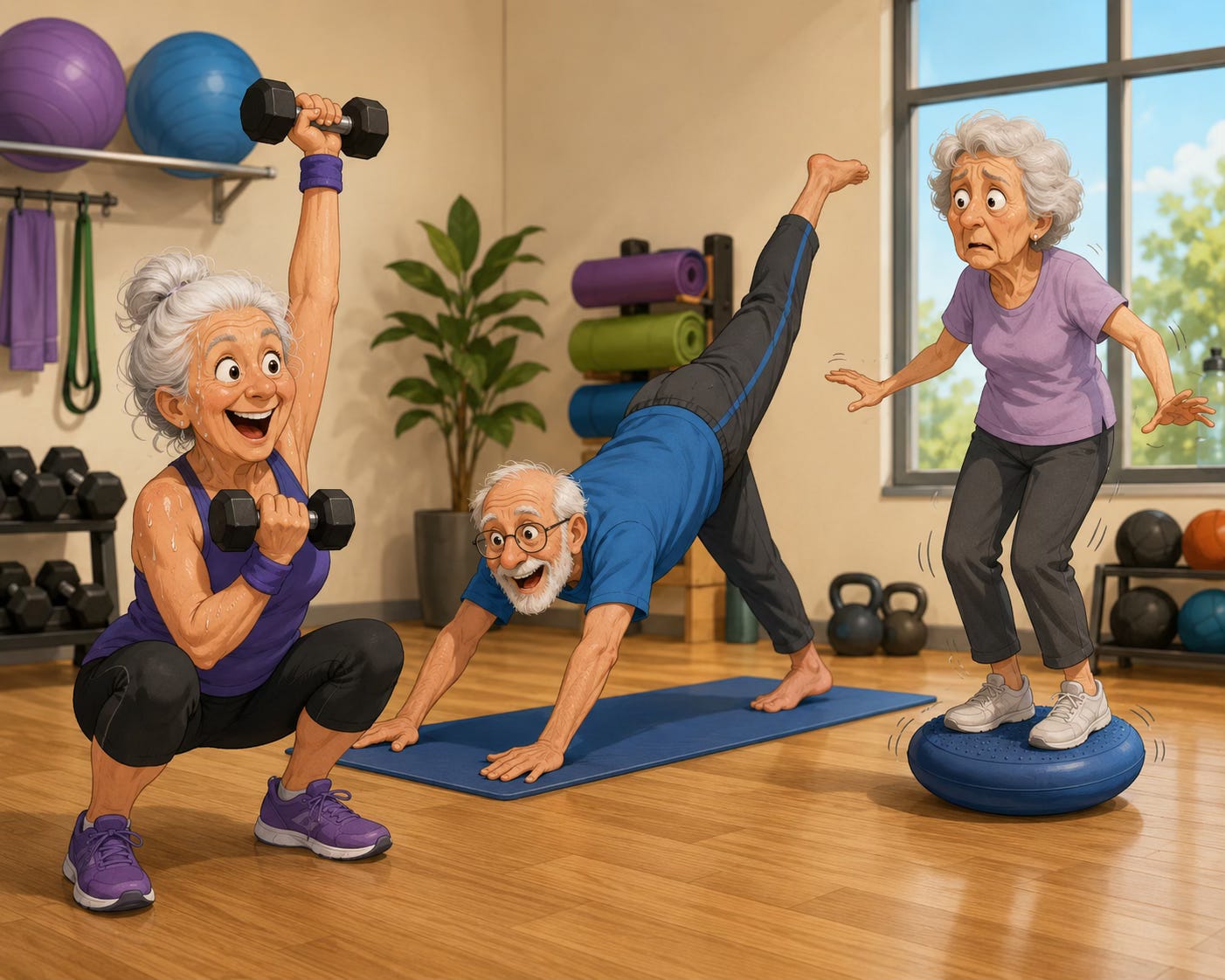
Balance training, alone is…risky. Watching my neighbor walk backwards — with easily observable deficits in joint mobility and (perceived) core and leg strength deficits — made me nervous that her fall-prevention training might…cause an actual fall!
So just as well-rounded “base training” is a more effective and safer way to run a fast mile, so, too is first prioritizing foundational mobility, stability and strength work for geriatrics as raw materials for better balance and agility.
All people will have better balance if we first emphasize:
• restoring, maintaining and routinely accessing full motion of the foot/ankle, knee, hip and spine
• optimizing and routinely using hip and trunk stabilizers, and challenging movers with both daily activity and — most notably — frequent high-intensity resistive exercise: weight and plyometric training!
(And of course, by doing so, this enhanced mobility and strength can do far more than simply prevent falls!)
Want good balance? First get and keep the whole body mobile and strong!
Victory Friday. “See Something, Say (& Do) Something!”: Stride Coaching Is (Sometimes) Everything. It’s past the solstice and the spring track season is fully in the rearview. Yet we continue to tally the receipts from the year.
• A few weeks ago I shared some of my favorite program-wide Victories, including only 5 “kid-days” lost to injury2.
• Mid-season, I discussed the importance of running stride optimization for both injury treatment and prevention, and peak performance3.
Today I share the receipts of two stride coaching projects that yielded big end-of-season wins: one easy, one difficult.
Athlete #1: Quick & Forward. Our first project was a senior 800-meter runner. Last year as a junior he had a mediocre season: stuck in the 2:12–2:16 range, seeking a personal best of 2:11.7 at season’s end, but too slow to advance to the post-season.
Since then he trained relentlessly—summer running, a strong cross country season, and consistent winter work through cold and rain. He entered the season stronger and faster.
Yet, like many young runners, he faded in higher-volume workouts:
• The first few reps looked fast and strong
• In the middle reps he began to struggle and fell behind his teammates
• In the final reps he was several seconds slower, well off his starting pace
While poor fitness or mental toughness can play a role, for him the issue was simpler. If you watched closely, his form degraded in two key ways:
He lost his forward posture, and
His cadence slowed dramatically.
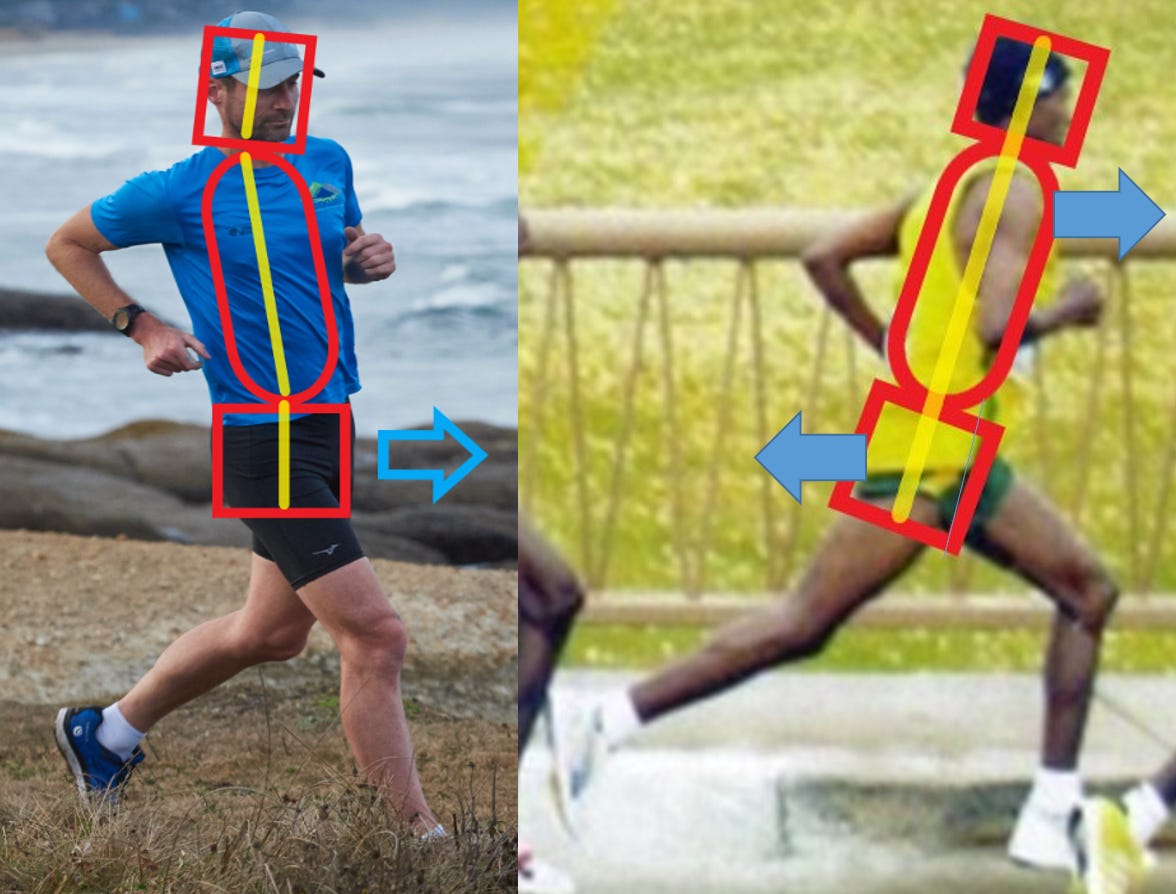
In one early-season workout the team ran 12 × 200-meter repeats. For the first several reps he was relaxed, hitting 30-second splits and hanging with his fastest teammates. But by reps 7–9 he slowed to 32 seconds and fell behind. His stride had broken down: he was leaning back and his cadence had dropped from 180+ to below 160 steps per minute.
This is what his posture would look like when he fatigued:
During the short rest after the 10th rep, I gave him one simple cue:
“Don’t worry about the split. Focus only on posture and quick feet.”
His 11th and 12th reps were perfect 30-second splits, right back with his teammates.
Post-workout we discussed it as a team. When I asked him how hard it felt to hit that time while focusing only on form, he replied, “Not that hard!”
Simply by holding proper posture and quick foot-to-ground contact, his body generated force more efficiently—producing fast times with far less effort.
This was a key point: in doing so, he learned how to maintain speed without strain.
This is a key piece of peak performance that I tell kids nearly every workout:
“Run as fast as you can as relaxed as you can!”
And stride optimization is the centerpiece to that effort.
After that, I stayed on him like a hawk about his form. Because form breaks down with fatigue, he needed frequent cueing throughout the season—both in tough workouts and races.
But that’s exactly what coaching is for.
Over time, he learned to hold good form longer, self-assess, and make corrections even mid-race.
The results spoke for themselves:
• He ran an 800-meter personal best in the very first meet of the season and ran progressively faster in (nearly) every race
• He made the district championship finals, running another personal best while just missing a state meet berth
• He stayed healthy and avoided injury all season
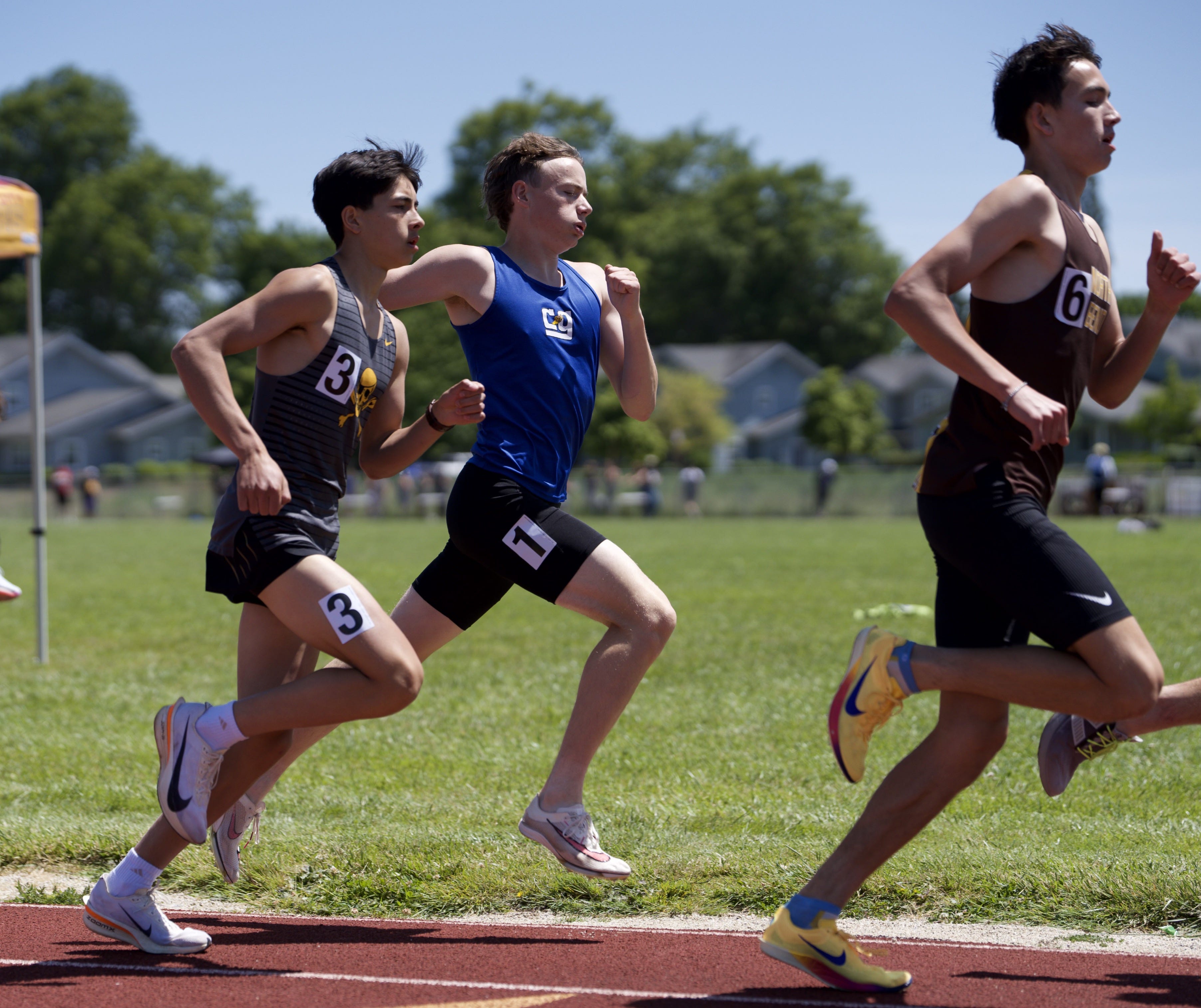
The year-over-year receipts:
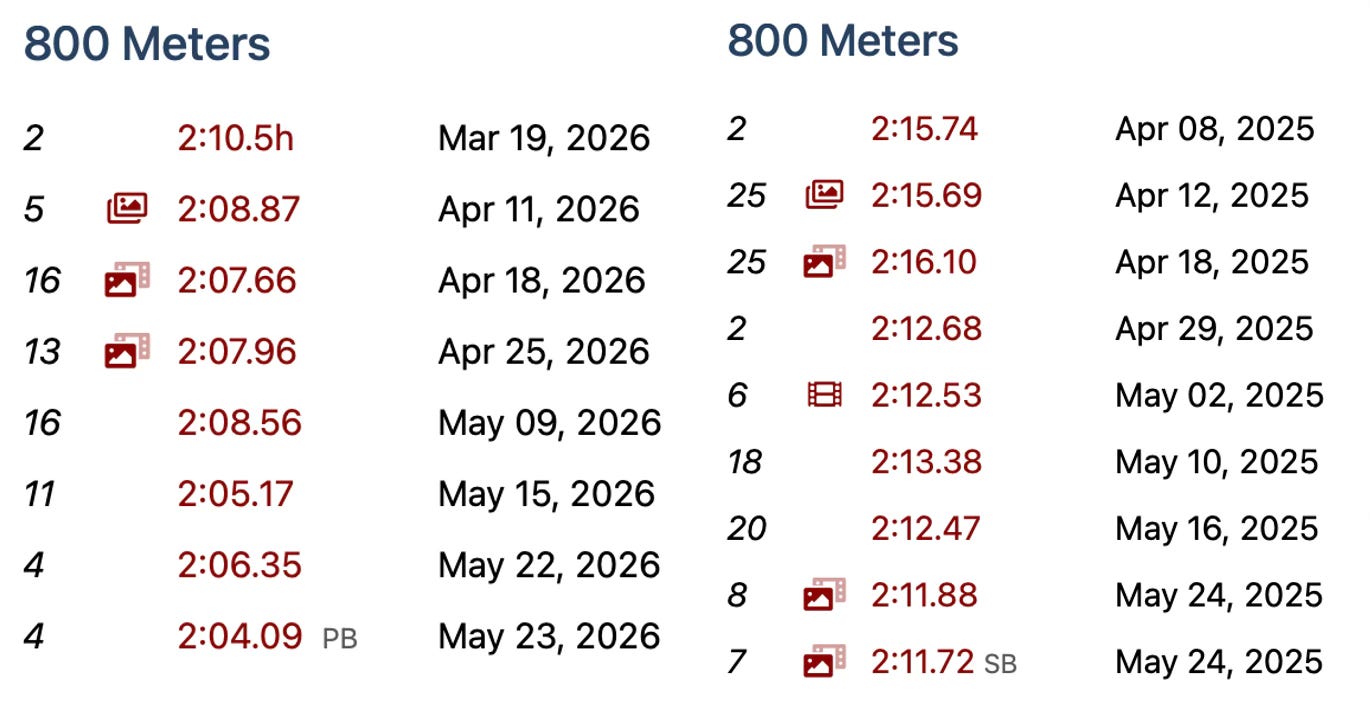
This year-over-year improvement shows what’s possible when hard training is paired with a relentless focus on stride efficiency. The toughest thing for any young athlete is to train hard yet see limited — or even no — progress: something that happens far too often when efficiency is ignored.
He finished his senior season on a high note, and I’m excited for his future as a runner and young man.
Athlete #2: Hungry-Hippos. This was a tougher, sneakier, but more impactful case involving a junior 800-meter boy—the fastest on our team.
He had qualified for the state meet as a freshman and sophomore, yet he struggled at last year’s state meet (poor performance and no placement). He also dealt with persistent aches and pains in his feet and lower legs, including tight calves, foot issues, and even blisters—uncommon for short-distance racing.
We managed those issues with mobility and strength work plus general efficiency cues (posture and cadence), similar to his teammate.
Yet he had some quirky habits: he often ran on his toes, and when fatigue set in his stride lost power. This pattern showed up early in the season:
• He ran extremely fast in workouts (100-400 m intervals), yet
• He struggled at the end of his 800 m races.
Despite strong even pacing and mental focus, he repeatedly ran his final 200 m 2–3 seconds slower than earlier sections. He would look on pace for a personal best, only to fade—often getting passed by competitors in the closing stages.
After it happened again at a big invitational, it clicked: his backside mechanics were too big, causing braking and loss of speed.
I’m a big believer in this concept:
The best time to optimize stride mechanics was 2(0) years ago.
The second-best time is right now!
So mid-meet, between his 800-meter race and anchor leg of the 4x4, we found an empty parking lot across from the stadium and went to work.
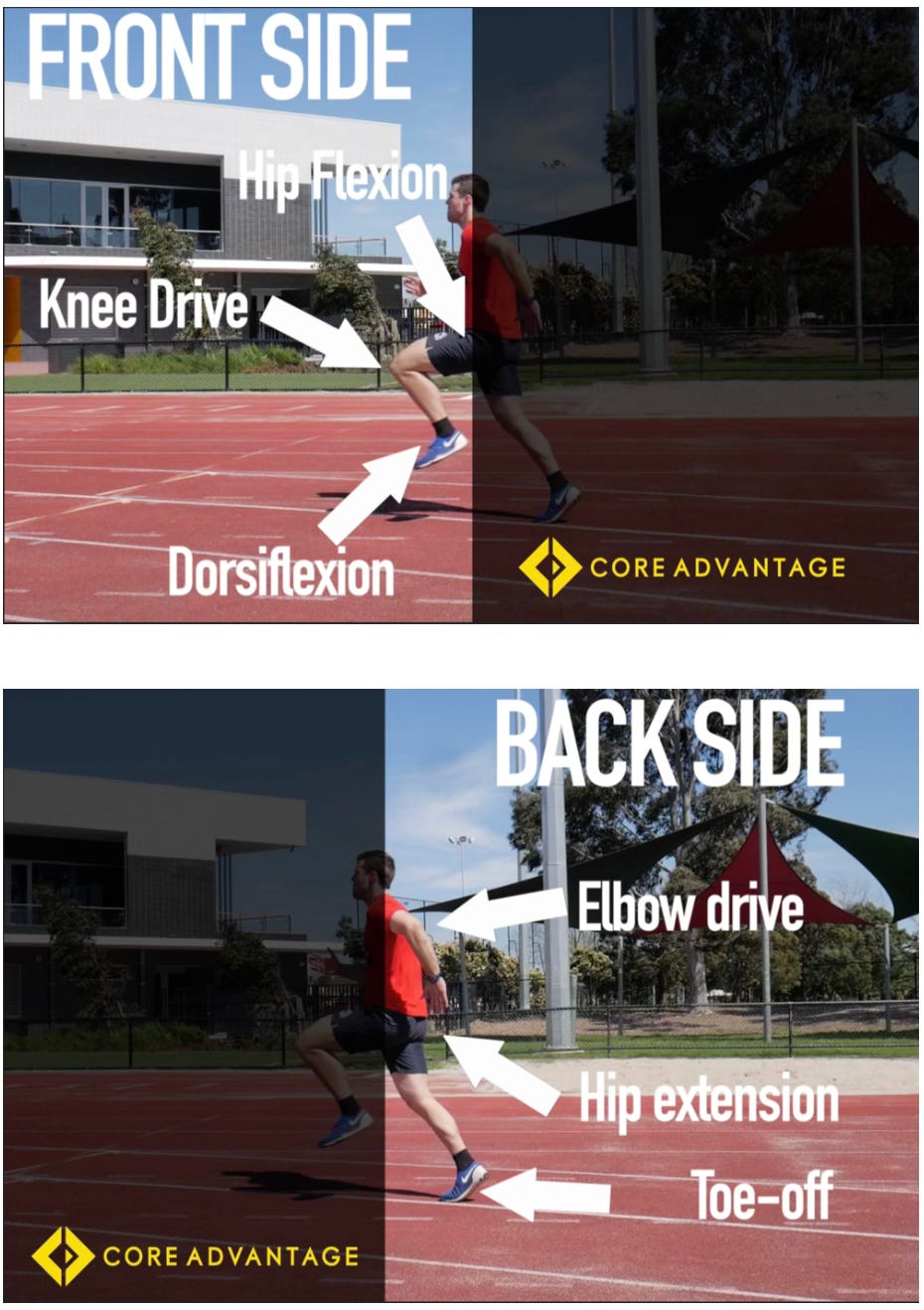
I unpacked the concept of front-side versus back-side running mechanics:
• Half of the stride occurs in front of the body, and
• The other half occurs behind.
Each creates a semi-circular leg path. Combined, I call this The Circle of Propulsion:
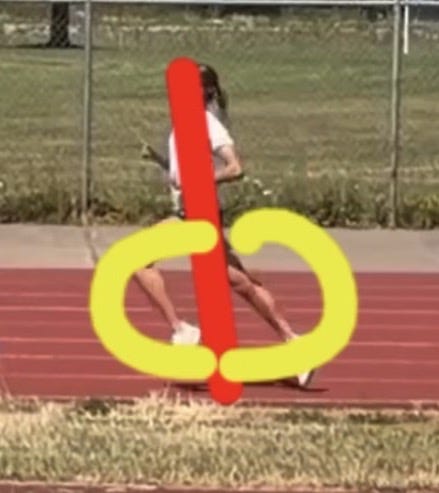
Peak efficiency requires a balanced front-versus-back strategy. Even though he looked strong and fast, my guy was over-emphasizing backside mechanics: too much left movement occurring behind him.
This imbalance was more pronounced with fatigue, resulting in reduced forward propulsion and increased braking at the worst possible time: the end of a race.
Here is a solid primer of this concept, courtesy of coreadvanctage.com:
And here are some visuals of this excess backside concept, from another athlete, with whom we saw this:
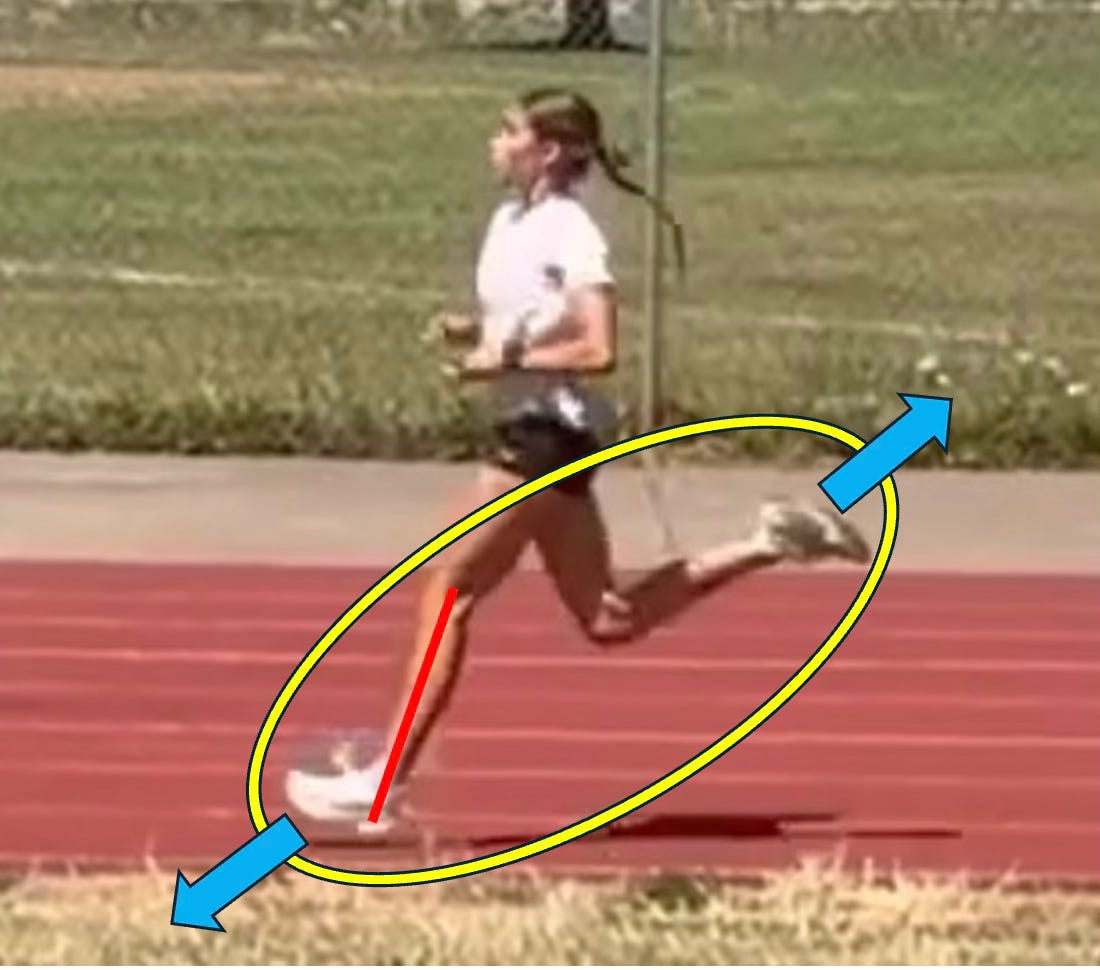
In this video I explain the consequences of the excess backside action and our strategies for how to rebalance the Circle of Propulsion:
Fix The Back By Expanding the Front. We went to work. Fixing this is more than simply restricting the backside (“Don’t lift your heel so much!”4). Rather, it’s about emphasizing forward leg drive.
Several weeks earlier, when I noticed a deficit of front-side action, I cued him for “more hip flexion!”. He did it, but that strategy didn’t fix the imbalance, and on race day failed to help him finish fast.
In the gravel lot outside the stadium, I instead cued him to drive the leg forward and reach longer in front.
To those who coach distance running mechanics, and constantly deal with over-striding athletes, this may seem anathema: “You’re cueing them to stride longer in front??”
But for runners with excessive backside mechanics — who might comprise only 10% of distance runners — they are actually under-reaching. Expanding the forward movement is what re-balances the stride.
We first ran through some running drills, including A- and B-skips, with the added emphasis of a strong forward hip, knee and even shin drive.
Then I added a visual:
“Do you know the game, Hungry Hippos?”
This idea of stronger, longer forward leg drive…while still demonstrating a quick foot-to-ground, and rotary “pull-push behind” is what keeps this enhanced front-side movement, circular!
The Hungry Hippos game is the ideal visual of the reach then pull-back!
This front-side expansion, while preserving the foot-under-body landing and hip extension, results in:
• more hip force generation in both directions: enhanced forward drive also enhances hip (glute) extension
• decreased landing stress: the shin lands farther out front…but in more vertical, less straining position
More propulsive energy produced and less absorbed. Win-win!
The results were immediate:
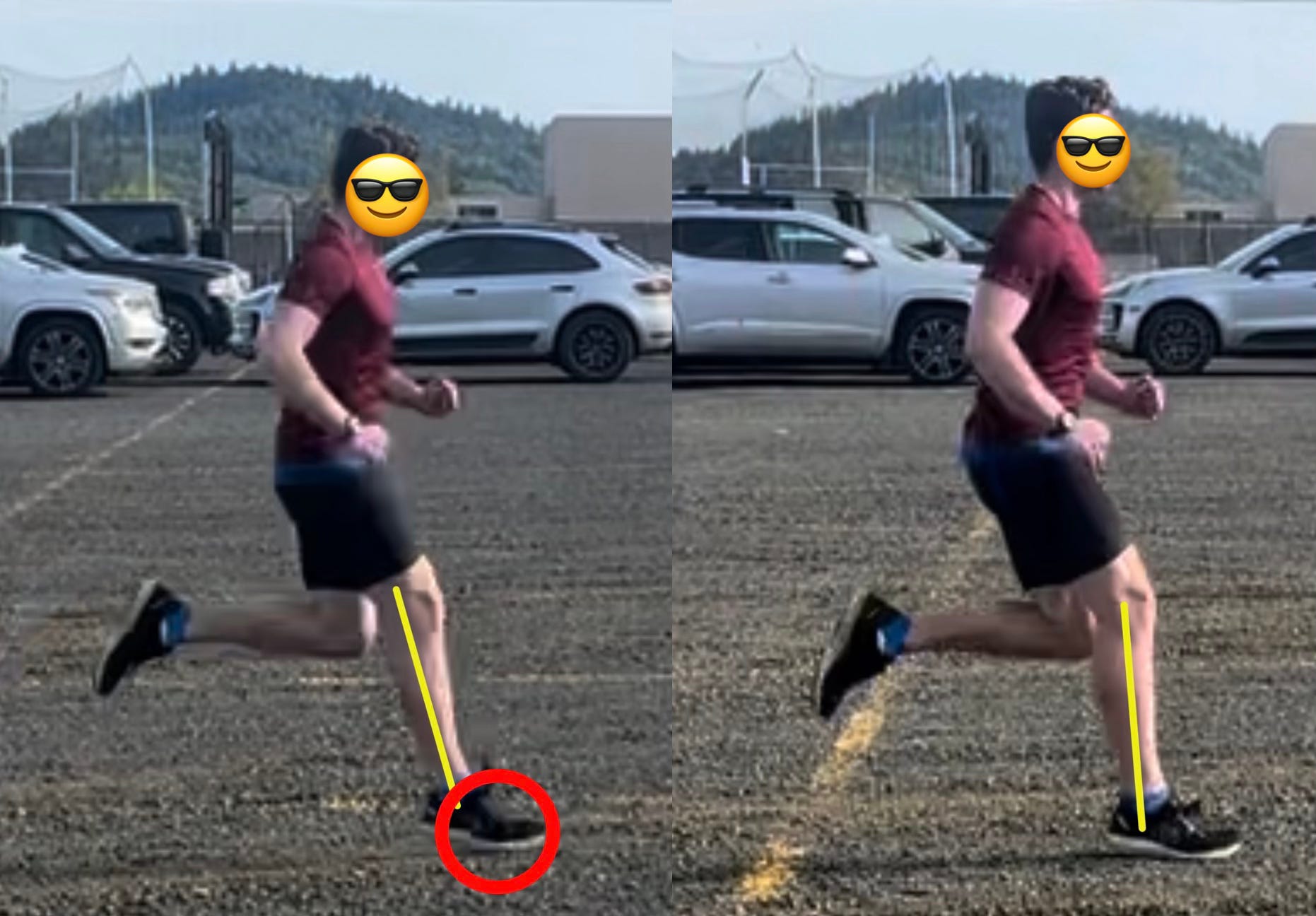
Once establishing that new pattern, it was a gradual building process: establishing both the muscular strength and motor control repetitions. He was able to do it in the 400-meter leg an hour later, then continued to hone it season-long.
The receipts included:
• A personal best 400-meter race, two weeks later, run as a “training stimulus” (not 100% effort)
• Progressively faster 800-meter race performances, culminating with a wire-to-wire district championship run.
Then at state:
• While he got boxed in early, he blasted his fastest 2nd and final lap, to finish strong and equal his personal best time.
• This included by far his fastest closing 200 meters — nearly 4 full seconds faster than before we made the stride change.
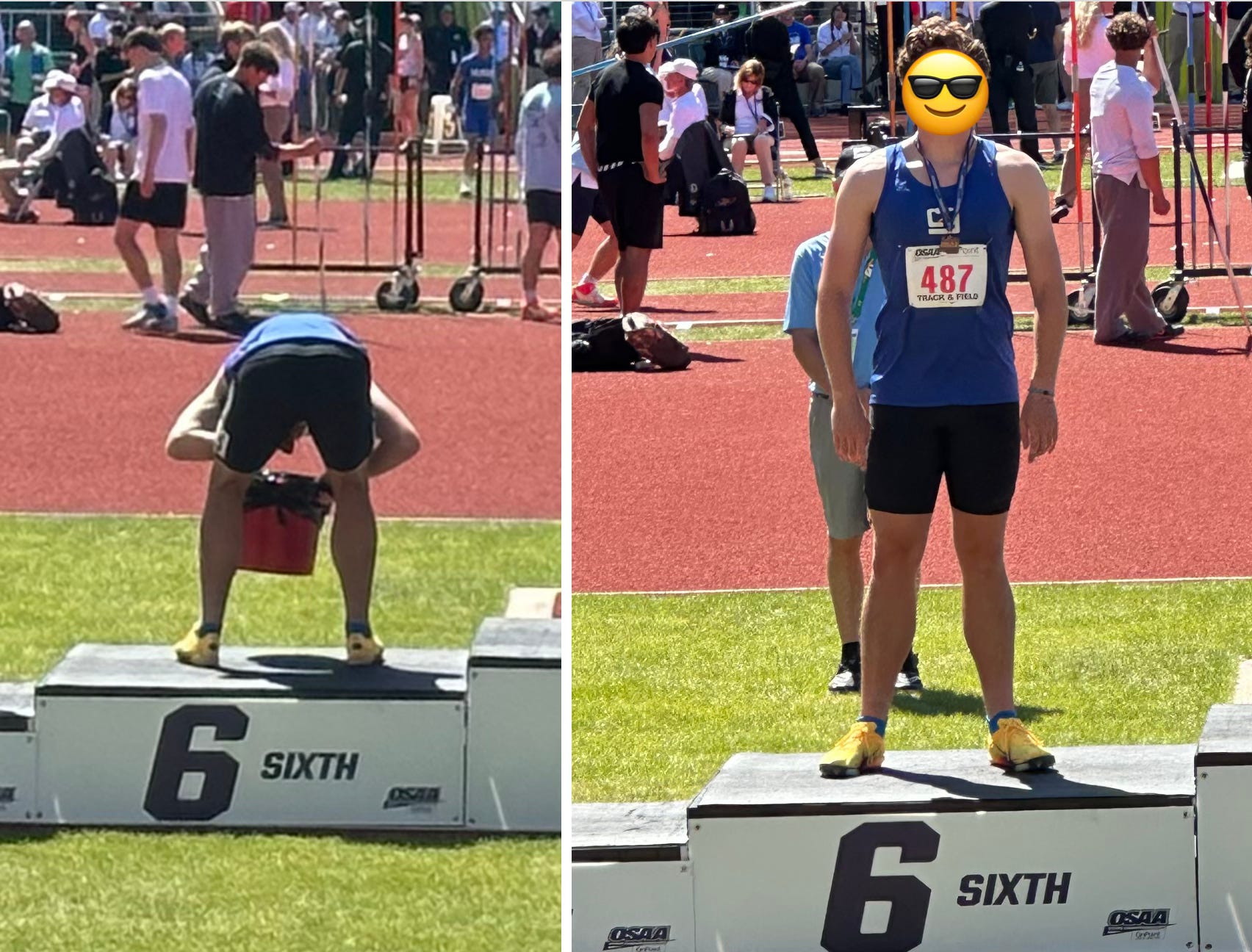
The result was 6th place in the state and firmly on the podium (though he lost some pre-race fuel, prior to receiving his medal):
Take-Aways. “See Something, Say (& Do) Something!” When a kid—or a client—does everything right (cardio, strength, mobility) yet still falls short, it’s on us to ensure their movement patterns are optimal.
Making these simple (but sometimes complex) biomechanical changes meant the world to both of these young men. They were the difference between success and stagnation, fun and frustration.
Ever since that first-year physio experience with my high school runner client, I’ve been compelled to speak up and act when I see a movement pattern that could be a game-changer.
Changing technique isn’t always difficult, but it’s seldom easy. The consequences of changing—or ignoring it—can be huge.
See something? Say (and do) something. Take the leap. Keep trying and keep learning. I know I will—and this backside optimization was one of my biggest learning experiences in years.
Issue 141 is complete!
Help people move, function and feel better: please share this publication!
Thanks for reading, and have a great weekend,

Issue 69: Balance (vs “Falling”) Training. Many falls in older adults result from a lack of capacity: of joints and body systems to both perceive and adjust to perturbations, and of strength systems to react to create a self-righting response. Optimize first with joint mobility and core stability, then train multi-system challenges plus reactive self-righting practice (e.g., erratic catch drills or recovery steps) rather than isolated extreme balance tasks.
Issue 138: Track Wins & Zero Wounds. Season highlights included: our 24 distance runners logged 1,728 “kid running days” (6 days/week × 12 weeks) with just 5 total days lost to injury and zero competitions missed. Every athlete achieved at least one personal best in the final meets. The keys: consistent mobility (post-hard-effort foam rolling/stretching), twice-weekly banded hip stability, relentless stride efficiency focus, and the kids’ high-agency commitment to communication, at-home care, sleep, and nutrition.
Issue 132: The Performance Imperative: How Coaching Makes Me a Better Physio. Stride optimization coaching is poorly understood and taught: I had to self-teach through physio clients and run coaching. Stride optimization — including cadence, posture, and limb propulsion strategies — is now central to both my physio practice and high school coaching: it boosts performance, prevents pain, and solves chronic issues many specialists often miss.
Note to self and the reader: someday I will write about the concept of “Restrictor Cues”. Inefficient movement results from misplaced energy. Attempts to simply restrict that energy will, at best, waste it (or cause other issues trying to restrain it). The superior strategy is to redirect that energy in a different, more efficient direction. As such, I never use “Don’t” cues; instead, I say, “Do This Instead!”