
Victory Friday | Issue 147
Orthopedic Insights: Radical Rehab Reminders (Trauma & Torsions) • Reverse Plank Posture Perfecter • Elbows & Wrists…and Shoulders & Necks? Thrilling Tricep Triumphs

“The only thing necessary for the triumph of evil is for good men to do nothing.”
~ Edmund Burke
Victory Friday is a weekly digest of reflections, insights, and tools from the world of functional manual and performance medicine. It is a free weekly publication. To support Victory Friday with a paid subscription, click below:
Welcome to Victory Friday! This week we’re diving into high-energy trauma that (always) needs real rehab, the surprisingly stubborn “pelvic plague” that messes with everything below it, a reverse plank that quietly fixes anterior tilt, and some unexpectedly powerful tricep mobilizations that are lighting up elbows, wrists, shoulders—and even necks. Let’s gooo!
What I’m Into. Radical Rehab Reminders (Trauma & Torsions). Here’s a grab-bag of key reminders — especially for you new readers — on important rehab concepts:
• High-Energy Trauma is Always Complex (and Requires Rehab). I recently treated a new client who fractured his leg in a minor motorcycle accident. He underwent open reduction internal fixation (ORIF) surgery, a procedure typically reserved for complex, high-energy fractures.
The surgery was a success. However the new guy presents six months post-surgery still struggling: with pain, mobility and strength deficits, and life limitation.
Most curiously:
The patient reports that the surgeon did not recommend any physical therapy or guided rehab.
This confuses me, to say the least. While some may argue that not all surgeries require guided rehab, traumatic injury—involving the absorption of large amounts of energy into the body—always deserves a multi-dimensional, Systems & Dimensions rehab approach1, no matter how routine and successful that surgical intervention may have been.
Trauma energy reverberates throughout the whole system: maybe not enough to break or tear everything, but enough to create problematic dysfunctions.
• The Pesky Pelvic Plague. This may seem controversial, but it shouldn’t be:
A pelvis that is elevated, rotated, or torsioned will almost always result in dysfunction—including mobility loss, stiffness, weakness, and pain—above or below it.
As I point out to clients, it’s like pushing A Shopping Cart with Two Bad Wheels2: if a pelvis is torsioned3 or rotated, things (in the legs) invariably rub the wrong way.
Cool Exercises I Like. Reverse Plank Posture Perfecter. Here’s one of the cooler exercises I have seen in a while that also pairs with a Gregg’s Gems-esque4 evidence backing!
A reverse plank… that fixes anterior tilt posture?
Fresh from exercise innovators, Squat University (@squatuniversity), this reverse plank is, on the surface, a terrific strengthening exercise for the glutes, shoulders and posterior chain musculature, as well as a nice chest opener
But it also does way cooler than that: it helps sustainably correct anterior pelvic tilt posture!

In fact, this is substantiated by research showing that performing a reverse plank significantly improved standing posture in the upper spine5 — a key element in pelvic tilt inefficiency.
How does it accomplish that?
It demands a balance of both posterior extensors and anterior abs to maintain the neutral plank position
It fires the glutes like crazy, which both extend the hips and assertively pulls the pelvis into a more neutral (posterior-tilted) alignment
The posterior shoulder planking has a dual effect:
1. it stretches open the chest, scapulae and anterior ribs, and
2. it strengthens the posterior and inferior scapula stabilizers, which helps re-establish ribcage neutral
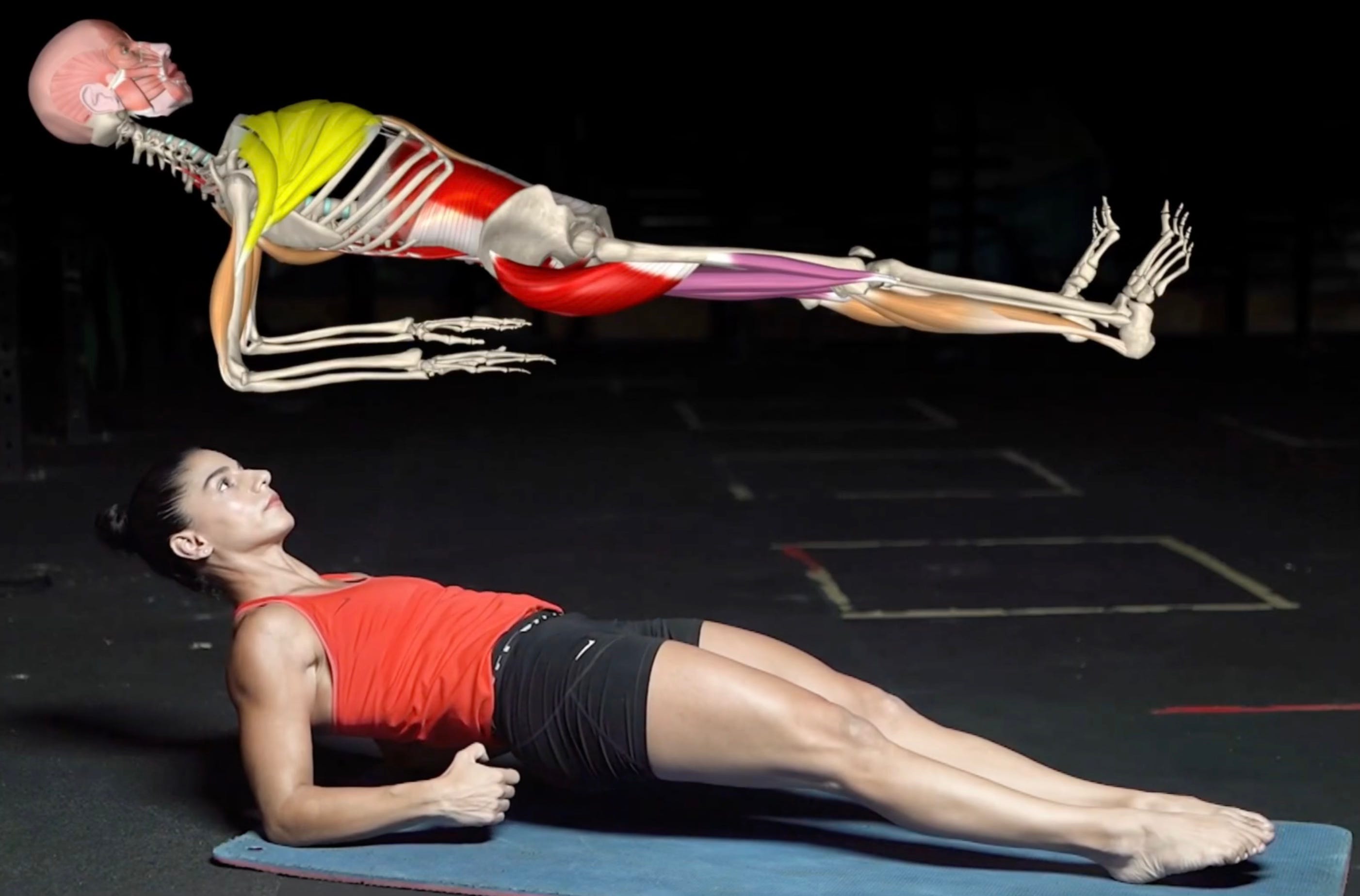
Personally and professionally, I love this exercise for runners, but usually done as repetitions (the “straight leg bridge”): moving at the hip.
But according to SU and the research evidence, prolonged holds of at least 30 seconds get the best benefit of brute strength and myofascial balancing to best pull together that posture!
Try it this week and see what you think!
Victory Friday. Elbows & Wrists…and Shoulders & Necks? Thrilling Tricep Triumphs.
Last week I identified a novel (to me) strategy to mobilize the upper arm around the tricep6. In the past two weeks I have put this new strategy to the test, and I’m thrilled with the gains and key victories I’ve achieved so far.
Not only does this technique:
• improve elbow joint mechanics (efficiency and maximum mobility)
• decrease upper extremity nerve tension and neurogenic symptoms in the forearm, wrist, and hand
It also showed even more powerful effects, above the tricep!
I used it on three clients in the past two weeks:
A mid-40-year-old male with bilateral elbow and wrist pain (who does a lot of rafting and heavy upstream rowing).
A mid-40s highly active male weightlifter and obstacle course racer with stubborn bilateral elbow and wrist pain that made it difficult to perform heavy or repetitive pushing or pulling—a key part of his sport.
A mid-50s female with bilateral neurogenic-driven shoulder pain and stubborn shoulder mobility loss.
In each case we performed thorough myofascial mobilization around the tricep—both the medial side (ulnar nerve), the lateral side (radial nerve), as well as proximal (shoulder area) and distal (elbow) techniques.
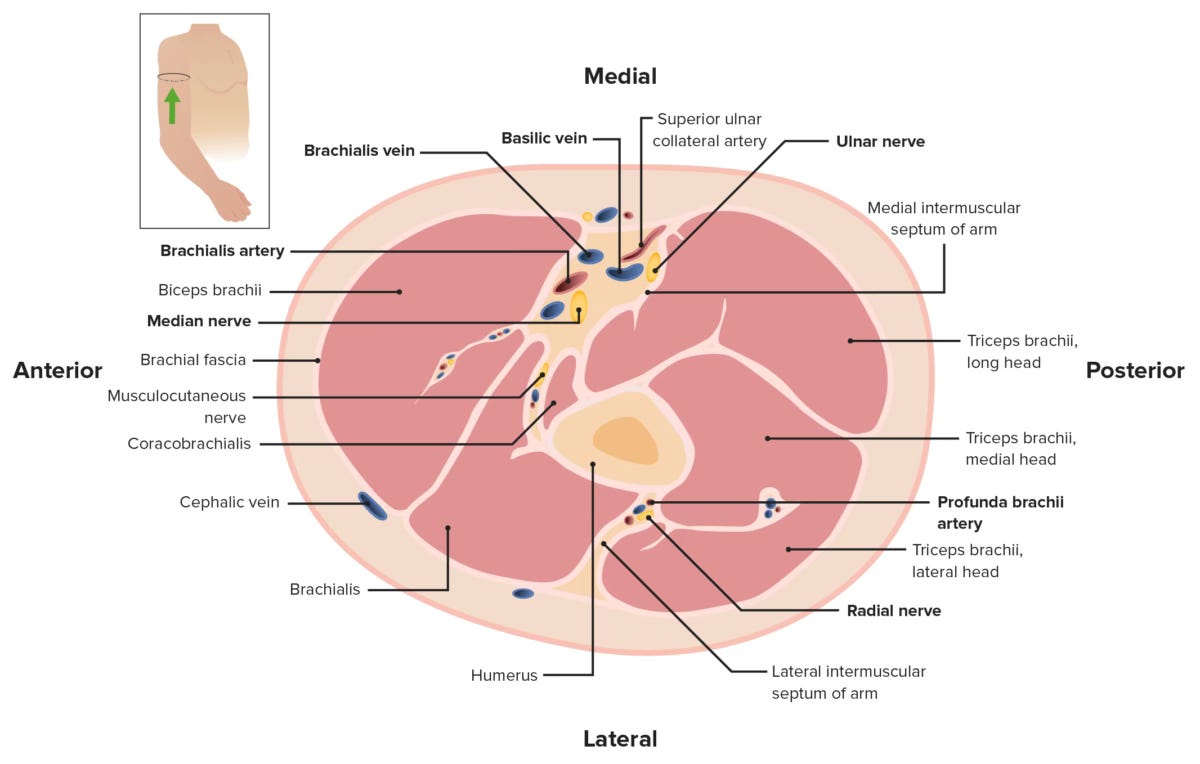
We utilize fascial-play techniques—separating one adjacent fascial border (muscle, bone, nerve) from another — in the upper arm, namely: tricep from bicep, tricep from humerus bone
This included sustained pressure or strumming at fascial borders, combined with the patient’s active arm movements such as elbow flexion/extension and shoulder internal and external rotation.
Thorough mobilization of these fascial borders around the upper arm had great downstream effects:
• improved elbow motion and decreased pain
• decreased pain in the forearm, wrist and hand
But I was pleasantly surprised to observe key improvements, including:
• improved shoulder motion
and — most notably:
• improved cervical motion!
This was a bigger surprise, but shouldn’t be: Working at the very upper humerus often elicited neurogenic symptoms, as these “spaces” house many important arm nerves, namely the axillary and radial nerves.
Freeing those nerves so close to the shoulder and brachial plexus likely decreased tension in the area, resulting in improved shoulder and neck motion!
Early Takeaways. Potent & Profound. It’s not unusual for me to learn or experiment with new hands-on techniques. But I must say that this tricep mobilization strategy has already produced some of the most potent and fast-acting results of any new technique I’ve learned in the past five years—if not one of the most potent of my entire 17-year career.
The techniques are simple: freeing adjacent muscle groups, utilizing active patient movements to free both muscle and nerve fascial structures, and quite simply taking out and reducing stiff areas in the upper arm from shoulder to elbow, inside and outside.
But as it tends to be, simplicity does not minimize its potency.
Like many effective hands-on techniques, the simple combination of:
• a curious mind
• perceptive hands, and
• an anatomy book or website
is all you need to free the structures of this key area and achieve similar Victories!
For me, one thing is certain: I won’t ever overlook the upper arm when treating anything in the upper quadrant—this includes anything from neck pain to finger pain.
Stay tuned over the next couple of Fridays—I’m in the process of developing a tricep self-mobilization technique and will share those in a short video.
Until then, get to the lab, start playing, and see what you can do to improve mobility and decrease pain in the full arm!
Issue 147 is complete!
Help people move, function and feel better: please share this publication!
Thanks for reading, and have a great weekend,

Issue 41: Systems & Dimensions. Full and sustained pain relief and recovery of function often requires a comprehensive treatment approach of multiple Systems (body areas: spine, pelvis, abdomen, pelvis, hip, knee, etc) and Dimensions (types of tissue: muscle, tendon, bone/joint, fascia, nerves, blood vessels, etc).
Issue 110: The Shopping Car with (Two) Bad Wheels. A rotated, elevated, misaligned or otherwise restricted pelvis acts like a shopping cart with bad wheels: the “front wheels” orienting the wrong way while the “car” (the body) tries to move straight ahead. This can potentially create strain below (anywhere in the leg: hip, knee, ankle, foot) or above (spine) Correcting the torsion first (often via thoracic, visceral, or cranio-cervical treatment) dramatically improves the success of any local leg or spine treatment that follows.
A pelvic torsion is when the pelvis is rotated to one side and the pelvis is in a paired-twist: the same-sided pelvis (if rotated left, the left side of the pelvis) is externally and anteriorly rotated; and the opposite-sided pelvis (if rotated left, then the right) is internally and posteriorly rotated.
For more information on this, check out this outstanding graphic explanation.
A pelvic can also simply be rotated: both “hips” pointed to one side, but without the three dimensional adaptations. Both are problematic, but pelvic torsions tend to be older and more involved than rotations: the entire lower quarter adapts to the facially-driven rotational pattern.
My writing on torsions:
• Issue 10 (introduction)
• Issue 101 (The Torsion Rule)
My mentor and Institute of Physical Art Founder Gregg Johnson sends daily journal article abstracts and summaries to the IPA Google Group.
Koo, D.-K., Nam, S.-M., & Kwon, J.-W. (2022). Immediate effects of the reverse plank exercise on muscle thickness and postural angle in individuals with the forward shoulder posture. Journal of Functional Morphology and Kinesiology, 7(4), 82. https://doi.org/10.3390/jfmk7040082
Study & Findings: Participants performed 5 sets of 30-second reverse planks (with 30-second rest between sets). Researchers measured forward shoulder angle and thickness of key muscles (pectoralis major, serratus anterior, upper trapezius, lower trapezius) before and after.
Findings included: Significant improvement in forward shoulder angle (better postural alignment); increased thickness of underactive posterior muscles (serratus anterior and lower trapezius); decreased thickness of overactive anterior muscles (pectoralis major and upper trapezius).
Issue 146: Elbow, Forearm, Wrist & Hand Pain? Try the Tricep! Mobilizing the triceps can significantly improve elbow, wrist, and shoulder mobility while reducing radial and ulnar nerve tension and associated neurogenic pain. As a primary pushing and weight-bearing muscle of the arm, the triceps readily develops fascial stiffness that restricts joint mechanics and function; freeing these restrictions often restores smoother movement, decreases pain, and enhances overall arm strength and performance.