
Victory Friday | Issue 126
Orthopedic Insights: Run Faster for Quicker Recovery • Fix Your Posture (Learn to Exhale) • Vertical Hips for Your Best Running • Arm Swing is Everything, Part II: Posture & Movement is Body Language.

“Great catastrophes begin with trifles, and great works with trifles too.” ~ Sophocles
Victory Friday is a weekly digest of reflections, insights, and tools from the world of functional manual and performance medicine. It is a free weekly publication. To support Victory Friday with a paid subscription, click below:
This week’s Victory Friday theme: the symphony of the body’s moving parts and the yin and yang of efficient moving: up-and-down, forward-and-back, and inhale-and-exhale. We need both, enough, and equally!
What I’m Into: Run Faster for Quicker Recovery. Sometimes when working with an injured, recovering runner, I make them run fast.
Even if tissue is still load-sensitive.
This is counter-intuitive — if not paradoxical. But nearly always:
Efficient running trumps all other running for pain relief and prevention.
Too many clients have mildly inefficient form. Then they develop pain or injury.
So they slow down. Running gingerly. Protective.
But in doing so, their run stride is even more inefficient, and tissue-straining.
And they get caught in a vicious cycle: inefficiency - pain -
”babying” - more inefficiency - more pain…
To break the cycle:
rest irritable tissue as much as necessary
restore system integrity: the Systems & Dimensions approach1 to making sure the whole “running body” can move and function efficiently .
run as fast as necessary to have minimum stride efficiency
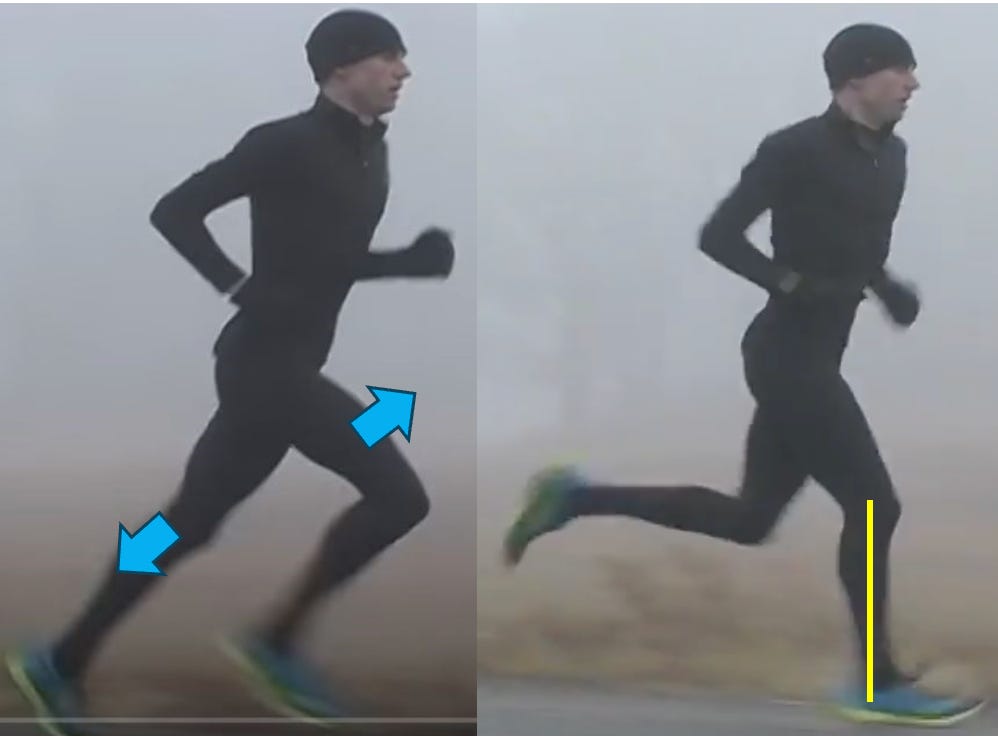
For my clients, that often means running fast enough to utilize a vertical hip strategy to achieve a foot-under-body landing (see below)
(More on this topic, soon).
This almost always requires — at least temporarily — running a faster pace.
But even though it’s “more force”, it is ultimately less stressful to sensitive tissue. The force is properly directed — and thus less straining than a “careful” — but shuffly, inefficient — stride.
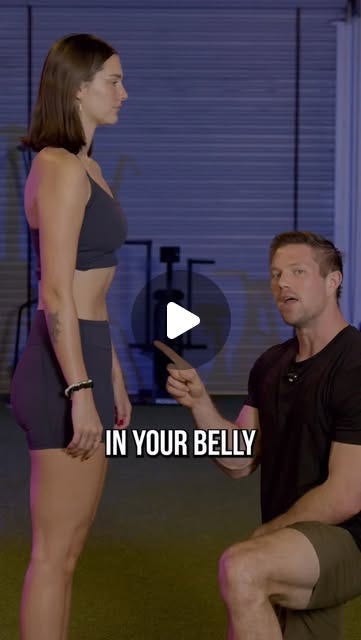
Cool Exercises I Like. Fix Your Posture (By Learning to Exhale). I post a lot of trainer and biomechanist Conor Harris (@conor_harris_) because he’s among the few resources out there to identify and effectively target the root cause of common and often stubborn problems.
Not Band-Aids and medications. Real solutions.
So if you struggle with any of these issues:
• excess “anterior pelvic tilt” posture (and a stiff low back and anterior hips)
• it looks like you have a gut, even though you’re lean (but you can “suck it in”)
your issue is likely postural, and it may be due to a movement and alignment imbalance in your ribcage.
Learn to exhale: drop the ribs, naturally elevate your pelvis (without sucking or tensing) and:
• even out posture
• lose your gut
• breathe and function better!
Check out how:
As I tell my clients:
Your survival depends a lot more on inhaling than exhaling.
In a fight-or-flight world, we often get stuck in an inhaled — elevated ribcage, extended spine, and tilted pelvic — position. Use Conor’s seated exercise to learn how to truly — and mechanically — exhale!
Joe’s Articles. Vertical Hips for Your Best Running. Efficient running uses the hips.
Duh. But what does that mean? More clamshells, lateral band walks, and lunges?
Efficient running uses a vertical hip strategy:
• upward and forward hip flexion
• downward and rearward hip extension.
At all speeds, a vertical strategy maximizes propulsion and minimizes landing stress.
As you — and your spring and summer running goals — thaw out of the winter freeze, don’t forget to wake up and use your hips!
From iRunFar.com,
Where the Rubber Meets the Road: The Importance of a Vertical Hip Strategy for Optimal Running
TL;DR:
Optimal running (for speed, efficiency, endurance, and injury prevention) relies on a “hip-driven” strategy that uses quick, powerful, vertical hip torque — combining upward hip flexion and downward hip extension — rather than inefficient horizontal pushing or shuffling patterns.
Hip torque defined: It is rotary force at the hip joint; upward-and-forward flexion lifts the leg quickly, while downward-and-rearward extension drives it powerfully back to the ground, creating propulsion like a “rubber ball” rebound.
Inefficient strategies contrasted:
• “Shufflers” over-stride horizontally → braking and energy loss.• “Pushers” emphasize vertical bounce from the knees and ankles → wasted upward energy.
• Hip-driven approach outperforms both for efficiency and reduced injury risk.
Injury and performance implications: Inefficient patterns (e.g., overstriding or poor hip use) increase strain/injury risk; hip-driven mechanics minimize braking, energy absorption, and fatigue — especially valuable in ultras and long-distance running.
Practical form cues:
• Maintain forward-oriented posture with a hip-hinge lean.• Drive legs upward/forward quickly (not just forward), then downward/rearward powerfully.
• Aim for high cadence (~180 steps/min), midfoot strikes under the body, and balanced reciprocal leg action.
Training recommendations:
Strength exercises for hip flexion and extension: Bike Pedal Abs, Bent-Knee Extensions, Abdominal March, Single-Leg Bridges, Step-Ups with Knee Drive, Cable Hip Flexion/Extension.
Drills: 100-Up Runner Hops, Straight-Leg Pulls, A-Skips.
Workouts: Stride-outs (short 80–95% efforts) and hill sprints to build hip power, core stability, and quick force application.
(FotW &) Victory Friday. Arm Swing is Everything, Part II: Posture & Movement is Body Language. A few weeks back I shared a few cool victories about arm-swing:
that scapular-driven arm swing is crucial, not just for maximum run/walk speed, but for pain relief and prevention in the lower body2.
Early in my career I learned about the concept of body language: a person’s posture and movement patterns are an extension of who they are; that attempts to change posture and movement — even if it’s “for their own good” — can be jarring, threatening, and painfully difficult3.
Sometimes body language is personality, psychology and emotional.
But sometimes it’s simply… physical. It’s simply about how to position and move your unique physique.
After treating my two runners, I was working with my third “stiff shoulder blade” client — and older walker.
All three clients are female.
When I shared with her, a former runner and “track and field mom”, about working with two young female runners on arm swing, she asked me, bluntly:
“Are they ‘bigger-chested’?”
Me: 😳🤦🏻♂️
The relevance was quick (and useful) face-palm for me.
For larger-chested women, arm swing is difficult for two reasons. For one, an assertive arm swing may create more movement and “exposure” to breasts.
There’s a real psychology to this. Doing so may bring “unwanted attention” to a prominent and attention-getting area of the body — especially for younger women.
But likely more relevant: a more aggressive arm swing may cause excessive breast movement that restrictive and uncomfortable.
A scapular forward-and-back movement of even a couple inches will create more breast movement that may be jarring and uncomfortable. And especially as girls develop, they may unconsciously stop moving their arms and shoulders as a way to avoid that discomfort.
This wasn’t the first time I’d encountered this reality. Larger-chested women have many orthopedic challenges. The weight and size can cause strain to the neck, upper back and shoulders. And especially when they are trying to avoid drawing attention to it, large-chested women often slouch their upper back and ribs, creating posture dysfunctions and more pain.
Takeaways. So what can we — especially male physios and coaches — do about addressing things like posture and arm swing in larger-chested female athletes and clients?
Coach/Physio Awareness Goes a Long Way. Recognize the obvious mechanical — and potential psychological — challenges to “efficiency”. For both posture and movement, “ideal” may feel physically or psychologically uncomfortable.
Acknowledge. Helpers should neither avoid or plow through difficult, awkward conversations. Acknowledge with sensitivity: many women (especially if younger) may not realize why they position and move in certain ways. Acknowledge the physiological reality as a starting point toward sustainable optimization.
Some is Better than None. I often say, we needn’t be perfect to feel better:
Moving 50% better, 50% of the time will still feel a lot better.
Consider Enhanced (Passive) Stability. If arm swing is a major challenge — and a key performance element — for you, your client or athlete — then optimize support may be a key strategy. Not all sports bras are created equal. Your athlete may need to shop around and try different support garments to enhance stability and allow the most efficient movement.
However, there are difficult trade-offs: too loose = too much motion. But too tight might limit breath volume. Find the best middle ground.
I always appreciate a good wake-up call: a strong dose of empathy and a way to better help all clients by recognizing — and working with — their unique body!
Issue 126 is a wrap!
Help people move, function and feel better: please share this publication!
Thanks for reading, and have a great weekend,

Issue 41: Systems & Dimensions. Full and sustained pain relief and recovery of function often requires a comprehensive treatment approach of multiple Systems (body areas: spine, pelvis, abdomen, pelvis, hip, knee, etc) and Dimensions (types of tissue: muscle, tendon, bone/joint, fascia, nerves, blood vessels, etc).
Issue 124: Arm Swing is Everything, Part I. Clinical observations of female runners and long-distance walkers with persistent hip, knee, foot, ankle, and neurogenic pain revealed a common deficit: inefficient scapular-driven arm swing during gait. This scapular motion—primarily posterior depression—is essential for optimizing hip flexion/extension, glute propulsion, spinal stability, and leg-under-body landing to minimize stress and pain in high-volume activities. Treatment emphasizing thoracic and scapular mobility, followed by targeted arm swing drills, yielded notable improvements in hip mobility, landing mechanics, pain reduction, speed, and endurance.
As a physio AND a larger chested woman... Yes yes yes. Nailed it. I often see larger chested teens and young women folding in on themselves in an emotional protective posture and resonate with it a lot. It's definitely an easier conversation for a woman to have with them but so important for men to be aware. I would also like to add to the sports bra conversation- you can go too far and mess up breathing if there's too much compression. A lot of the support comes from the chest strap but if it's too tight it makes it hard to inhale and rotate. Crossover shoulder straps are a huge help but there's a fine line between enough and too much support in both the shoulder and chest straps. My solution is a good sports bra with a second less supportive one on top to stop the jiggle. This way you don't mess up your mechanics but it's a more physically and emotionally comfortable experience
You write what I need. Thanks renegade!